A 1.45-million-year-old fossilized bone fragment with nine mysterious markings has revealed many fascinating and chilling details about "The Upright Man".
According to CNN, a researcher from the National Museum of Natural History in the United States accidentally noticed something unusual on a fossilized tibia bone in the collection of the National Museum of Nairobi (Kenya).
Initially, Dr. Pobiner only intended to search for bite marks from extinct animals that may have hunted older relatives of Homo sapiens, from early hominids to species that closely resembled modern humans.
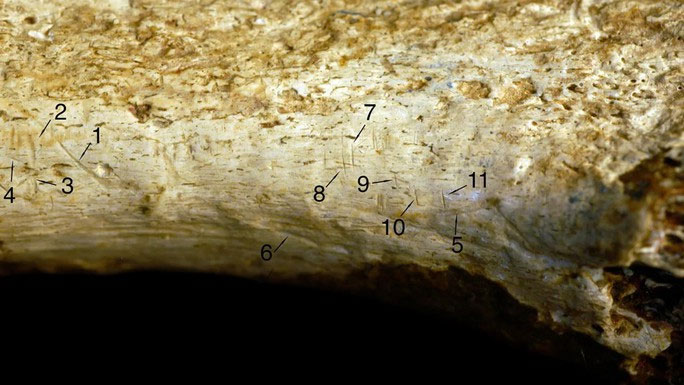
Eleven marks were found on the fossilized bone fragment, nine of which were confirmed to have been made by a hand skilled in using tools - (Photo: CNN).
However, what was visible on the fossilized bone fragment were actually cuts . "It appears that the meat from this leg was eaten as a nutritional supplement, not for a ritual," said Dr. Pobiner.
This means that some ancient creature of the genus Homo (Human) practiced cannibalism.
Of course, that's not Homo sapiens— a species only a little over 300,000 years old —nor is it the "other-species ancestors" Neanderthals or Denisovans, other human species that interbred with Homo sapiens tens of thousands of years ago.
Co-author Michael Pante, a paleontologist from Colorado State University (USA), created a 3D computer model of the bone to carefully compare the shape of the cuts with a database of 898 other bone marks, ranging from bite marks to stomp marks, that have been recorded on ancient remains.
The results confirmed that those cuts could only have been made by a hand using a tool.
This aligns with the results of a 1990 study on the bone, which showed it to be the remains of Homo erectus , not Australopithecus as previously speculated.
Homo erectus, also known as Upright Man , was the first species to use stone tools based on direct evidence, although some recent studies are skeptical and suggest that other species may have used tools even earlier.
Homo erectus was also a "breakthrough" species , with physical characteristics and lifestyles that resembled true humans more than ape-like creatures.
This evidence is the earliest confirmed proof of cannibalism in a creature belonging to the broader Homo genus. Prior to this, there was an even older, less conclusive piece of evidence: the cheekbone of an unidentified Homo fossil from South Africa, approximately 2 million years old, with a controversial cut.
- Evidence of other intelligent human species hunting beasts in the "Garden of Eden".
- Amazing physique of a "god-like" man from an extinct human species 2 million years old.
- Why can't the "Gateway to Hell," which has been burning for 50 years, be sealed off in Turkmenistan?