Due to over-reforestation, the 16km long sand dunes along the Tottori coast have gradually shrunk, to only 12% of their size 100 years ago .
With its golden sand dunes and clear blue skies, the Tottori Sand Dunes evoke the deserts of the Middle East. But they are actually located along the coast of the sparsely populated San'in region in southwestern Honshu, and are Japan's very own piece of desert.
The sand dunes stretch 10 miles along the coast, with the highest peaks reaching more than 150 feet. They have existed for thousands of years but are slowly disappearing, not because of climate change but because of community "greening" efforts, CNN reported on June 16.
The dunes formed over 100,000 years , when the Sendai River transported sand from the nearby Chugoku Mountains and emptied into the Sea of Japan. Over the centuries, winds and ocean currents pushed the sand back to the coast.
In 1923, when it appeared in a work by famous author Takeo Arishima, the sand dunes began to become a tourist "hot spot" . Today, the sand dunes play an important role in the tourism industry of Tottori Prefecture, welcoming an average of 1.2 million visitors each year. Tourists can visit the Sand Museum, sandboard and ride camels.
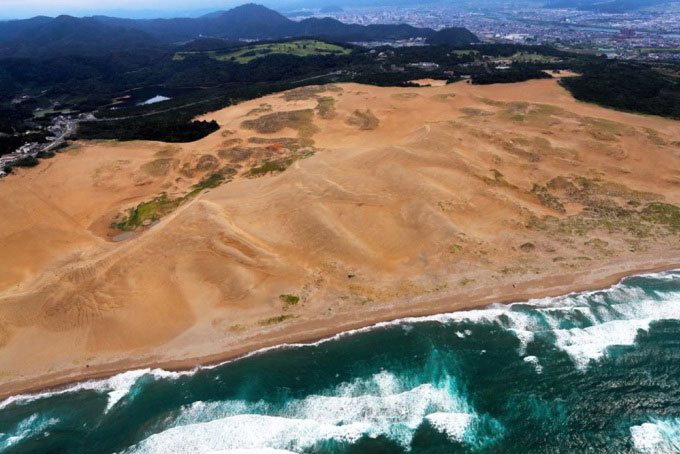
The Tottori Sand Dunes are the closest thing to a desert in Japan. (Photo: Sean Pavone/iStock/Getty).
"Desert" shrinking due to encroachment of trees
The dunes bring in millions of dollars a year in tourism, but there's a problem: They're shrinking, now only 12% of what they were 100 years ago. The reason is a hugely successful reforestation project launched in Japan at the end of World War II. In Tottori, the project aimed to turn the dunes into forests and farmland to feed the people, prevent damage from sandstorms, and create a better environment.
"A lot of pine trees were planted on coastal dunes all over Japan to prevent sand from blowing. Especially in the 20th century, when technology became more advanced, coastal forests were formed. The tree planting project was so successful that many coastal dunes were converted into fields, residential areas, and the dunes disappeared," explains Dai Nagamatsu, a professor in the Faculty of Agriculture at Tottori University.
As the reforestation project progressed, scholars and tourism operators proposed preserving part of the desert for economic and future research purposes. Local authorities agreed and set aside 160 hectares of the dunes, or 12% of the area, as a national park for conservation.
Efforts to deforest and protect the "desert"
In 1972, efforts to clear the encroaching desert forest were thwarted. The trees that were introduced kept trying to grow back, blocking the free movement of sand that created the famous ripples of the Tottori Sand Dunes. Clumps of trees grew where the forest had once been flattened. Scientists have been fighting to stop the desert from shrinking ever since.
Perhaps this is not surprising, since Japan is so good at growing forests that its methods have become an export commodity. The country is home to the famous Miyawaki method of forestation, developed by botanist Akira Miyawaki in the 1970s and used in many forests around the world, including the Brazilian Amazon.
Today, volunteers regularly come to remove stubborn plants growing in the sand – a tradition that began in 1991. This is necessary if the vegetation is to be prevented from growing further. The Tottori government even adds more sand to the dunes.
Many scientists believe the rare conditions of the Tottori Sand Dunes make them worth preserving. "The environmental conditions of the Tottori Sand Dunes are different from those of arid lands because of the humid climate ," said Nagamatsu, who and other experts are planning to study the area.
Some scientists even speculate that as the climate continues to change, dune restoration may become a better protection than reforestation. 'Given the potential tsunami damage that could hit Japan in the near future, it may be necessary to reconsider current coastal land use and consider restoring natural dunes to the Japanese coast ,' Nagamatsu said.