 Dan Van Khoan, a man who lives in the forest more than at home, has been monitoring the Tonkin snub-nosed monkeys in Khau Ca for more than 23 years. Photo danviet.vn
Once considered ruthless 'wildlife killers', former hunters in the old Na Hang commune have traded their rifles for conservation work, becoming protectors of the Tonkin snub-nosed monkey.
Dan Van Khoan, now the leader of a community group protecting this critically endangered primate, openly recalls a dark past - shooting dead a 30kg male langur, killing a nursing female langur and even eating a baby langur. The total number of langurs killed by his group is at least 62.
Khoan, who spends more time in the forest than at home, has been monitoring the Khau Ca langurs for more than 23 years. At the langur protection 'headquarters' deep in these primeval forests, experienced 'experts' are always on duty.
These locals are intimately familiar with the Khau Ca and Du Gia forests, bringing with them unparalleled knowledge from their previous lives as hunters—now they focus on preserving the fragile habitat and its rare inhabitants.
The world's rarest lagur
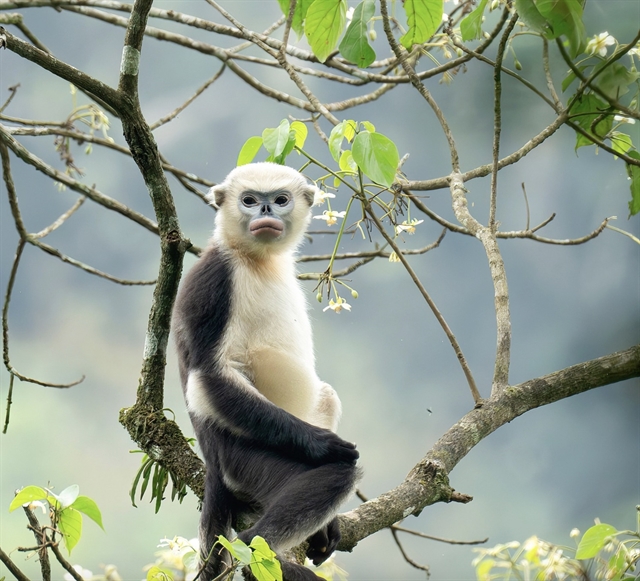 A Tonkin snub-nosed monkey. Photo danviet.vn
The Tonkinese snub-nosed monkey, a wild species endemic to Vietnam, is listed as critically endangered in the IUCN Red Book. It is also among the 25 most endangered primates in the world.
Their appearance in some places and disappearance in others is a mysterious story.
To date, in some places such as Tat Ke - Ban Bung, biodiversity loss has caused the Tonkin snub-nosed monkey to be "no longer recorded". This rare and endemic animal is now only found in the Khau Ca primeval forests - part of Du Gia National Park, Dong Van Karst Plateau, across Vietnam and even around the world.
In 2002, a troop of 60 douc langurs was discovered – the largest troop ever recorded in Vietnam at the time. Since then, awareness campaigns and drastic action have been launched to end the exploitation of this rare, endemic primate and its habitat.
To date, about 200 Tonkin snub-nosed monkeys have been recorded.
Conservation work is enhanced
Vigilance is still needed but peace has returned and joy seems to shine in the eyes of each langur as they enjoy the magnolia flowers and frolic freely among the lush green foliage of Khau Ca.
These primate groups, once considered 'critically endangered globally,' are now thriving. In fact, a troop can have as many as 20 young langurs. A 'young langur population' is like pure gold for development—and not just for humans. The langur troop in Khau Ca is slowly becoming more familiar with humans.
The terrifying 'inexplicable disappearance' or 'temporary absence' of primate groups is a painful lesson for conservation work in neighboring districts and provinces.
Fortunately, at Khau Ca, with the increasing number of langurs and many adorable baby langurs clinging to their mothers' wombs, conservation experts around the world have been truly impressed.
Over the past 20 years, the tireless efforts of the langur conservation team - climbing, tracking, recording and researching - have not been in vain.
More than a dozen members have endured daily hardships, patrolling 15,000 hectares of Du Gia National Park across vast areas in the rocky mountains of Tuyen Quang.
They have made notable achievements, such as setting up information boxes on tree trunks deep in the forest, where patrol members leave notes about any sightings or sounds of langurs.
Without roads or mobile signals, this method of recording and exchanging conservation data reveals the resilience and ingenuity of the people who lived and worked on the rugged limestone mountains.
Over the past 20 years, with investment from Fauna and Flora International (FFI) - one of the world's oldest wildlife conservation organizations - a stilt house large enough to provide food and shelter for nearly a dozen people has been built at the edge of the forest.
Recently, they have even been equipped with small solar power sources to charge GPS devices, walkie-talkies and cell phones.
' If the primary forest disappears, or the ancient magnolia trees are cut down or stop blooming, the grey-shanked douc langur will disappear, ' said Mr. Chu Xuan Canh, manager of FFI's Tonkin snub-nosed monkey conservation project in Tuyen Quang province .
' In 2023, I observed and photographed a group of 95 langurs, including nearly 20 calves. Counting the numbers made me extremely happy ,' he said. ' After posing for the photo, the langurs disappeared into the forest .'
Villages, countries and the world will lose a species found nowhere else but in Vietnam – a species that also supports local livelihoods and represents the integrity of the forest that sustains village life, he added.
' I love sitting here watching them [the langurs]. I've been doing this for 23 years and never get bored, ' Mr. Khoan said.
The langurs seem to have turned notorious hunters like Khoan into romantics.
According to research, the world currently recognizes five species of gray-shanked doucs : Golden snub-nosed monkey (Rhinopithecus roxellana): Found in temperate mountain forests in central and southwestern China. Yunnan snub-nosed monkey (Rhinopithecus bieti): Found only in southwestern China (Tibet and Yunnan). Guizhou snub-nosed monkey (Rhinopithecus brelichi): Found in Guizhou province, China. Myanmar snub-nosed monkey (Rhinopithecus strykeri): Found along the Myanmar-China border. Tonkin snub-nosed monkey (Rhinopithecus avunculus): Endemic to Vietnam, living in some forests in the northeast of the country.