To date, there are still many unknown and uncertain aspects about the properties and behavior of quasars.
When discussing the most terrifying objects in the universe, many people may think of black holes first. Black holes are extreme objects with such strong gravitational pull that not even light can escape.
However, you may not know that in the universe there is an entity that is even more terrifying, powerful and mysterious than a black hole, which is a quasar.
Quasars are a class of extremely bright active galactic nuclei that contain a supermassive black hole surrounded by a rotating accretion disk at their core. The matter in these accretion disks is attracted by the black hole's enormous gravity, creating an extremely hot and compressed environment. In the process, the matter is heated to extremely high temperatures, releasing enormous amounts of energy that make quasars some of the brightest objects in the universe.

Quasars are extremely distant and extremely bright celestial objects, with characteristically very large redshifts. (Photo: Zhihu).
The process of formation of quasars is not fully understood, but some theories suggest that they may be created by the collapse of primordial clouds or mergers between galaxies.
These celestial objects were first discovered in the 1950s. At that time, humans could only observe their faint, point-like light in the visible light spectrum, but could not understand their nature.
It was not until 1963 that Dutch-American astronomer Maarten Schmidt accidentally discovered the phenomenon of extremely large redshift when observing the spectrum of quasar 3C-273, which showed that quasars are objects moving very far and at high speeds. Since then, people have begun to conduct more in-depth research and observations on quasars, and have discovered many different types and characteristics of quasars. So why are quasars scarier than black holes?
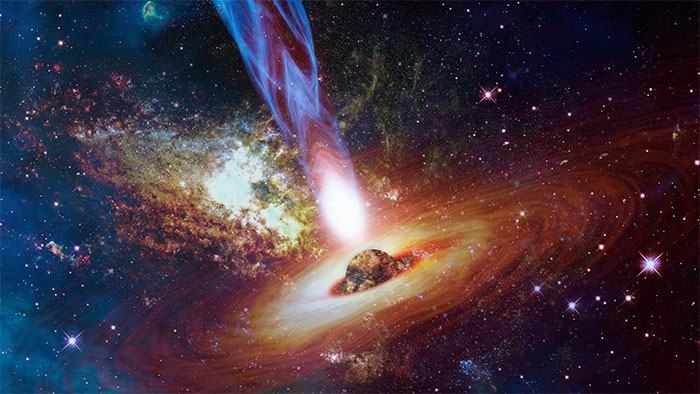
In visible light, quasars look like ordinary stars, or point sources. In fact, they are actually light emitted by halos of dense matter, located around the nuclei of active (young) galaxies, often supermassive black holes. (Image: Grunge)
The size of a black hole is determined by its mass, which is usually measured by the event horizon radius. The event horizon radius is the boundary of a black hole beyond which matter and light cannot escape. According to general relativity, we can calculate the event horizon radius of black holes of different masses.
Using the mass of the Sun as a reference, the event horizon radius for a black hole of the same mass as the Sun is about 3 km. The black hole at the center of the Milky Way has a mass about 4 million times that of the Sun, so its event horizon radius is about 12 million km.
However, the supermassive black holes at the centers of quasars far exceed these numbers. The largest known supermassive black hole is located in the quasar TON-618 . Its mass is about 66 billion times that of the Sun and its event horizon radius is about 190 billion kilometers. If this black hole were located at the center of the Solar System, its event horizon radius would encompass the outer part of the Kuiper Belt.

The first quasar, designated 3C 273, was discovered in 1963 by Dutch-American astronomer Maarten Schmidt in the constellation Virgo, using the Palomar Observatory. By 2005, more than 100,000 quasars had been discovered. (Photo: USGS).
Black holes themselves do not emit light, but as they accrete material around them, they produce intense radiation. This radiation can be observed across many different bands of the electromagnetic spectrum, including radio waves, infrared, visible light, ultraviolet, X-rays, and gamma rays.
Observing these emissions is crucial to our understanding of the nature of black holes and the behavior of the matter around them. However, despite their extremely powerful emissions, even the brightest black holes are no match for quasars.
Quasars are active galactic nuclei driven by supermassive black holes. They have higher accretion rates and larger accretion disks than typical black holes. As the gas in the accretion disk falls toward the black hole, it releases a huge amount of energy, forming intense radiation and jets. The radiation power of quasars is enormous , with the brightest quasars reaching luminosity in excess of 10^41 watts, thousands of times the luminosity of typical galaxies. Quasars can even be brighter than the galaxy clusters in which they reside, allowing them to still be observed from great distances.
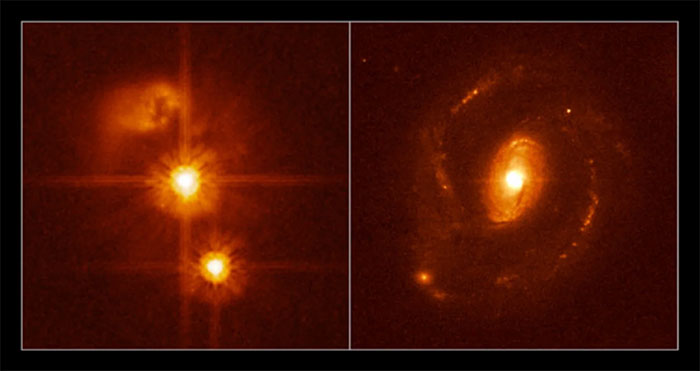
Quasars are celestial objects more terrifying than black holes, which were formed in the early stages of the universe and have an important impact on the structure and evolution of the universe. (Photo: Zhihu).
Although black holes can swallow up surrounding matter, they do not absorb everything indefinitely. As matter is sucked into the black hole and begins to accumulate, a high-temperature, high-pressure accretion disk will be formed. This accretion disk will release a lot of energy during the accretion process, forming radiation pressure. This radiation pressure is created because the matter in the accretion disk is subjected to intense friction under the influence of very large gravity, resulting in strong thermal radiation. This radiation pressure can offset the gravitational pull of the black hole to a certain extent and limit the rate of matter accumulation.
This is called the radiation pressure equilibrium limit , and it determines the maximum luminosity a black hole can reach. However, the supermassive black holes at the center of quasars can surpass this limit and reach luminosity beyond the Eddington limit.
This is because the physical conditions at the quasar center are very complex. In addition to the existence of accretion disks, there are factors such as strong magnetic fields, turbulence and jets that affect the transport of matter and energy. These complex factors lead to the formation of multi-level, multi-dimensional and multi-band mechanisms at the quasar center.
In this complex system, some of the material is ejected at extremely high speeds, creating intense radiation and shock waves. This ejected material can remove some of the energy and angular momentum, thereby reducing the radiation pressure of the accretion disk. This phenomenon allows more matter to accrete into the black hole.

Quasars are also an important tool for exploring the history and physical laws of the universe. By understanding quasars, we can not only gain a deeper understanding of the universe, but also allow us to think more about ourselves. (Photo: Zhihu).
Black holes are extreme objects in the universe and their properties and behavior can be described and predicted using existing physical theories. According to general relativity, we can calculate the size, shape, temperature, entropy, and Hawking radiation properties of black holes.
With quantum mechanics, we can explore phenomena such as the quantum state of black holes, the information paradox, and the evaporation process. With thermodynamics, we can analyze the laws of thermodynamics, thermodynamic equilibrium, phase transitions, and other processes of black holes.
Quasars, on the other hand, still have many unknown and uncertain aspects about their properties and behavior, requiring us to continuously observe and explore . For example, we still do not know how quasars form and evolve, how they affect the structure and chemistry of the universe, how they interact with surrounding matter and energy, and how they produce intense radiation and rays.
So while the properties and behavior of black holes can be described relatively clearly by physical theory, there are still many unanswered questions about the properties and behavior of quasars. For quasars, we need continuous observation and study to elucidate their formation and evolution mechanisms as well as their impact on the universe.