New analysis of the Whatcheeria beast, whose partial remains were found in the United States, has led paleontologists to call it a super predator.
A study recently published in the scientific journal Communications Biology, conducted by the University of Chicago (a research university in Illinois) and the Field Museum (USA), has "upgraded" the danger level of this curious Whatcheeria monster .
Whatcheeria is most famous for a terrifying skull fossil unearthed in Iowa, which is 340 million years old, dating back to the Carboniferous period. After the Carboniferous came the Diapsid period, then the Triassic period (early dinosaurs appeared at the end of this period), the Jurassic period and the Cretaceous period (the heyday of the T-rex).
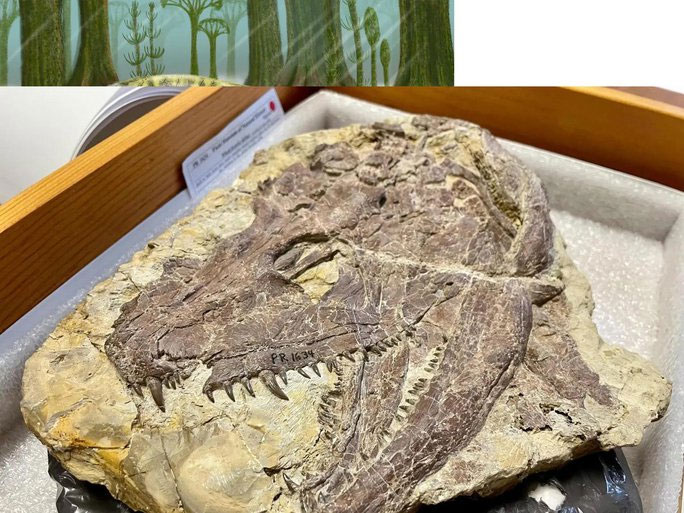
Monster skull unearthed in Iowa - Photo: FIELD MUSEUM
Thus, this dinosaur-like creature is much older than the T-rex , but like the T-rex, is the lord of the ancient beast world.
It was smaller than a T-rex with a body similar to a crocodile, able to fit in a bathtub if rolled up, but new research shows something that made it even more dangerous: Rapid growth in its youth.
Unlike modern reptiles that mature slowly and steadily, ancient Whatcheeria quickly reached "beastly" size early in life, according to study co-author Dr. Ben Otoo.
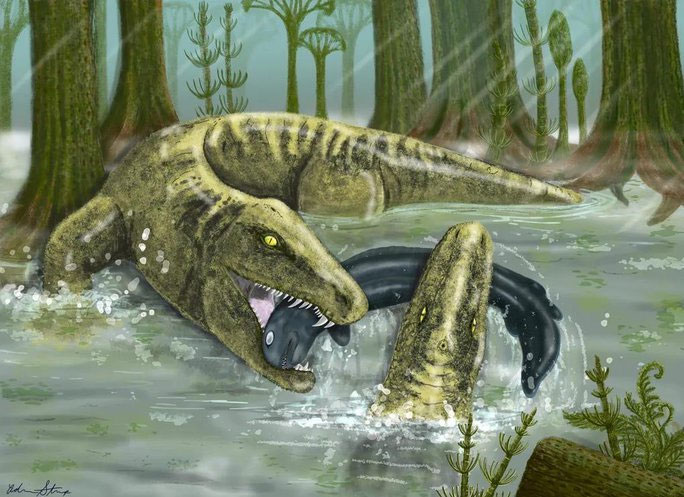
Graphic depicting the "portrait" of our Carboniferous beast ancestor and other four-legged animals - (Photo: FIELD MUSEUM)
The new study also revealed bony grooves in its skull that housed sensory organs similar to those found in fish and amphibians, suggesting it lived in water. Sturdy leg bones allowed it to hunker down and wait for prey to swim by.
"It probably spent a lot of time near the bottom of rivers and lakes, darting out and eating whatever it liked. You could definitely call this the T-rex of its time," Dr Otoo told SciTech Daily .
Although Whatcheeria looks like a giant salamander, it is completely unrelated to this group, but is part of a lineage that eventually evolved into today's four-limbed animals - which includes us.
"That means it could help us learn about how four-legged animals - including us - evolved," concluded Dr Ken Angielczyk, a curator at the Field Museum and co-author of the study .