In a statement on January 24, NASA Administrator Bill Nelson said that with the help of this new rocket, astronauts can travel to and from deep space faster than ever before, an important capability in preparation for Mars landing missions.
NASA has hired Lockheed Martin to design, build and test a nuclear-powered rocket for space travel that could speed up a manned trip to Mars from the current minimum of seven months to just 45 days.
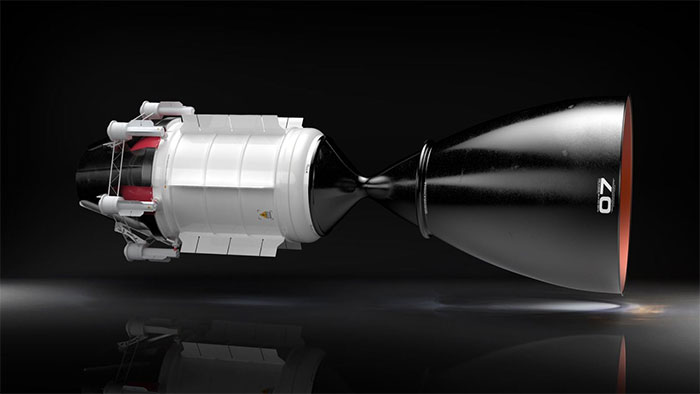
Safe Nuclear Technology Brings Advanced Nuclear Engine Design to NASA. (Illustration: Engadget).
NASA has been planning to use nuclear power in an effort to cut the time it would take to send a manned mission to Mars, Popular Mechanics reports. The latest plan involves NASA reviving 70-year-old nuclear thermal technology research and working with contractors to begin testing nuclear-powered rockets in space as soon as 2027.
NASA and the Defense Advanced Research Projects Agency (DARPA) have contracted Lockheed Martin to design, build and test nuclear-thermal rocket technology for a shorter, faster trip to the Red Planet. The rocket, called DRACO, is also expected to operate at twice the efficiency of a conventional chemical rocket, which combines fuel and oxidizer to create combustion energy.
'Working with DARPA and companies in the commercial space industry will allow us to accelerate the development of the technology we need to send humans to Mars,' Pam Melroy, NASA's deputy administrator, said in a statement. 'This demonstration will be a critical step in meeting our goals of sending crewed missions deeper into space, from the Moon to Mars,' he stressed .
Lockheed Martin will lead the design, integration and testing of the spacecraft in the roughly $500 million project, while BWX Technologies will design and build the nuclear fission reactor to power the engine.
Tabitha Dodson, DARPA program manager for the project, said in a statement that the DRACO project 'aims to give the nation superior propulsion capabilities.'
Nuclear-thermal rockets can achieve high thrust – similar to chemical propulsion – but with three times the efficiency. This means that instead of taking a minimum of seven months to get to Mars as it does today, a nuclear-powered trip would take just 45 days. And getting to Mars in 45 days isn't the only benefit, as NASA is also looking at a more efficient connection between Earth and the Moon.
'For our country, for our people to explore deeper space, we need more efficient propulsion changes. Higher thrust is really important. And I think we're on the cusp of that,' Kirk Shireman, Lockheed Martin's vice president of lunar exploration, said in a press conference.
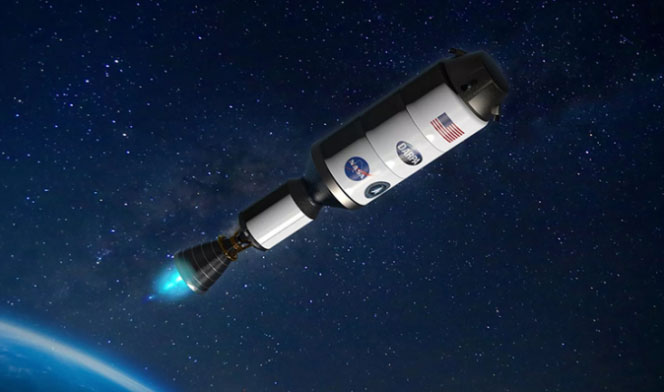
Simulation of a missile using a nuclear propulsion engine. (Photo: DARPA).
NASA says fusion rockets could be three or more times more efficient than conventional chemical propulsion and would help reduce transportation times.
The new DRACO program aims to build on that initial research, but with a new fuel option to ease the logistical hurdle. Using high-enriched, low-enriched uranium fuel, the fission-based reactor can split atoms, heat liquid hydrogen, and fire that high-temperature gas through an engine nozzle to generate the necessary thrust.
The higher performance of nuclear-thermal rockets not only reduces transportation time, but also reduces the risk to astronauts and cuts the need for payloads for the entire system.
One challenge that remains unsolved, according to Live Science, is the need to heat hydrogen to over 2,400 degrees Celsius while also storing it at minus 215 degrees Celsius. ' This is both a demonstration of cryogenic liquid hydrogen storage in orbit and a demo of a nuclear thermal rocket,' Dodson said.
During the test launch, expected in 2027, the engine's fission reactor will be shut down for safety reasons until the rocket reaches its designated orbit. The US Space Force will provide the launch vehicle to send the test craft into space.
The initial DRACO test is planned to take the craft at least 430 miles (696 km) and no more than 1,200 miles (1,984 km) into space. It does not plan to maneuver, and will instead allow the vehicle's reactor to use the new fuel and collect data along the way. With plans to store two months of liquid hydrogen on board, the crew could also test the ability to refuel in space, according to Space News.
'We're going to put these things together, we're going to do this demonstration, we're going to collect a lot of great data, and we really believe that will open up a new era for America, for humanity, to support our space exploration mission,' Shireman told reporters, according to Live Science.