Resembling a beautiful flower, even down to the effect of petals fluttering in the wind, the orchid mantis is actually a bloodthirsty killer with sophisticated and ruthless hunting tactics.
With an appearance identical to a delicate and beautiful orchid flower, but in reality a bloodthirsty predator, the orchid mantis (scientific name Hymenopus coronatus) is considered a master of camouflage in the natural world, fascinating scientists and insect collectors alike.

The orchid mantis is almost invisible among the orchid petals. (Photo: Flickr)
This unique insect species lives primarily in rainforests in Thailand, Malaysia, Indonesia, India, Singapore, and Vietnam.
It looks like an orchid flower.
Although they don't live on orchids, these praying mantises look exactly like orchids thanks to their spectacular mimicry.
Except for its serrated forelimbs, similar to other praying mantis species, which it uses to grip prey, Hymenopus coronatus, with its pale pinkish-white color, has developed a broad abdomen and four lobes on its hind legs shaped like petals, completely deceiving both its predators and prey.
Their size is even comparable to real flowers, with adult females measuring about 6-7cm in length, while males are only about 2.5cm long.

Orchid mantises even use a trembling effect just like real flower petals. (Source: Shutterstock)
Most impressively, the praying mantis can change color depending on the light or temperature , making it resemble not only orchids in general but also the specific orchid species in the area where it lives.
Scientists have noted that orchid mantises exhibit over 90 different patterns and color tones, depending on the orchid species they choose to inhabit.
When they perch on an orchid branch, even their bodies have a swaying effect, like petals in the wind.
Interestingly, these camouflaged praying mantises attract even more pollinating insects than real flowers.
Live like an orchid.
The orchid mantis not only looks like an orchid, but in many ways, it also lives like an orchid.
In rainforests, this insect is found in bushes and on trees—places where epiphytic orchids grow (epiphytic plants are plants that grow harmlessly on other trees).
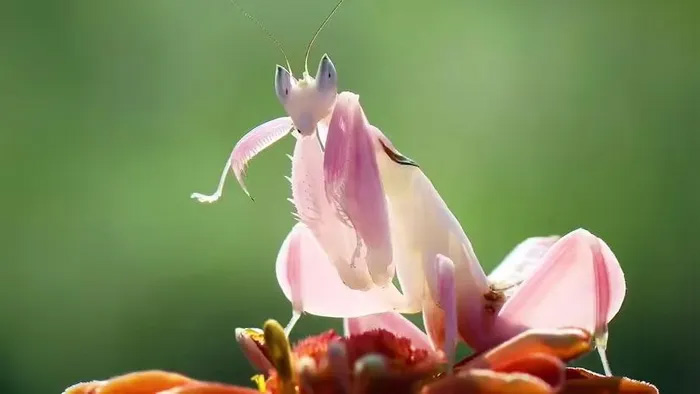
The orchid mantis is the first known insect with the ability to mimic an entire flower, from color to shape. (Source: Getty Images).
Orchid mantises even prefer weather similar to orchids, with daytime temperatures of 25-29°C and nighttime temperatures of 17-18°C. They also prefer high humidity, ideally 60-70%.
Hunting
Instead of hunting for prey, these praying mantises remain motionless for hours on orchid branches, waiting for prey to fly by so they can capture it with their sharp claws and lightning-fast speed.
Orchid mantises are highly aggressive, readily attacking any moving object that comes within their sight.
Their diet consists of insects, especially bees and butterflies, which often visit flowers to feed on nectar. They also prey on beetles, scorpions, frogs, and small lizards.
Unexpected findings
While studying the evolution of orchid mantises, American scientists discovered they possess some surprising tricks.
Since their discovery over 100 years ago, it has been believed that these orchid mantises evolved their beautiful pinkish-white color and broad, flat legs resembling orchid petals as a form of camouflage to protect themselves from predators and to confuse their prey so they can stealthily attack.

An orchid mantis is eating a fly. (Source: theconversation).
This is a type of camouflage evolution used for defensive or offensive purposes. Other insects, such as katydid grasshoppers, also camouflage their bodies to resemble a dry leaf in order to blend in with the foliage.
However, in 2014, scientists conducted systematic field experiments to see how adult female orchid mantises behaved and discovered that their evolutionary mimicry was aggressive mimicry, not just camouflage. They are actually sophisticated and ruthless killers.
Orchid mantises not only hide among flowers, but they can also perch on other plant substrates such as stems, branches, and leaves. And wherever they perch, they attract even more nectar-feeding insects than actual flowers.
Researchers found that nectar-feeding species, such as bees, 'diverted from their usual flight paths and flew straight toward this deceptive predator.'
Scientists believe that praying mantises may not actually be precisely mimicking a specific type of flower. Instead, they exploit a 'rule of thumb' in the insect brain regarding food perception, meaning anything that matches the color X is a nectar-containing flower.
The orchid mantis exploits this by 'sensory exploitation'. It's a concentrated mass of color that responds to a super-sensitive stimulus. The nectar-feeding insect will classify the mantis as a giant flower brimming with nectar and rush to its demise.
Female orchid mantises are three times larger than males, a phenomenon known as sexual dimorphism, which in other animals and insects is usually for reproductive purposes. But with this insect, scientists have interestingly discovered something completely different.
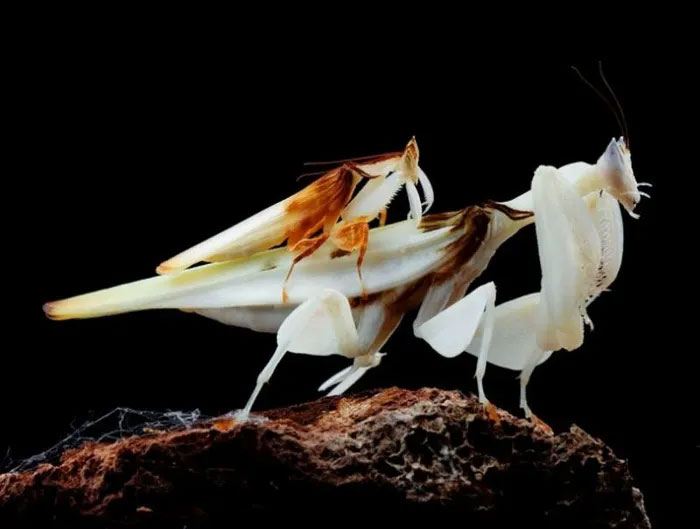
A pair of orchid mantises are mating. (Photo: Jason Zhu).
A 2016 study, led by Dr. Gavin Svenson of the Cleveland Museum of Natural History (CMNH), indicated that this was a rare finding of female adaptations in a species geared towards hunting rather than reproduction.
According to Svenson, the males survive in a completely different way from the females; they are omnivorous, eating anything they can get their hands on, and have a narrow range of movement, trying to find mates and avoid predators.
The research team suggests that the differentiation in size and behavior between males and females appears to be to make females better predators, while smaller males can more easily evade predation (by the females themselves) and increase their chances of mating.