NASA instruments have captured the moment part of the Sun appeared to be completely detached and caught in a polar vortex.
However, scientists have reassured that the impact of this phenomenon is not as terrible as people think.
Watch video of plasma swirling away from the Sun's surface. (Source: Twitter/Tamitha Skov)
Tamitha Skov, a space weather physicist and research scientist at the Aerospace Corporation of Southern California, was the first to share images of the phenomenon. In fact, a large piece of plasma broke off from the surface of the Sun and was caught in a polar vortex.
In a video posted on social media, physicist Skov described: 'Some of the material has started to separate from the main structure and is being drawn into a polar vortex. It takes up to 8 hours for that material to completely rotate around a pole at an angle of 60 degrees.' According to preliminary calculations, Skov said the polar vortex is moving very fast, with a speed of up to nearly 100km/s.
According to the National Weather Service, a polar vortex is a large, rotating low-pressure area that forms near the Earth's poles. The polar vortex is a 'little-known' phenomenon, according to Sara Housseal, a space weather operations specialist at the US Space Force's Space Weather Operations Center .
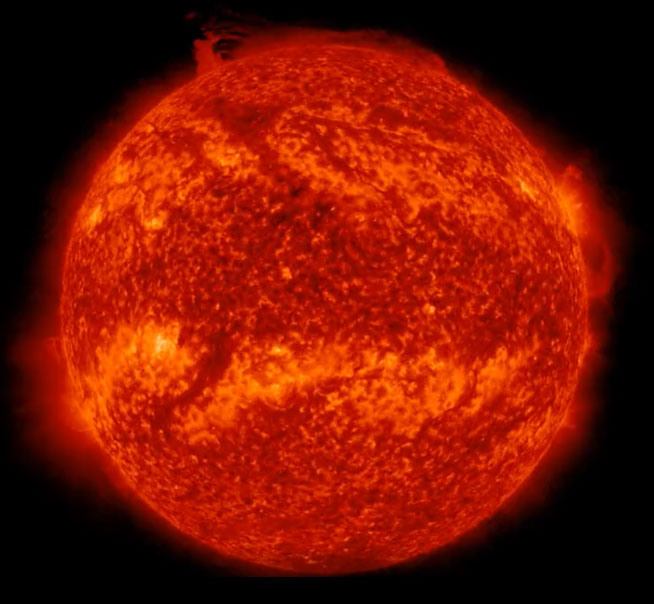
Some material has begun to separate from the main structure and is being drawn into a polar vortex.
According to Scott McIntosh, a solar physicist and deputy director at the National Center for Atmospheric Research, plasma debris has been seen breaking away from the sun's surface in previous solar cycles. However, it is rare to see plasma debris and the polar vortex interact.
'After each solar cycle, plasma debris begins to migrate to the poles of the Sun. However, the cause of this phenomenon is still unknown. Why does the plasma strip only move towards the poles once, then disappear, and then return in the same area after 3-4 years?' , expert Scott wondered.
The interaction between plasma debris and the polar vortex could play a significant role in understanding the Solar System and other gas giants, such as Saturn and Jupiter, which are known to have extremely strong winds, Skov said.