
Space science
The universe is expanding faster and faster
A study of several hundred thousand galaxies showed that the rate of expansion of the universe increased with time.
Browse ScienceInfo articles and explainers related to Matter.
537 published items.
A study of several hundred thousand galaxies showed that the rate of expansion of the universe increased with time.

American scientists have created a strange kind of material that has never been seen in the world by colliding charged gold atoms at super high speeds in particle accele…

Professor Tristan Ferrroir, of the University of Lyon, France, announced that his team has discovered that new matter is harder than diamond.

Mysterious dark matter is always an unanswered question for scientists. This type of invisible material accounts for three-quarters of the universe.

A new argument suggests that the Higgs boson and dark matter particles are likely to belong to the same material.

The extreme heat change at the center of a very distant star cluster produces matter particles and antimatter, causing this star cluster to become unstable.

Dutch astronomers measured the relative distance between the earth and the nearest black hole.

The large particle accelerator re-starts last night after a problem more than a year ago, and will begin the process of simulating the Big Bang explosion.

A galaxy that humans cannot see collides with the Milky Way but it retains its shape.

For the first time in history, physicists may have discovered an element of dark matter, a form of matter that accounts for 90% of the mass in the universe.
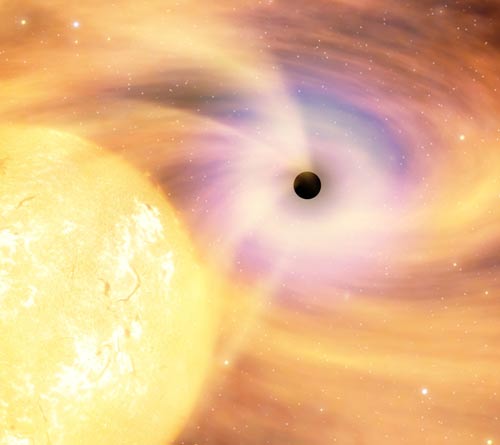
Two Chinese scientists have reported that they have created a small black hole in the laboratory, but it is only capable of absorbing light.
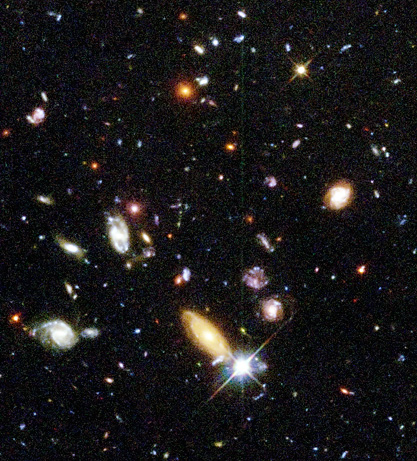
Dark energy, the mysterious resource that came out more than a decade ago to explain why the universe is separating at a faster rate, is no longer needed.

A group of international scientists headed by Oxford University have looked at the dense and hot mass in the center of the planets ...
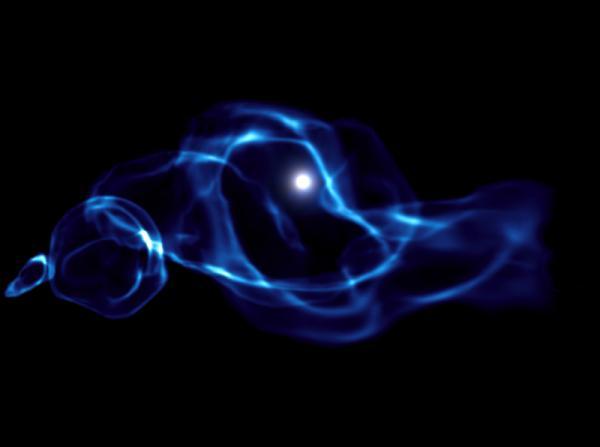
The first black holes in the universe have a huge impact on their surroundings despite the fact that they are small and grow very slowly, following new supercomputer mod…
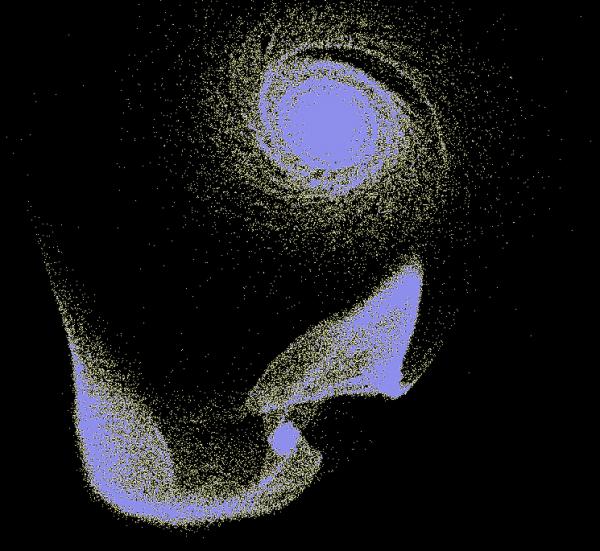
The new study, published July 30 in Nature, explains the origin of spherical dwarf galaxies.