Space science
Asteroids challenge every law of gravity
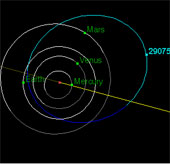
A giant asteroid with a special orbital close to Earth is in fact an unusual combination of debris, spinning rapidly at a record speed.
Browse ScienceInfo articles and explainers related to Moving.
410 published items.
A giant asteroid with a special orbital close to Earth is in fact an unusual combination of debris, spinning rapidly at a record speed.
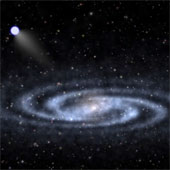
Chinese-Chinese scientists have discovered a super-fast star, moving at a rate of 1.6 million km / h, located near the center of the Milky Way.

RIA Novosti quoted Roscosmos spokesman as saying that moving the missile into the launch pad was planned as planned.
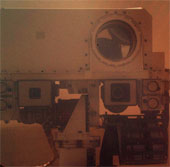
Nearly a year after successfully landing on Mars, Curiosity robotics of the US Aeronautics and Space Administration (NASA) will switch to self-driving mode.
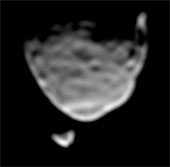
Recently, the Curiosity self-propelled robot has captured pictures showing the two Mars moons are Phobos and Deimos and sent to Earth.
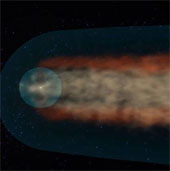
The US Aeronautics and Space Agency (NASA) said one of its spacecraft had long suspected that the solar system had a tail like a comet.
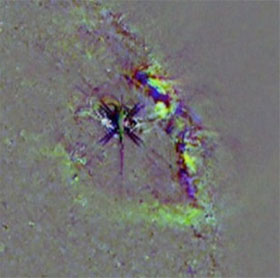
Japanese and American artificial satellites capture the phenomenon of a series of 'tsunamis' spreading on the surface of the Sun at tremendous speeds.
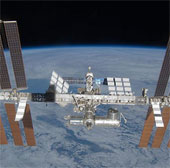
The US Aeronautics Agency (NASA) said the astronauts on the International Space Station (ISS) have detected an ammonia leak in the cooling system outside the facility.
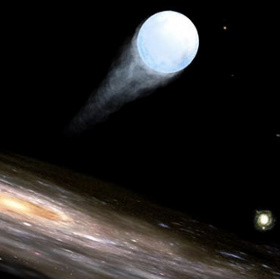
Last month astronomers discovered six super-fast stars flying very fast near the black hole in the center of the Milky Way, where the dust density was so great that the…
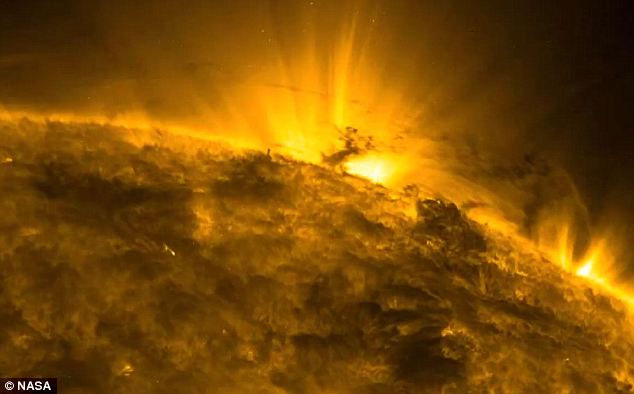
NASA's Solar Dynamics Observatory satellite captured a giant storm moving through the sun.

Scientists from the European Atomic Research Organization say they have discovered a type of particle that can move faster than light.
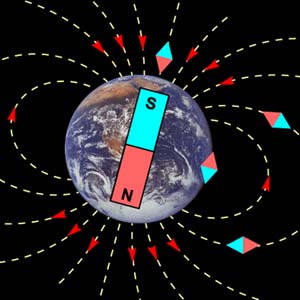
The movement of the pole from the North is causing serious problems for aviation, maritime and wildlife.
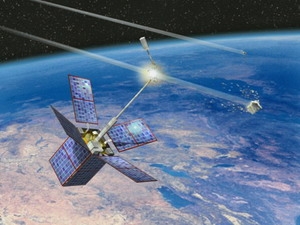
Automatic laser systems can detect and prevent debris floating on space colliding with spacecraft and satellites.

The US Hubble telescope detected a super-hot blue star moving at speeds of up to 2.56 million km / h.

American astronomers on March 17 announced that they have observed the darkest, most moving mass of matter in the universe ever.