Physics is the science that explores the most fundamental laws and structures of nature, and attempts to describe and explain the universe we live in using mathematical language.
Physicists constantly propose new theories and experiments to verify or overturn old theories and experiments, thereby deepening and perfecting our understanding of nature.
In the history of physics, there have been a number of major discoveries and breakthroughs that have changed our views and understanding of the universe, and have had a huge impact on human technological progress and social development.
For example, Newton's law of gravity, Einstein's theory of relativity, Bohr's atomic model, Feynman's quantum electrodynamics, etc. Among these important discoveries and breakthroughs is a very special and mysterious particle called the "God Particle" , or more precisely the Higgs Boson .
So what is this particle? How was it discovered? What impact does it have on physics and humans?

More and more scientists are interested in searching for the 'God Particle' in physics that can explain the fundamental principles of the universe. (Photo: ZME).
What is the God Particle?
The God particle is an elementary particle that interacts with the Higgs field, giving mass to other particles . So what is an elementary particle? An elementary particle is the smallest unit that makes up matter, it is indivisible and cannot be made up of other particles.
There are two known types of elementary particles: fermions and bosons .
Fermions are particles with half-integer spin that obey Fermi-Dirac statistics, are repulsive, and cannot occupy the same quantum state at the same time. Fermions include quarks and leptons (such as protons, neutrons, electrons, etc.) that make up the nucleus and shells of atoms, and gluons that transmit the strong interaction force.
Bosons are particles with integer spins that obey Bose–Einstein statistics, are grouped together, and can occupy the same quantum state at the same time. Bosons include the photon, which transmits the electromagnetic, weak, and gravitational forces; the W and Z bosons, and the graviton (which has not yet been discovered); and the Higgs boson, which interacts with the Higgs field.
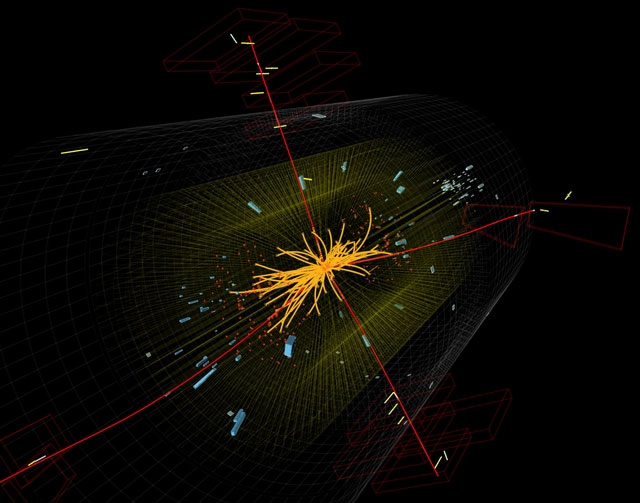
Many scientists in the past believed that the Higgs Boson was a particle, or a collection of particles, that formed the fundamental basis of mass. (Zhihu photo).
So what is the Higgs field? The Higgs field is a field that pervades the entire universe and it can be understood as an invisible, viscous medium through which different particles experience different levels of drag and thus acquire different masses.
Without the Higgs field, all particles would have no mass like photons, and could not form atoms, molecules, and matter. Therefore, the Higgs Boson is called the "God Particle" and it shapes the entire universe.
The Higgs boson was hypothesized in 1964 by Peter Higgs and several other physicists , who attempted to explain why the W and Z bosons, the carriers of the weak nuclear force, have mass, while the photon, the electromagnetic force carrier, is massless. They proposed the Higgs mechanism, which uses spontaneous symmetry breaking to give elementary particles mass without violating standard theory.

The Higgs boson has been theorized since the 1960s to be the source of mass for elementary particles. The Higgs boson is created by a popular hypothetical quantum field, also known as the Higgs field, which is capable of providing the momentum needed for particles to acquire their mass. (Photo: Zhihu)
How was the God particle discovered?
The Higgs boson is a very difficult particle to observe because it requires extremely high energy to create and decays quickly into other particles. Physicists spent decades searching for traces of it, until in 2012, at the Large Hadron Collider built by CERN, scientists observed a new boson with the same mass and properties as the "God Particle".
On March 14, 2013, CERN officially announced the discovery of the Higgs Boson and proved the existence of the Higgs field.
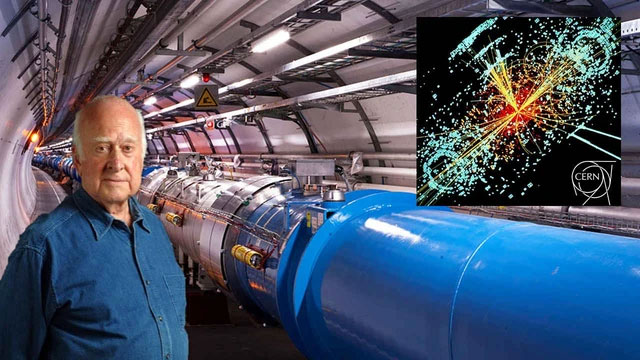
The European Hadron Collider, currently the world's most powerful particle accelerator, is located 100 metres from the Swiss-French border and is 27 kilometres in circumference, and can produce high-energy particle fragments. By analysing these fragments, physicists can explore the properties and interactions of fundamental particles, as well as what happened to the universe after the Big Bang. (Photo: NBC).
To discover the Higgs Boson, physicists need to conduct tens of millions of collision experiments at the Large Hadron Collider and use sophisticated data analysis methods to screen for events that might contain a Higgs Boson signal. This is an extremely difficult and time-consuming task, requiring the cooperation and efforts of thousands of scientists and engineers around the world.
The discovery of the God Particle was a momentous event in the world of physics. It not only confirmed the Standard Model, the most complete and successful theory of elementary particles, but also revealed one of the deepest mysteries of nature, how mass is created.
The Standard Model is a mathematical framework that describes fundamental particles and their interactions (except gravity). This model can explain most known physical phenomena and predict many new physical phenomena.
The Standard Model consists of 12 types of fermions, 4 types of standard bosons, 1 type of Higgs Boson and their corresponding antiparticles, for a total of 28 types of elementary particles . In the Standard Model, the Higgs boson is the only particle that has not been observed experimentally, so it is the final piece of the Standard Model, and the most difficult piece to find.
The discovery of the Higgs boson meant that the Standard Model was fully supported by experiment, and it also meant that our understanding of elementary particles had reached a new level.
In addition to having a great impact on physics itself, the discovery of the God Particle also has profound implications for human society. In order to discover the God Particle, physicists have developed many advanced instruments and devices, such as the Large Hadron Collider, detectors, computers, networks, etc. These instruments and devices are not only used in basic research but also used in other fields such as medicine, engineering, education, etc.