While Jupiter is the earliest planet to be born, determining which planet is the youngest is much more difficult.

Jupiter is the oldest planet in the Solar System. (Photo: Hakan Akirmak Visuals/Artem Musaev/IFLScience)
About 5 billion years ago, the Sun began converting hydrogen into helium in its core, becoming a true star. Surrounding the newborn Sun was a disk of material—mostly hydrogen from the solar nebula, but also more complex molecules. Interactions within the disk created ice and dust particles, which continued to grow and interact with other particles. Clumps of gas in the disk also began to separate from the rest. From this chaos, planets gradually formed.
Oldest planet
The earliest planet to form, probably within the first 3 million years of the Solar System, was Jupiter. This makes Jupiter massive and massive, much larger than any other planet. Jupiter has a mass 318 times that of Earth. In fact, the center of mass between Jupiter and the Sun—the point around which Jupiter orbits—is not the center of the Sun, but just outside the surface. So Jupiter doesn't even orbit the Sun exactly.
After Jupiter, Saturn also began to develop. Neptune and Uranus followed , although by the time these two planets were forming, Jupiter and Saturn had already swept up a large amount of gas from the outer reaches of the Solar System. Of the moons in the Solar System, Jupiter's moon Callisto has the oldest surface.
During this time, in the inner Solar System, four rocky planets and one dwarf planet gradually formed. The rocky protoplanets took longer to form, perhaps closer to 100 million years, because they depended on collisions between rocky bodies. Mars may have reached its current size more quickly than Earth and Venus, but scientists don't know exactly when. Scientists typically estimate the age of a solid body by the number of craters on its surface, but bodies with changing surfaces complicate this task.
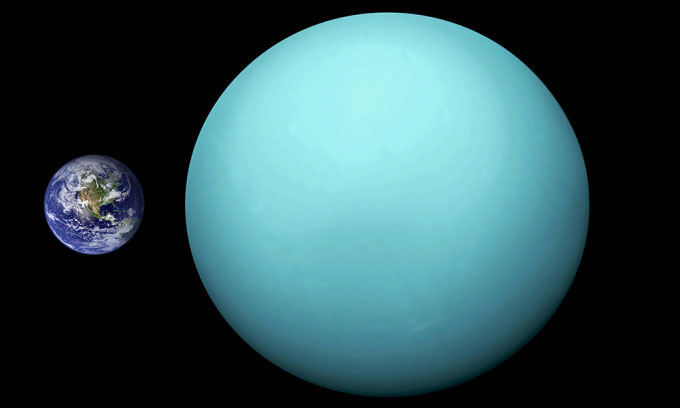
Earth (left) and Uranus (right) may be the youngest planets. (Photo: Wikimedia).
Youngest planet
While it is possible to determine that Jupiter is the oldest planet based on formation models, finding the youngest is not as simple. Another aspect to consider is that the planets need to have masses and properties similar to those seen today. If so, the title of youngest planet is a contest between Earth and Uranus . The reason these two planets are contenders for the title of youngest has to do with the fact that they have both undergone massive collisions.
The proto-Earth likely collided with Theia, a planet as large as Mars. The Moon likely formed from this event, which occurred about 4.5 billion years ago. The Moon took about 200 million years to solidify. The Earth that experienced the impact would have needed more time to become what it is today, with the formation of oceans and tectonic plates. The plates may have formed as early as 3.6 billion years ago.
Three to four billion years ago, Uranus also collided with an Earth-sized body, causing its internal structure to be disrupted. The event left Uranus with a tilted spin and a strange magnetic field. Because Earth and Uranus have undergone such structural changes, determining which planet is younger remains a puzzle.