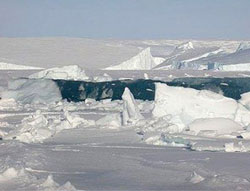
 On February 17, Spain's High-Level Scientific Research Council (CSIC) said it had discovered an ice block of up to 14,000 square kilometers separated from Wilkins ice shelf, belonging to Antarctica.
A group of CSIC scientists witnessed debris as high as 200 meters of the giant ice mass when they were on board Hesperides in the journey to study Belinhausen marine biology in Antarctica.
The report of the scientists confirmed the sea temperature in the "unusually warm" area and warned the first direct consequence that the sea level in the region would rise.
The ice shelf is a large ice ground and covers the surface of the great face. Only Canada, Greenland, Denmark and Antarctica have this ice structure.
Wilkins ice shelf is located about 1,600km from the southern tip of South America and has an area of approximately 16,500 m 2 .
Antarctica is the region with the highest average temperature increase in the world in the past 50 years, the average temperature in each decade increased by 0.5 degrees C. Scientists believe this is evidence for see the harmful effect of gas change on this icy continent.
A large block of ice separates from Antarctica
On February 17, an ice block of up to 14,000 km2 separated from Wilkins ice shelf, belonging to Antarctica.
Keep exploring
More in EnvironmentBrowse the category
Next reads
Continue reading
Environment
How Do Climate Models Work?
Environment
What Is the Evidence for Climate Change?
Environment
How Do Weather Forecasting Models Work?
Environment
How Do Tornadoes Form?
Environment
How Do Hurricanes Form?