Since the Big Bang, matter in the universe has been distributed throughout space and time. However, because galaxies were formed at different times and have different initial masses, the gravitational pull of galaxies is also different.
If we make an investigation of the distribution of galaxies in the universe, we will find that in certain regions the number of galaxies is very large and these regions often shine brightly, while others are scattered in groups of galaxies, like houses in the suburbs of a city.
In the observable universe with a diameter of 93 billion light years, there are indeed some regions of time that are not black holes, but in this region of space-time there are no stars or planets, dark matter and dark energy do not exist. And it is often likened to the void or void of the universe .
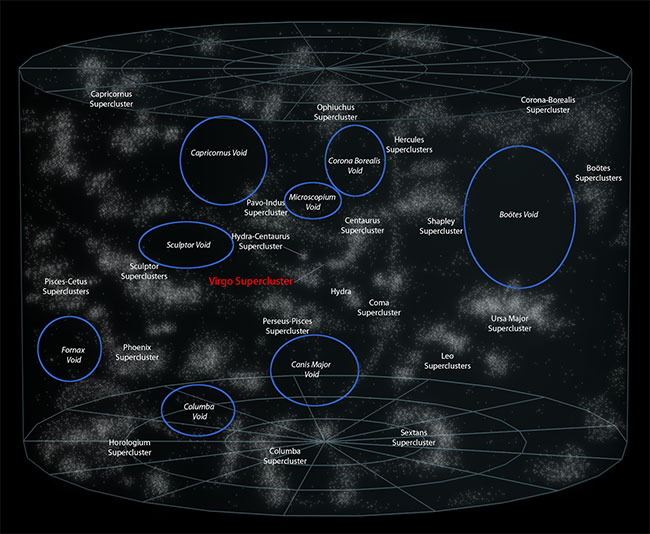
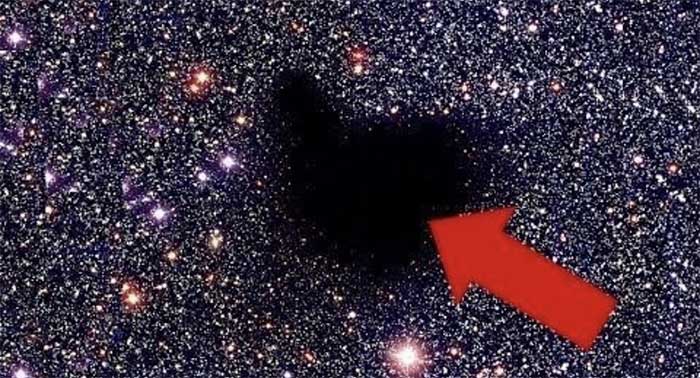
The Boötes void is a region of space-time nearly 250 million light-years across, containing very few galaxies. It is the largest void we know of in the universe. (Image: ZME)
This region of space-time is called the cosmic void.
The closest void to Earth today is the Boötes void, 700 million light-years away , with no stars and complete darkness, and an astonishing 250 million light-years across – the Milky Way is only 180,000 light-years across; the Solar System is only 2 light-years across. In other words, if the Solar System were at the center of the Boötes void, astronomers would likely feel that there was only one galaxy in the universe: the Solar System Galaxy.
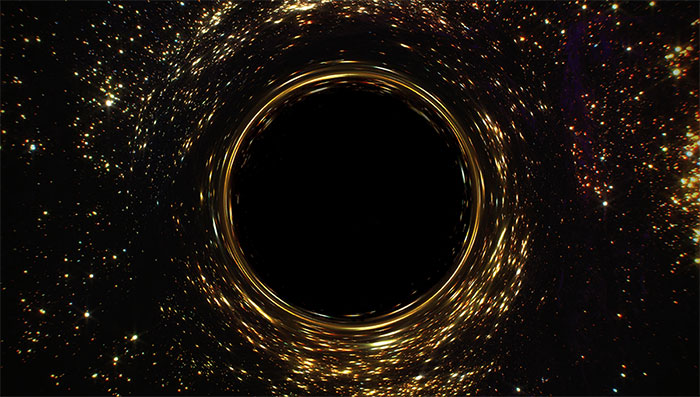
Matter is too scarce in the Boötes void. (Illustration: Zhihu).
Because matter is so scarce in the 250 million light-year diameter Boötes void, many science fiction enthusiasts feel that the Boötes void seems to have formed unnaturally, as if some force had forcibly cleared those 250 million light-years. Meanwhile, conspiracy theorists believe that this strange void is the result of an alien war, perhaps between two ancient supercivilizations, that eventually left this space devoid of any matter.
Of course, the scientific community will certainly not agree with these baseless speculations, so research into the Boötes void must still rely on scientific detection methods.
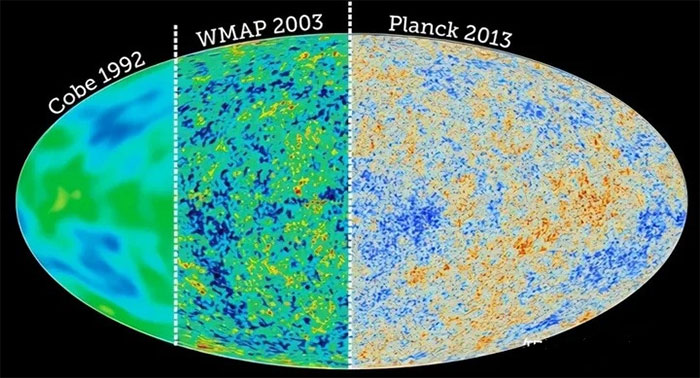
The center of the Boötes void is approximately 700 million light-years from Earth. (Photo: Zhihu).
In the microwave background map that reflects the entire universe, the Boötes void has almost no matter in it, so its temperature is significantly lower than the surrounding space-time, leaving a cold blue spot on the microwave background map. In the future, if a human civilization's spacecraft accidentally enters this region, it will be like an ant falling into the Pacific Ocean, the people on the spacecraft will lose all light sources, unable to reach the stars that can replenish nuclear fusion fuel.
The endless darkness with a diameter of 250 million light years is like a giant impassable wall in the universe. For any civilization that has not mastered ultralight spacecraft technology or wormhole travel technology, this space-time gap is impassable, and it can prevent the expansion of most civilizations.
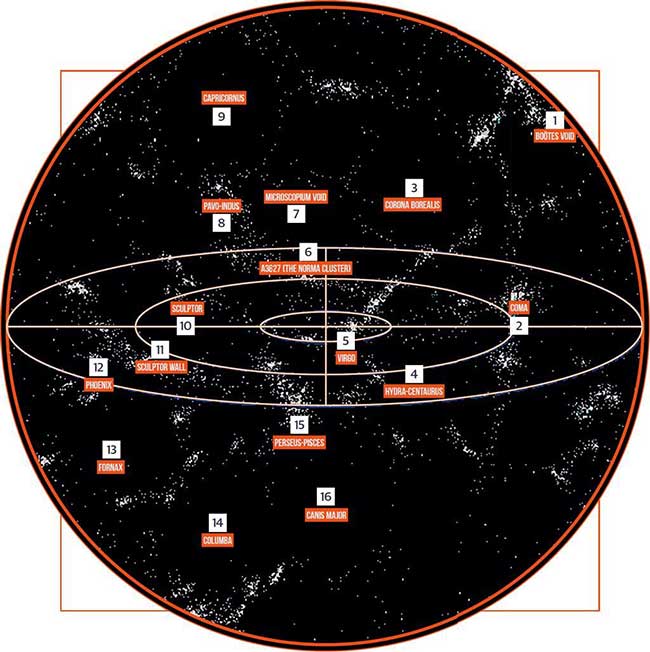
The seeds of the Boötes void were likely formed at the very beginning of the Big Bang. (Illustration: Science Alert).
How does a Boötes gap form?
Cosmologists believe that the seed of the Boötes void likely formed at the very beginning of the Big Bang . Then, as the universe expanded at an accelerating rate, the Boötes void grew larger and larger, eventually forming the diameter we see today.
The Big Bang theory believes that our universe began in an explosion caused by quantum fluctuations, and before the Big Bang, quantum disturbances in the field determined that there must have been some relatively empty spaces within the Big Bang particles. With the explosion in the early stages of the Big Bang, these spaces evolved into cosmic voids, and the Boötes void is just one of them.
Of course, there is also the hypothesis that the 250 million light-years-wide Boötes void did not form naturally, but is composed of many small voids merging during the expansion of the universe, much like black holes will eat each other to form larger black holes.
Boötes voids may have formed from the merger of smaller voids, like multiple soap bubbles combining to form a larger bubble. (Image: Zhihu).
We're even in a void right now, but it's too big for us to notice - the Milky Way is part of the Laniakea Supercluster , which contains about 100,000 galaxies. It seems big enough, but when you scale it up to a more macroscopic level, the Laniakea Supercluster is just a point surrounded by holes.
What is certain now is that for a long time in the future, the voids in the universe will be walls that prevent human civilization from observing the universe , human civilization may never know what is behind those voids and will also have no chance to pass through these holes - a region with a diameter of hundreds of millions of light years, a dark region with no energy supply inside.