This creature has a self-defense mechanism enough to startle many people when they learn the truth.
The fierce natural world requires creatures to have their own self-defense weapons. But with this animal alone, their self-defense weapons not only make the enemy falter, but also make us feel horrified when we know the nature.
The creature we mentioned here is Tripneustes gratilla - a species of thorns in the Pacific Ocean .
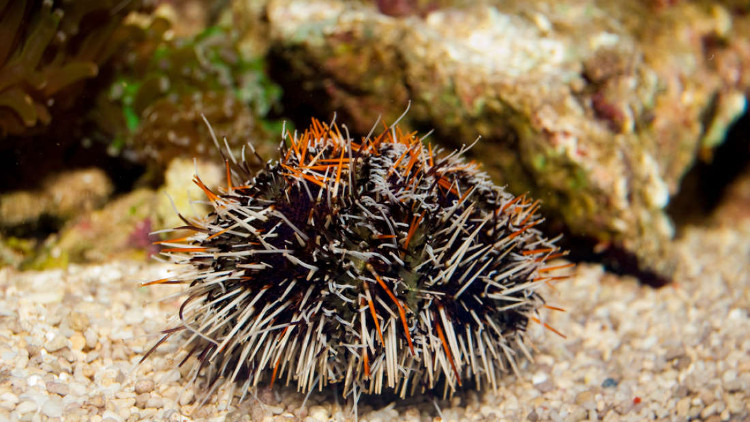
Tripneustes gratilla prickly.
As its name suggests, this animal's weapon is of course sharp spikes. But things aren't that simple.
According to a recent report, the thorny Tripneustes gratilla has a terrifying defense mechanism. When attacked, it will release hundreds of tiny "heads" , each with a sharp jaw. They will pump the enemy into deadly poison drops.
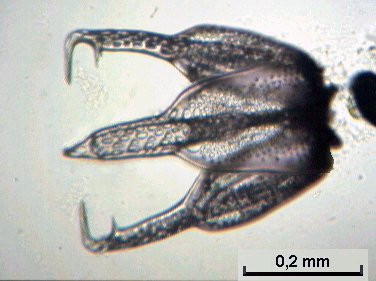
Close up of the "heads" of Tripneustes gratilla.
This mechanism is called "underwater pursuit signaling " , discovered by oceanographer Hannah Sheppard-Brennand from Southern Cross University (Australia). In fact, many animals have the ability to launch weapons for self-defense. But Tripneustes gratilla's ability is unique, since each "head" is capable of acting independently.
"These heads are really scary" - Sheppard-Brennand confessed. "When we first observed, we thought it was a parasite, based on the external shape and acted too independently of the host."
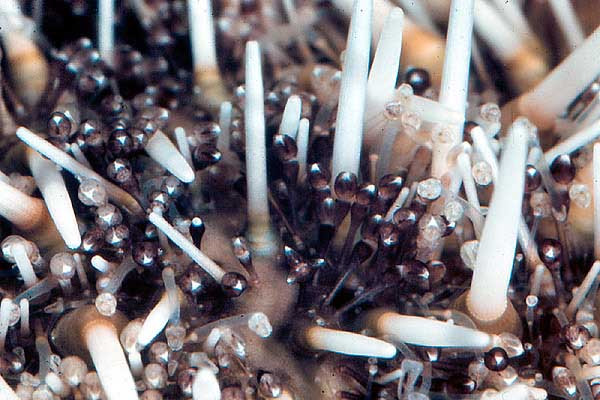
The heads plugged on the body of the thorns, just waiting to release.
These "heads" are called pedicellariae , and it is quite common in spiny animals. In common spikes, pliers will attach to moving targets, often used to attract food and fight enemies.
However, T. gratilla's pliers are exactly like Hollywood's alien monsters. They can automatically detach themselves from the bridge, chase enemies, bite and inject venom themselves.

T. gratilla's pliers are exactly like Hollywood's alien monsters.
Through some experiments, Sheppard-Brennand said that after each wave of self-defense, T. gratilla needed 40-50 days for pliers to regrow. Therefore, when excited, they usually release only about 10-20 "heads" . However, she has also seen cases of freeing hundreds of heads in just 30 seconds, and it is clearly a nightmare for their enemies.
The study is published in The American Naturalist magazine.