Astronauts aren't the only 'space workers' who often work in stressful conditions.
If you didn't know, rocket launches typically take place at midnight or early morning, when the weather tends to be milder. For example, the Artemis 1 mission lifted off at 1:47 a.m. (ET) on November 16th. Prior to that, the first launch attempt in late August was scheduled for 8:33 a.m. (ET). This means that the entire team of over 200 NASA engineers and technicians often have to stay up all night to perform checks and refuel the rocket booster, a process that takes approximately 9 hours.
This is a difficult and lengthy process, as engineers must spend the entire night carefully pumping hundreds of tons of liquid hydrogen and oxygen into several tanks on the 100-meter-tall rocket.
Furthermore, a greater challenge in fueling the SLS is that its primary propellant, hydrogen and oxygen, are cooled to -253°C and -145°C, respectively. This requires a complex pipeline system on the ground. Even the rocket's hydrogen propellant tanks shrink by up to 15 cm when filled with the ultracooled fuel.
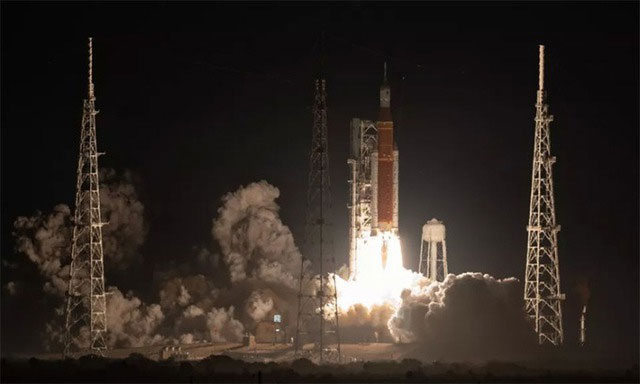
Missiles are usually launched at midnight or dawn.
During the August launch attempt, the ground control system experienced a fuel leak and the engine temperature sensor malfunctioned. The launch was delayed by about an hour after the scheduled liftoff time, a period largely used to allow the engineering team to rest before figuring out what to do next.
"Today, the team tackled a number of issues, the whole team was exhausted by the end of the day, and we decided it would be best to pause and regroup tomorrow," Mike Sarafin, NASA's mission director, said at the time. "First, we're going to give the team time to rest, so they can come back refreshed tomorrow."
NASA engineers and technicians are very well-paid; however, considering the intensity of their work, these figures seem entirely justified. And if you want to be able to work 'extremely hard' and for 'long hours at high intensity ,' like your boss Elon Musk, then the following experiences from NASA might be helpful.
Fatigue can be dangerous.
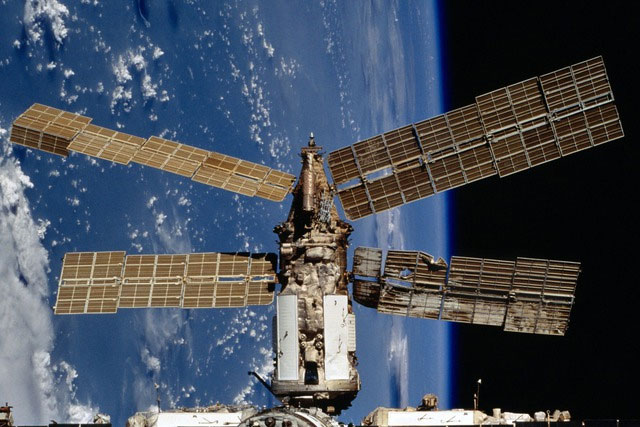
The incident on the Harmonious Space Station is believed to have been partly due to the astronauts being fatigued from lack of sleep.
In 1997, an American astronaut and two Russian astronauts were on board the Mir space station. A resupply spacecraft was en route to the station, and one of the astronauts used remote control to manually dock it. But the spacecraft crashed into the space station, damaging several structural components, and those on board tried to seal a damaged module with only a few minutes of air remaining.
Following the accident, several technological issues emerged, but a larger problem also came under scrutiny: the astronauts, who controlled the spacecraft, had not gotten enough sleep . A psychologist from the Russian space agency acknowledged "serious doubts" about the astronauts' ability to dock with the spacecraft, but they still endorsed the attempt.
Dr. Stephen Hart, a neuroscientist who served as a NASA flight surgeon for 25 years, shared: "It's not surprising to find that human error is linked to high levels of fatigue during work."
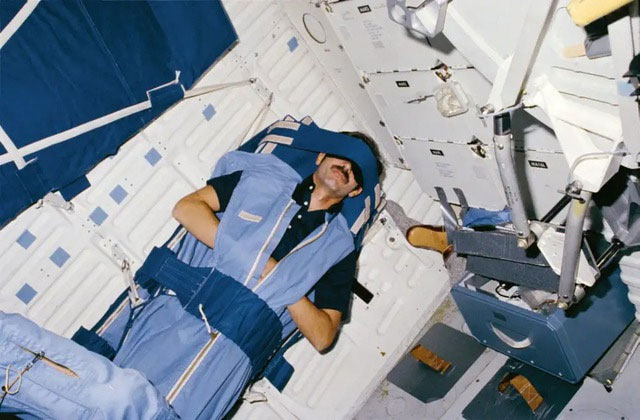
An astronaut is taking a break.
NASA's approach to balancing work productivity and rest.
Hart's primary job is ensuring the well-being of the astronaut crew. These individuals must adhere to a military-style work schedule and require approximately 8.5 hours of sleep per day while on the International Space Station. But Hart and his colleagues also advise NASA leadership on planning to ensure that on-site teams are always ready for critical decision-making. This involves answering the question: 'What is the best time for us to go to sleep so we can be alert for important tasks?'
NASA ground personnel were advised on how to alter astronaut sleep schedules using familiar substances like caffeine and melatonin, employing various tools such as blue-tinted glasses, eye masks, and earplugs. They also experimented with various sleep techniques .
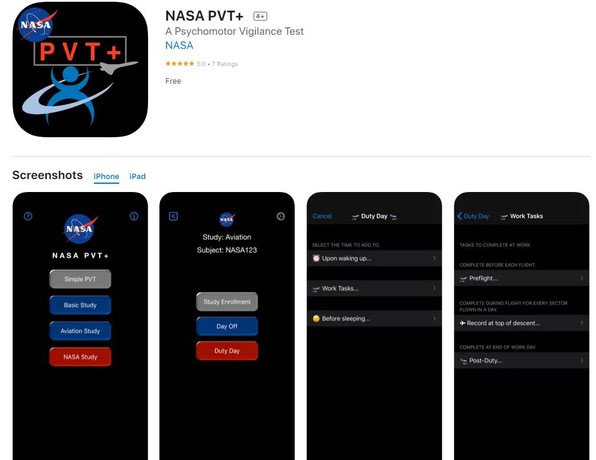
NASA's app on the App Store.
A large part of the challenge is that there are so many differences in how people react to sleep deprivation . NASA is very interested in its space experiments, but they also want their employees to participate in the experiments so they know what to expect. NASA then built an app based on the techniques they use to assess whether astronauts in orbit are too tired. It's designed for researchers to use in assessing 'psychomotor alertness' during sleep research. You can use it yourself to see how fatigue is affecting you. On the App Store, look for the app called NASA PVT+ .
"Some people are rock-solid and don't need much sleep, but others break down and become exhausted," Hart shared. "You have to encourage people to experiment with their own bodies before they put themselves or others in stressful situations."
- Genetically modified trees reduce pollution equivalent to 30 air purifiers.
- These lavish parties are so extravagant that they've made it into world history.
- Which nation dominates space?