The "9th Planet" that has divided the International Astronomical Union (IAU) and NASA continues to bring new hope for the possibility of habitability through a super ice volcano.
According to Space.com, a supervolcano of ice that erupted just a few million years ago on Pluto may be living evidence of an underground ocean just below the heart-shaped icy plain of Sputnik Planitia.
Pluto used to be the 9th planet of the Solar System, but was "demoted" to a dwarf planet by the IAU in 2006. However, a series of top NASA officials affirmed that it deserves to be considered a planet.
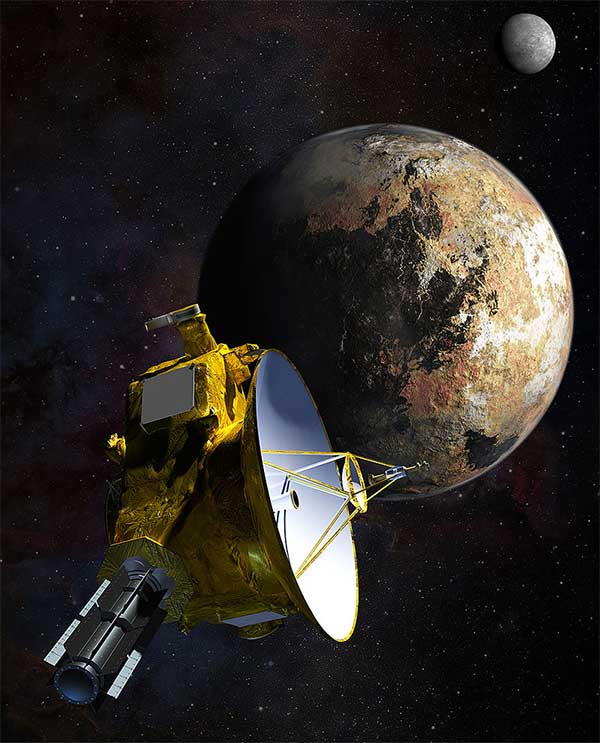
New Horizons spacecraft and Pluto - (Photo: Wiki).
NASA's argument is based on a series of studies from data sent back by the space agency's New Horizons spacecraft from the deep region beyond Neptune.
The data suggests that the celestial body has an extremely complex structure, even the possibility of an underground ocean and a glimmer of hope for extreme forms of life like those found in some of the boiling waters near volcanoes, under the permafrost in Antarctica.
In a new study led by Professor Dale Cruikshank from the University of Central Florida (USA), a large crater named Kiladze in Sputnik Planitia was once thought to be a meteorite impact crater, but the latest data suggests another possibility.
It seems a bit long, with water ice standing out clearly from the methane ice covering the rest of the planet.
The team claims it must be a volcanic crater, the remnant of a supervolcano that was active just a few million years ago, spewing icy "lava " from beneath the underground ocean.
The existence of volcanoes also suggests that Pluto's interior is warmer than we thought, overturning the theory that the planet is so small that it lost all its heat long ago.
One possibility is that this "Planet Nine" contains radioactive elements in its core, releasing heat as it decays.
But wherever the heat comes from, it does what it does best: keep water in a liquid state below the surface, something NASA has been hoping for on other worlds in its search for evidence that we're not alone in the universe.
