New technology
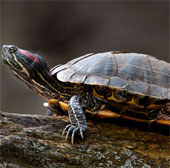
Remote turtle control
Last year, scientists successfully controlled the path of living cockroaches by stimulating their beard and sensory organs.
Track emerging technologies, autonomous vehicles, advanced materials, clean energy, robotics and engineering breakthroughs changing the future.
7,777 published items in this category and its subcategories.
Last year, scientists successfully controlled the path of living cockroaches by stimulating their beard and sensory organs.
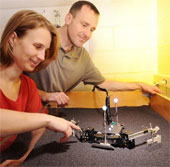
American scientists at the Georgia Institute of Technology have created robots that adapt to the movements of newly hatched sea turtles. Scientists hope this could help…

The textile industry is witnessing a new breakthrough, with the emergence of antibacterial fabrics, allowing for 100 days of wear without washing or ironing.
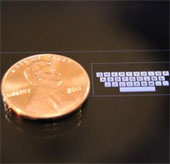
With the rumors surrounding the smart meter flooding the tech world, US researchers are now trying to figure out how to allow for the entry of letters / numbers on scree…
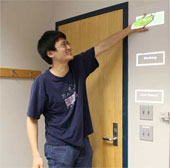
All surfaces can be requisitioned as touch screen controls electronic devices, thanks to intelligent projection interface.
In an effort to ensure the safety of women, the Government of Canada has welcomed the initiative to launch a smartphone application that provides emergency response to a…
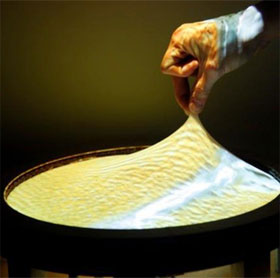
Ignoring the illusion-based 3D screens, American engineers are aiming for a generation of true three-dimensional screens, the kind that users can structure, pinch and ev…
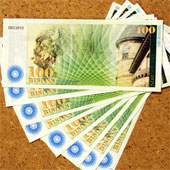
US researchers have found a way to embed radio frequency identification (RFID) tags into paper, promising a broad array of applications in everyday life.
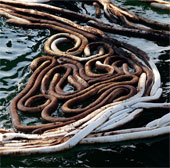
On April 30th, a group of French and Australian scientists said they had made a new lightweight material that could be reused and especially absorbed by some. chemistry.

Both Samsung and LG are competing fiercely to become the first company in the world to launch a curved OLED TV.
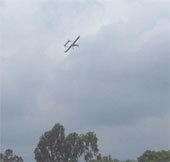
At the testing ground of the Space Technology Institute of the Vietnam Academy of Science and Technology, the High-Technology Telecommunication and Computer Science Prod…

Inspired by the eye of insects, US scientists have said they have made digital dome cameras, with unusually wide angles and sharp images.
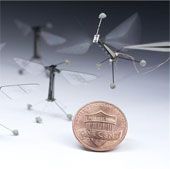
In the early morning, at a Harvard University robot lab last summer, an insect robot made a flight.

In the next 30 years, British and American soldiers will be able to carry more than 90kg of mass, running dozens of kilometers at a constant speed, see through the dark…
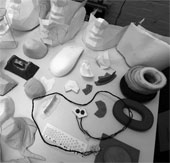
British scientists have just released a kind of superman mask