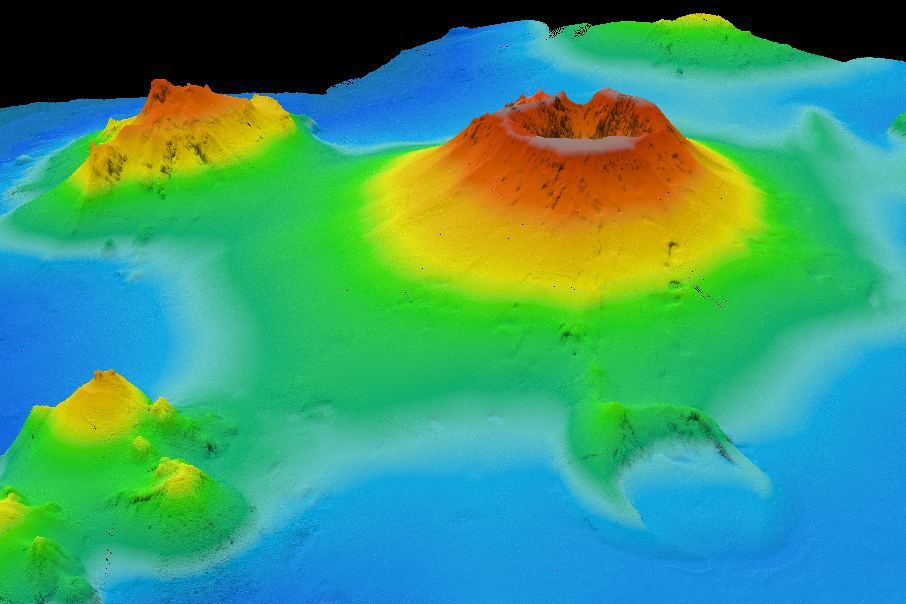
According to the research team, led by ecology professor Kathrin Bolstad at Auckland University of Technology (New Zealand), the whale graveyard was discovered by chance during an expedition in 2017. Realizing that this was a rare discovery, the team used a camera to record high-resolution footage for later analysis.
It turns out that the place they filmed is the furthest natural whale graveyard ever discovered from the equator . The researchers published their observations in the journal Polar Biology .
It is extremely rare and extremely lucky to come across a whale graveyard, said Professor Kathrin Bolstad. There are hundreds of thousands of such sites on the seabed at any given time, but finding one of them is difficult and not always successful.
The whale cemetery is located 945 meters deep, off the coast of the West Antarctic Peninsula, according to the team. But the location makes the discovery even more unusual. Most whale cemeteries are in the North Pacific, off the coast of California and Japan. In fact, less than 5% of whale cemeteries are located near the poles.
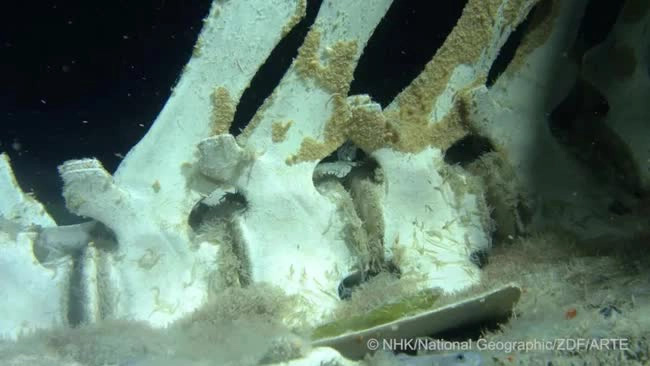
The whale carcass was found decomposing. (Photo: NHK)
The whale carcass in this cemetery is enormous. The skull alone is about 2 meters long . Researchers identified the animal as an Antarctic minke whale . According to the US National Oceanic and Atmospheric Survey (NOAA), this is a whale species that can grow up to 10.7 meters long.
Professor Bolstad said the skeleton could have been on the seabed for 1-2 years. During this time, the whale's body would have been colonized by an ecosystem of other marine life. "Most whale graveyards have dozens, even hundreds, of different species taking advantage of this unexpected food source," he said.
To observe this rich ecosystem, Professor Bolstad and his colleagues filmed high-definition video for two hours and then reviewed the details to determine the species present. The team found that among them were sea fleas, bristle worms, and mucus deposits that revealed the presence of bone-eating worms.
The whale carcass provides a 'feast' for deep-sea populations for decades. The abundance of different species attracted to the site creates a whole new food web around the whale carcass.
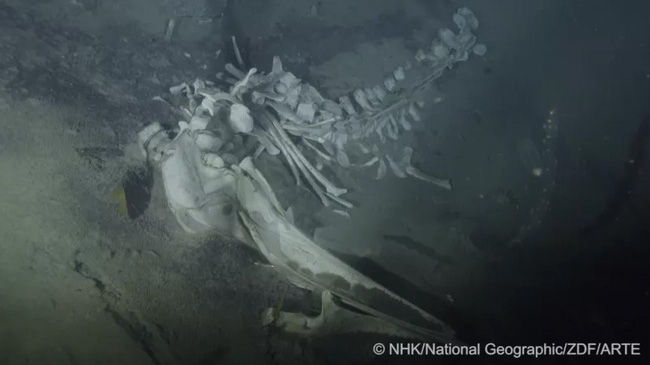
Whale carcasses have been a food source for many marine creatures for many years. (Photo: NHK).
According to experts, whale carcasses usually go through four stages of decomposition after falling to the seabed. In this case, the whale carcass in the picture is at the end of stage 2. During this stage, most of the soft tissue has been digested by large scavengers, but its skeleton still has some remaining tissue that attracts smaller animals.
There is still much to learn about whale graveyards, including many species that are unknown to science. However, opportunities for underwater diving in Antarctica are few and far between, so discovering a feast around a dead whale is a rare occurrence.