The disappearance of this animal made scientists extremely regretful.
In 1918, Lord Howe Island, located between Australia and New Zealand, suddenly had an "incident" after the sinking of the Makambo ship. That was when black rats escaped from this ship began to invade and disturb the island. The rats multiplied out of control and wiped out many native species, including the Lord Howe stick insect .
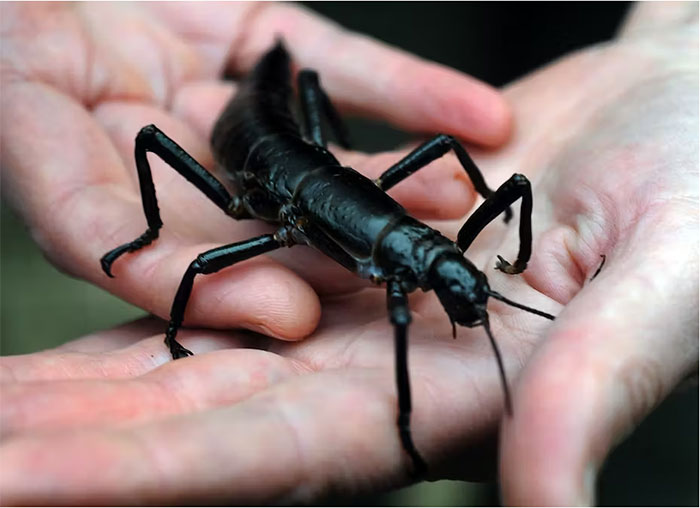 Lord Howe stick insect. (Photo: NYT)
The disappearance of the Lord Howe stick insect has caused great regret among scientists because they are considered one of the strangest insects in the world.
What are Lord Howe stick insects? Why are they of such interest?
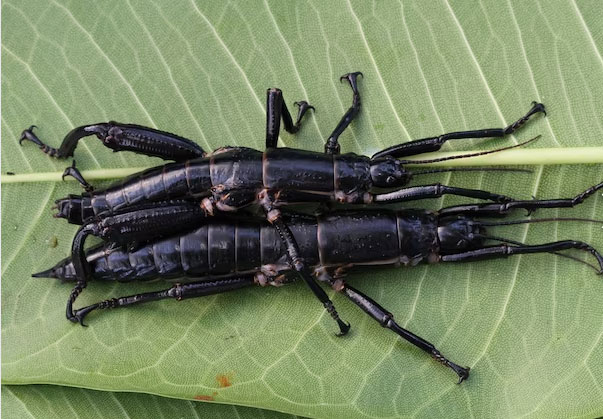
This is one of the strangest insects in the world. (Photo: NYT)
The Lord Howe stick insect (scientific name Dryococelus australis), also known as the "tree lobster" , is a species of insect that lives on Lord Howe Island.
According to The Conversation , the Lord Howe stick insect belongs to a group of ancient invertebrates, nicknamed "Jurassic insects" . They are flightless, about 15 cm long, and weigh about 25 grams. Males are smaller than females and their hind legs are more curved, spiny, and muscular. Males often show affection for females by using three legs to wrap around them to protect them when they go to sleep.

The Lord Howe stick insect is also known as the "tree lobster". (Photo: NYT)
They usually feed on plants at night and hide during the day in nests made of plant debris or shrub roots. In the nest, they huddle together to protect themselves from predators. Sometimes they can appear in dozens of places at once, as if huddled together.
The females lay eggs while hanging from tree branches. The eggs hatch nine months later. The young stick insects are bright green and active during the day, but as they mature they turn black and are active at night.

Baby stick insects are bright green and active during the day. (Photo: NYT)
In 2001, scientists found a small population of about 20 small insects that looked quite similar to the Lord Howe stick insect on Ball's Pyramid Island , about 23 km off the coast of Lord Howe Island. Initially, scientists mistakenly thought it was a similar-looking stick insect.
Ball's Pyramid is a cork island, a remnant of a shield volcano and caldera. The island is 562 meters high while being only 1,100 meters long and 300 meters wide, making it the tallest volcanic rock in the world. The island has steep, eroded terrain, extremely harsh living conditions, and a lack of food, but the stick insects continue to live here.
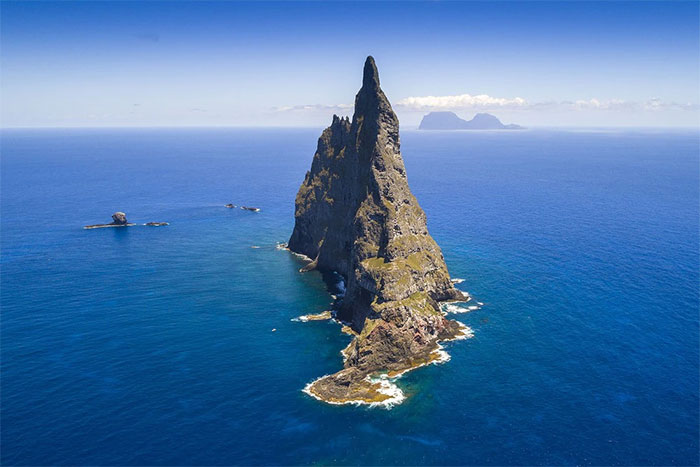
In 2001, scientists found a small population of about 20 tiny insects that look a lot like Lord Howe stick insects on Ball's Pyramid Island. (Photo: Atlas Obscura)
How they got to the top of the island remains a mystery, but scientists have captured four of them for breeding. They have compared their DNA with that of museum specimens. The results have confirmed that the stick insects found on Ball's Pyramid are indeed Lord Howe stick insects. Thus, the Lord Howe stick insects have been "resurrected" in a spectacular way, and they have delighted scientists.
The two Lord Howe stick insects on Ball's Pyramid were named "Adam and "Eve" and sent to Melbourne Zoo for breeding. In 2003, a team from the New South Wales Department of Wildlife and National Parks returned to Ball's Pyramid and collected two more breeding pairs, one of which was sent to a private breeder in Sydney and the other to Melbourne Zoo.
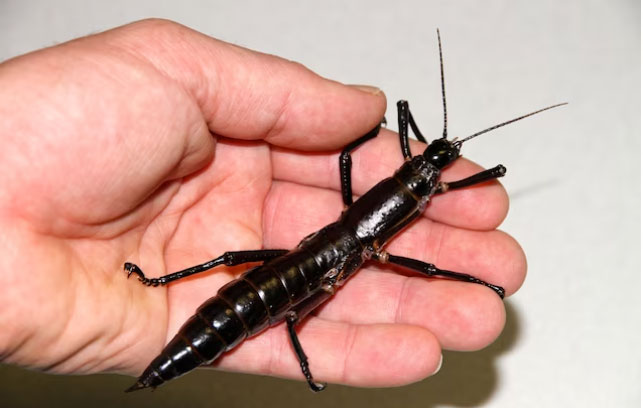
The Lord Howe stick insects have made a spectacular "resurrection" and they have delighted scientists. (Photo: NYT)
After initial difficulties, they have successfully bred them in captivity in Melbourne. The ultimate goal is to produce large numbers of Lord Howe stick insects for release back to Lord Howe Island after the successful eradication of the invasive rats.
By 2006, the captive population was around 50 individuals and thousands of eggs waiting to hatch. By 2008, the population had increased to 11,376 eggs and 700 offspring. Most of them were kept at Museum Victoria and at the San Diego and Bristol zoos. Twenty stick insects were later released into a special habitat on Lord Howe Island.
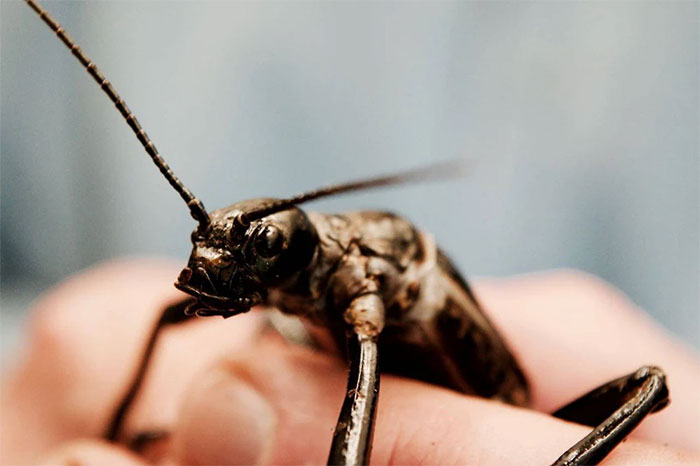
Twenty stick insects have been returned to a special habitat on Lord Howe Island. (Photo: NYT)
Commenting on this "resurrection", evolutionary biologist Alexander Mikheyev of the Okinawa Institute of Science and Technology, Japan, said: "The insects on Lord Howe Island have become a symbol of the fragility of the island's ecosystem. Unlike most stories of extinction, this discovery gives us a second chance."