Space science
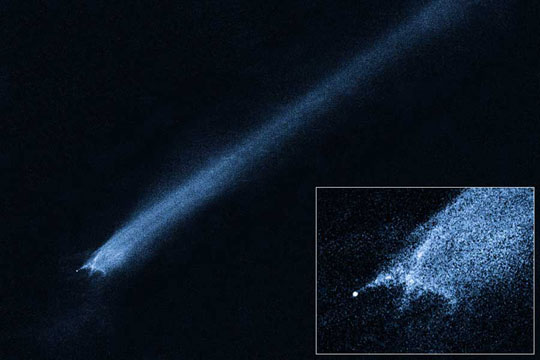
Celestial Body P / 2010 A2 is just a fake star
Through comet probe Rosetta, scientists have verified that the new celestial body called P / 2010 A2 is a broom star.
Browse ScienceInfo articles and explainers related to Collision.
417 published items.
Through comet probe Rosetta, scientists have verified that the new celestial body called P / 2010 A2 is a broom star.
When twin stars revolve around each other, they can alter the orbits of the surrounding planets and cause terrible collisions.

Compared to previous research on Earth's age, scientists from Cambridge University (UK) have confirmed the green planet is younger than 70 million years ...

A meteorite will fly close to the earth tomorrow but not collide with our planet.

Scientists at the European Center for Atomic Research (CERN) have created 10 million explosions in a large particle accelerator in a week.

The European Atomic Research Organization (CERN) has successfully conducted experiments to create a direct collision between proton particles producing extremely large e…

On March 11, American paleontologists introduced a new hypothesis about the mass extinction cycle of life on Earth.

We know that meteorite collisions can cause great catastrophes for the Earth as a cataclysm. But it seems that the Earth can also attack in reverse.

We will be crushed before we hear an explosion if a meteorite with a diameter greater than 50 m plunges into the green planet.

Based on an image taken by the Hubble Space Telescope, scientists believe that collisions in the universe are no longer hypotheses.

The US Aerospace Agency (NASA) announces an object will approach the Earth today, but does not collide with our planet.

The Russian Space Agency can launch a spacecraft to space to deflect the orbit of a large meteorite capable of colliding with the globe.

A galaxy that humans cannot see collides with the Milky Way but it retains its shape.

At a November 3 space conference in Omaha, Nebraska, the US military warned of an increased risk of collisions between satellites in the universe.

Scientists were stunned to learn that a meteorite flew nearly 14,000 kilometers from Earth last Friday but they only discovered it before 15 hours.