Among the secrets to longevity of the people of the land of cherry blossoms, sitting on the floor has been proven to help people become healthier.
1. Improve digestion
This leg position increases blood flow to the stomach, which helps digest food easily, so the body absorbs as many vitamins and nutrients as possible. When you bend down to pick up food and return to the original position, the abdominal muscles are strengthened and also prevent bloating.
2. Improve bone and joint quality
Your hips will get stiff if you sit in a chair for a long time, but sitting on the floor stretches your hips and ankles, making your joints more flexible. Sitting on the floor to eat actually encourages your muscles to work even when you are resting.
3. Flexible operations
Sitting in a chair for long periods of time can cause back pain and strain the discs in your spine, whereas sitting on the floor stretches your knees and hips, making you more comfortable. This position allows you to sit taller, prevents your body from sagging, and strengthens your back and shoulders.
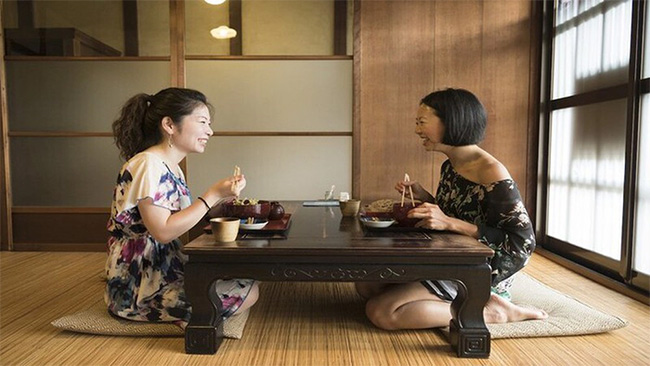
This leg pose increases blood flow to the stomach, helping in easy digestion of food.
4. Prolong life
The Japanese believe that sitting on the floor while eating and standing up several times a day can prolong your life. If you can easily stand up from a cross-legged position without any support, this proves that your health is still very good.
5. Supports weight loss
In this sitting position, the digestive system will produce a hormone called leptin, which helps send a signal to the vagus nerve that you are full, then this nerve will prevent further eating to avoid being overweight.
In addition, the Japanese secret to longevity through eating also includes:
Do not drink water while eating: To keep their health at its best, Japanese people often try not to drink anything while eating. Instead, they often supplement water with fruits, soups, vegetables. because they believe that adding water while eating puts a burden on the stomach, neutralizes stomach acid, and causes the body to lose more energy during the process of consuming food.
Food diversity: In 1985, the Japanese Ministry of Health, Labor and Welfare issued the "Guidelines for Healthy Eating and Living" and advocated eating 30 types of ingredients every day. Therefore, the typical diet structure of a Japanese family is as follows: cooked fish, sashimi or grilled fish, served with cold tofu, boiled vegetables, perilla, miso soup, seaweed, pickles. In particular, soy sauce is highly valued.
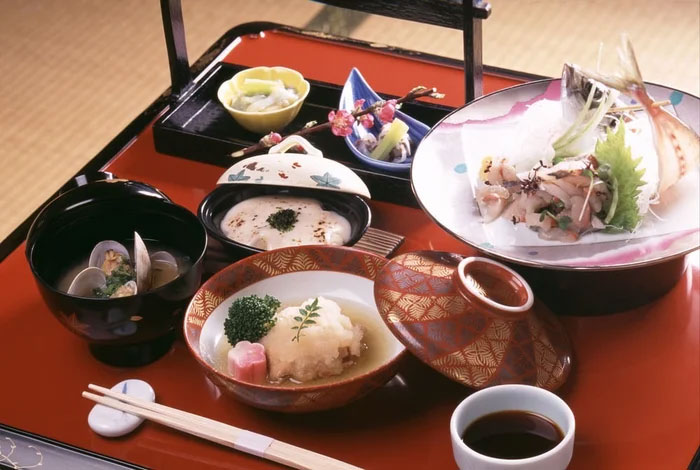
Japanese meal.
Focus on 3 main meals: For Japanese people, breakfast is the most important of the three meals. Therefore, Japanese women are very meticulous in preparing a variety of dishes for breakfast. Moreover, Japanese people rarely eat out, instead, they choose to bring lunch to the office or prepare rice for their children to ensure nutrition.
Rule 0.8: Originating from the concept of a Japanese doctor, this rule requires using 80% of the body's energy for daily activities and activities, while the remaining 20% is considered a source of energy for defense. Some cooking rules also apply this number 0.8 such as: season with 0.8 teaspoons of salt instead of 1 teaspoon, only eat 8 servings and then stop.