The sex of a fetus in humans and other mammals is determined by a male-determining gene on the Y chromosome .
However, the human Y chromosome is in decline and could disappear in a few million years, leading to human extinction unless we evolve a new sex gene.
The good news is that there are now two branches of rodents that have lost their chromosomes but are still doing well . The US National Academy of Sciences has just shown evidence of how spiny rats developed a new male sex-determining gene.
In humans, as in other mammals, females have two X chromosomes and males have one X chromosome and a small chromosome called a Y. The names have nothing to do with their shape; X stands for 'unknown'.
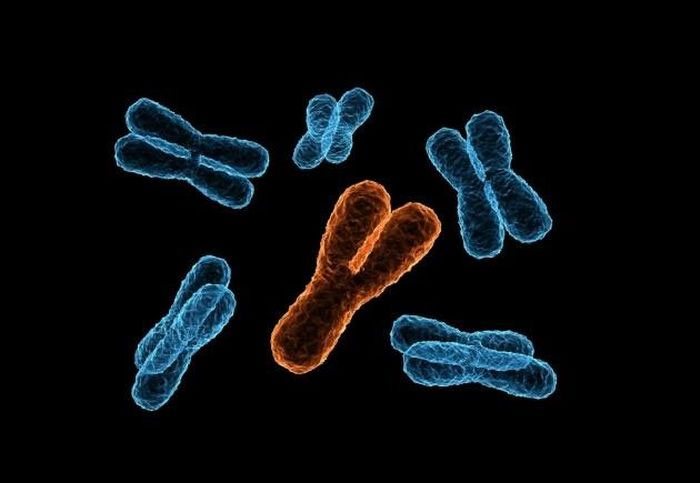
(Illustration: Nature).
The X chromosome contains about 900 genes that do all sorts of jobs that have nothing to do with sex. But the Y contains fewer genes (about 55) and a lot of noncoding DNA—simple repeats that don't seem to do anything.
But the Y chromosome is decisive because it contains a critically important gene that helps initiate male development in the embryo.
Around 12 weeks after conception, this master gene switches to other genes that regulate testicular development. The embryonic testicles produce male hormones (testosterone and its derivatives), ensuring that the fetus develops into a boy.
This major sex gene was identified as SRY (sex region on the Y) in 1990. It works by activating a genetic pathway that begins with a gene called SOX9 , which is key to male sex determination in all vertebrates, even though it is not located on the sex chromosomes.
Most mammals have an X and a Y chromosome similar to ours. An X has many genes and a Y has SRY along with a few other genes. The problem with this system is that the X gene dosage is not equal in males and females.
So how did such a strange system develop? Surprisingly, the Australian platypus has completely different sex chromosomes, more like those of birds.
In the platypus, the XY pair is just one autosome, with two equal elements. This suggests that in mammals, X and Y were once a normal chromosome pair.
In turn, this means that the Y chromosome has been decreasing in number over the 166 million years that humans and platypuses have been evolving separately: about 5 genes per million years. At this rate, the last 55 genes will be gone in another 11 million years.
Remarkably, rodents do not have a Y chromosome. The Eastern European mole rat and the Japanese spiny rat are typical species in which the Y and SRY chromosomes have completely disappeared. The X chromosome remains, in equal or double numbers in both sexes.
While it's still unclear how mole rats determine sex without the SRY gene, a team led by Hokkaido University biologist Asato Kuroiwa had better luck with spiny rats on the Japanese islands, all of which are endangered.
Kuroiwa's team found that most of the genes on the spiny mouse's Y had moved to other chromosomes. They also had a small difference near the important sex gene SOX9, on chromosome 3 of the spiny mouse.
This small piece of cloned DNA contains a 'switch' that activates SOX9 in response to SRY. When they introduced this clone into mice, they found that it increased SOX9 activity, so this change may allow SOX9 to function without SRY.
The disappearance of the human Y chromosome in the future has prompted speculation about our future.
Some lizards and snakes are female-only and can produce eggs from their own genes through parthenogenesis. But this cannot happen in humans or other mammals because we have at least 30 important genes that only work if they come from the father through sperm.
To reproduce, we need sperm and we need men, which means the end of the Y chromosome could spell the end of the human species.
But humans could evolve a new sex-determining gene. Such an evolution would come with risks. What if more than one new system evolved in different parts of the world?
Sexual 'gene wars' can occur that lead to the separation of new species, which is exactly what happened with mole rats and spiny mice.
So, on Earth in 11 million years, there are two scenarios. Either there will be no trace of any humans left, or several different human species separated by different gender identification systems.