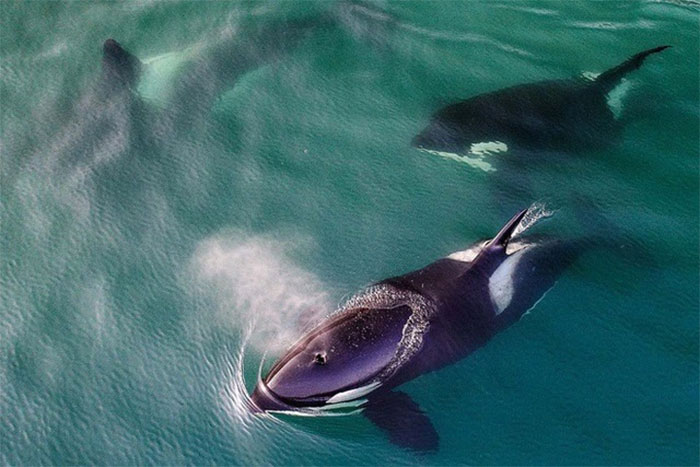
Many of us may think that killer whales have no eyes or that their eyes are the white spots on their heads. However, their eyes are extremely small and located below the white spots in front. These eyes are very small, completely disproportionate to the large size of their bodies and heads.
So why are killer whales' eyes so small? What do those big white spots on their heads do?

Killer whales, also known as great black dolphins or killer whales , are a species of dolphin belonging to the toothed whale suborder, a relative of oceanic dolphins. This is the largest whale subspecies in the family. In addition, they are also very good at intimidating other creatures, even daring to bully the great white shark, considered the ocean's god.
Why do killer whales have so small eyes?
In fact, not only killer whales, but almost all whales have small eyes that are disproportionate to their heads and bodies, such as the blue whale, the largest animal still living on the planet, whose eyes are so small that they are almost invisible compared to their body size.
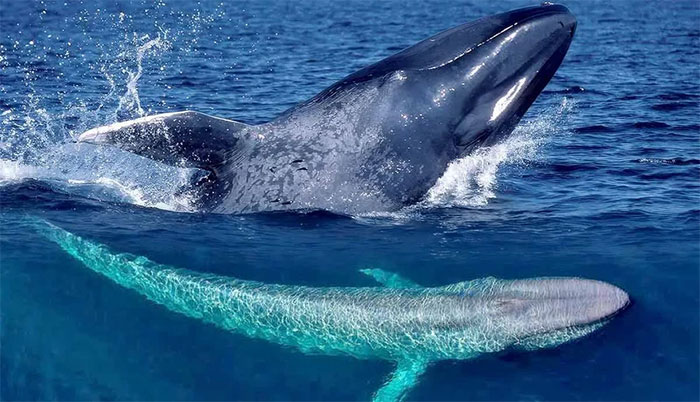
The blue whale, also known as the whale, is a species of whale belonging to the suborder Mysticeti. At 33.5 metres long and weighing 200 tonnes or more, it is the largest and heaviest animal that has ever lived. The body of the blue whale is long and slender, and can be slightly blue-gray on the dorsal surface and lighter on the ventral surface.
As the earliest ancestor of marine mammals, the ancient Pakicetus whale began evolving 50 million years ago. About 35 million years ago, primitive marine mammals developed eyes that could provide powerful underwater vision.
According to scientists studying whale eyes, they discovered a protein called "rhodopsin" that helps whales' eyes capture light better underwater and helps them find prey in the deep sea. It is clear that with such powerful underwater vision, whales would have to evolve to have larger eyes to develop this potential.
However, the eyes of whales are very small, and this is related to the environment they live in . Strong visual ability is important for survival in water, but strong vision with a pair of big eyes underwater has a deadly pink hole. Light will scatter and refract in water, in addition, this environment also has many different impurities, and the visual distance of animals in water is also very short, and this is not conducive to the foraging of large animals like whales.
In addition, most whale species live in groups, they have a great need for communication, so they need an organ that can not only locate prey from a distance but also communicate with each other. Therefore, they have developed an echolocation system , allowing them to "see" farther away, identify more surrounding objects without the need for eyes, and they can also communicate with each other using this system.

Baleen whales developed low-frequency echolocation, while toothed whales developed high-frequency echolocation, and these abilities have not only been reinforced through evolution. However, toothed whales rely on their foreheads to pick up sounds, while baleen whales rely on their ears to pick up sounds.
With such a "powerful" system, the whale's eyes would obviously no longer be useful. Even if they continued to evolve, the whale's eyes would still be limited by the environment, so compared to other organs, the whale's eyes would not evolve significantly over time. The eyes of small whales are like this because they have evolved other organs to compensate for the limitations of their eyes in the aquatic environment.
The mystery of the white spots above the eyes of killer whales
Killer whales have small eyes, but next to them are large white spots, so from a distance these two white spots look more like its eyes. So what is the function of these eye spots?
Some scientists believe that the white spots on the whale's eyes are actually there to protect their eyes , although the killer whale's eyes are not as important as the echolocation system, but they are still indispensable.
Although they have a very cute appearance, they are not a gentle animal, moreover, they are considered to be the fierce gods of the ocean.
As carnivores, killer whales will hunt and kill many marine creatures, including seals, sea lions, and other animals that are more agile and capable of injuring the killer whale's eyes, so this large eye spot may confuse other animals and prevent them from attacking the real eye.
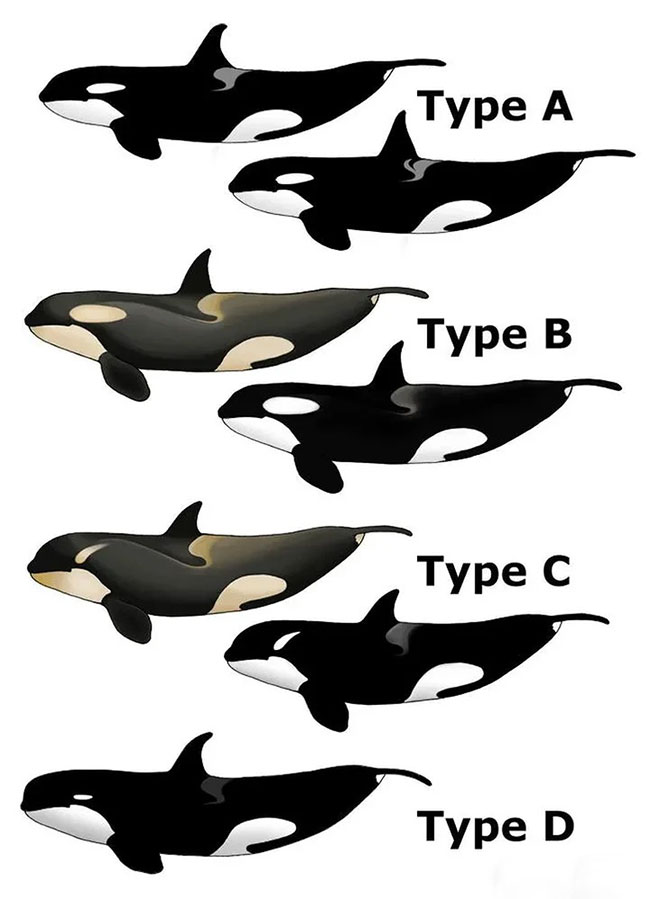
This hypothesis sounds reasonable, but it is not entirely correct. First of all , killer whales are marine mammals with a very wide distribution range. According to current scientific classification, killer whales can be divided into 4 types (A, B, C, D). These 4 types of killer whales generally have the same shape, but there are big differences in eye spots.
Second, the hunting preferences of these four types of killer whales are also very different and moreover, according to biologists' observations, killer whales have very few scars around the eye spots because the prey attacked by killer whales is often torn apart quickly and has absolutely no chance of attacking the head and eye area of the killer whale.
This animal also possesses an extremely high IQ and is capable of defeating many creatures on our planet. After all, the killer whale is not a simple creature at all.
What are the killer whale's big eye spots for?
Since this is a common feature among all killer whales, it must have some function that is essential to the survival of the killer whale. Given the ecological niche of this animal, biologists believe that the eyespots may be related to hunting activities.
Overall, killer whales have a black back and a white belly, which is a good camouflage color in the water environment. For example, when killer whales swim above, animals below can see the killer whale's white belly blending with the white of the sea surface, which allows killer whales to hide better, thereby increasing the success rate when approaching prey.
When killer whales swim in the middle or deep sea, marine life above sees the killer whale's black back, almost blending in with the dimly lit deep sea environment.
The big white spot on the eye is the same, look at the side of the killer whale, when the killer whale is close to the prey and the prey is at the same depth as it, its body will become more mottled in the eyes of the prey, and the prey is not easy to judge the size of the killer whale (most marine creatures only have black and white vision).