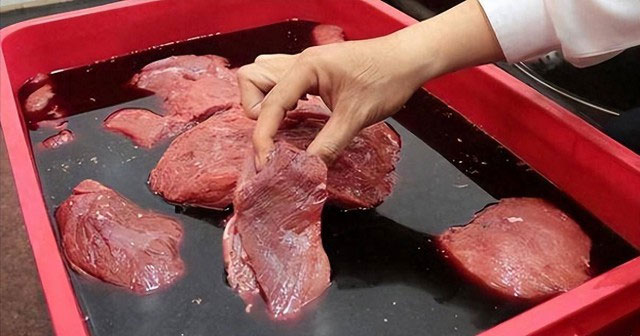
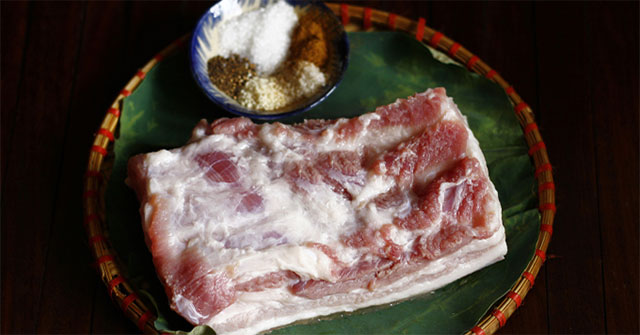
Associate Professor, Dr. Nguyen Duy Thinh, a food technology expert, said that any food has the risk of causing poisoning. Because food is food for people but also 'food' for microorganisms.
'If people want to avoid poisoning, they must prevent and limit the spread of microorganisms. If food is not preserved properly and microorganisms contaminate it, it will cause poisoning,' said Associate Professor, Dr. Nguyen Duy Thinh.
According to him, although any food has the risk of causing poisoning, protein-rich foods (meat) are more likely and more dangerous . All types of meat (raw meat, cooked meat) are very susceptible to infection .

All kinds of meat are susceptible to bacterial contamination.
In which, frozen meat and fresh meat are infected in principle the same . Associate Professor Thinh also emphasized that if fresh meat is not infected and then frozen, it is still good, but if fresh meat is infected, bacteria have accumulated, and toxins are in it, then even if put in the refrigerator, they will still be in there.
Salmonella bacteria grow slowly, so even if you put them in the refrigerator, they will still grow.
' If meat is contaminated with Salmonella , it will grow slower than if it is kept in the refrigerator, but faster than if it is kept in the freezer. If it is kept outside, it will grow faster than if it is kept in the refrigerator. The worrying thing is that Salmonella bacteria cannot be seen with the naked eye, so this bacteria is mainly prevented,' said Associate Professor, Dr. Duy Thinh.
According to him, with the naked eye, only some types of food contaminated with Ecoli and Coliform bacteria can be detected, causing odors (stink, rotten). If food is contaminated with these two bacteria, it will spoil more and more, but Salmonella does not cause odors or rotten odors.
'Therefore, this bacteria is mainly a precaution , if it is infected, it cannot be detected by the naked eye. Therefore, to prevent it, you must choose fresh meat, meat that has just been slaughtered, cleaned, wrapped and stored in the freezer if left for a long time, and eaten immediately, also kept in the refrigerator, which will greatly limit Salmonella infection' , Associate Professor, Dr. Nguyen Duy Thinh said.
Meanwhile, from his own eating experience, a nutritionist believes that to prevent food poisoning, especially in collective kitchens, the first thing to do is to control the input from the food purchasing stage to ensure safety (meat purchased in the morning is different from unsold meat in the afternoon) to the storage process (refrigerator, freezer) to ensure safety or not; then the processing is guaranteed to be cooked?.
Vegetables must also be washed thoroughly, at least 3 times under clean water . He also noted that people should eat foods in season to avoid the most chemical pesticides. Accordingly, vegetables and fruits (radish, bitter melon, carrots, kohlrabi.) should be used to avoid contamination compared to leafy vegetables.
Experts emphasize that Salmonella bacteria can penetrate very quickly through the small intestine into the bloodstream and cause rapid systemic effects. Especially for children with low resistance, poisoning will be much more dangerous.
Salmonella grows in the thawing water of frozen poultry, so it is absolutely necessary to strictly adhere to the principle of thoroughly cooking food, and absolutely do not freeze and refreeze food many times because Salmonella bacteria are very resilient and can easily reproduce in both hot and cold environments.