Most infectious diseases that were once deadly can now be prevented with vaccines or treatments, with the exception of a few dangerous ones like prion diseases.
Infectious diseases account for three of the top 10 causes of death according to the World Health Organization (WHO), causing millions of deaths each year globally. Nearly every infectious disease that used to be 100% fatal is now preventable with vaccines or treatable with modern medicine, according to Amesh Adalja, an infectious disease physician at the Johns Hopkins Center for Health Security. However, there are still deadly infectious diseases that humanity has not been able to solve . Some of these diseases are always or almost always fatal, while others have very high mortality rates.
For example, amoebic meningitis —or 'brain-eating' amoeba infection —is a rare infection that is almost always fatal. It spreads to the brain through the nose, often after a person has been exposed to contaminated water. In rare cases, people have been treated successfully, but scientists are still searching for better solutions.
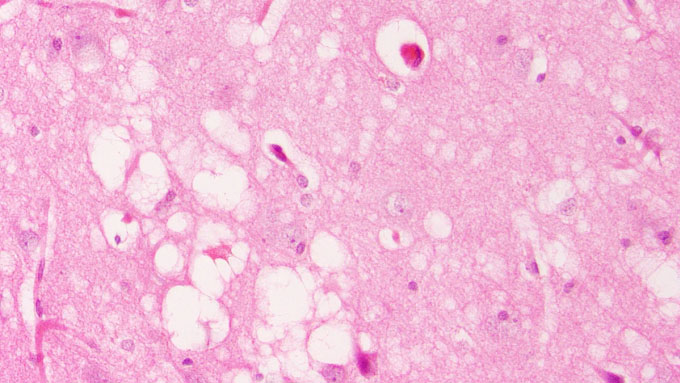
A form of prion disease called spongiform encephalopathy. (Photo: UCSF).
Some other rare diseases remain mysterious, such as prion diseases . These diseases are caused by misfolded proteins in the brain - called prions . They cause other proteins to misfold in a chain reaction, eventually causing brain damage and death.
Most prion diseases are not considered contagious. They result from inherited or spontaneous genetic mutations. However, in rare cases, people can become infected after eating meat contaminated with prions or being exposed to them during medical procedures, for example, Creutzfeldt-Jakob disease (vCJD) can be contracted after eating meat from cattle infected with 'mad cow disease,' or Kuru, a disease that occurs among the Fore people of Papua New Guinea.
'Prions have been studied for decades, but I think people are still trying to figure out the root cause,' says Rodney E. Rohde, an infectious disease specialist at Texas State University. Although extremely rare, prion diseases have one thing in common: Once infected, there is no cure, and death usually occurs within weeks of symptoms appearing.
What makes this disease so deadly? The evolutionary history of the disease is one reason. When a disease has infected human hosts for tens of thousands of years, the human body has worked hard to build up defenses against it, increasing the chances of survival. However, if humans are incidental hosts, or dead-end hosts—as is the case with rabies—the disease is not geared toward keeping humans alive, because humans are not the definitive host. In such cases, humans often have not yet developed the appropriate immune response to fight it off without medical help.
For example, rabies triggers an immune response in humans, but that response is not fast enough to defeat the virus before it reaches the brain and kills the host. 'Some pathogens are much worse and more vicious. They overwhelm the immune system and the body can't adapt,' Rohde says.