Scientists have created the 'world's largest family tree' linking some 27 million people around the world, including the living and the dead.
We've all flipped through family albums and learned about the mysteries of distant cousins and great aunts. Even snapshots of previous generations can take a long time to put together.
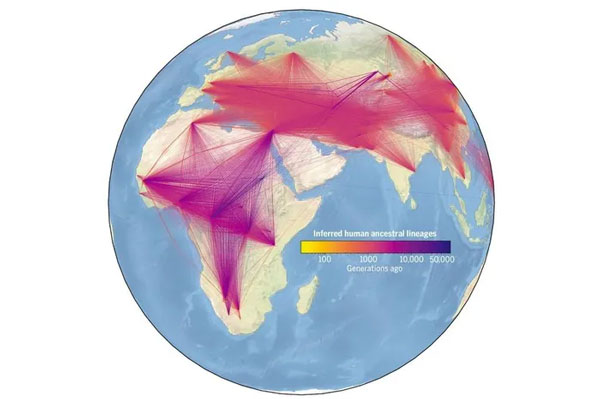
The world's largest family tree connecting 27 million people reveals interesting things
So, a huge dataset like this is only possible thanks to the efforts of so many people who spend hours on research with a little love and passion.
British scientists at the University of Oxford's Big Data Institute have created "the world's largest family tree" linking together 27 million people including the living and the dead around the globe.
The study is an important milestone in the journey towards mapping the full spectrum of human genetic relationships.
"This pedigree helps us see how each person's genetic sequence is related to each other, along with all the points," said Yan Wong, an evolutionary geneticist at the institute, who co-authored the study. of the genome".

The family tree shows how people around the world are related to each other in an "unprecedented detail".
The first humans to appear in the genealogy date back to before Homo sapiens, living in what is now Sudan, more than a million years ago.
The "family tree" increases the traceability of people's genetic diversity, creating a complete map of how individuals around the world are related to each other, the researchers say. how.
The scientists integrated data on modern and ancient human genomes from eight different databases, including 3,609 individual genome sequences from 215 populations.
Ancient genomes with many samples found around the world range in age from 1,000 to more than 100,000 years.
Dr Anthony Wilder Wohns, lead author of the study, said: "We're essentially reconstructing the ancestral genome and using it to form a vast network of relationships."
And who knows, maybe in the coming years you'll see larger genealogical trees with so deep roots that connect all the people in the world.