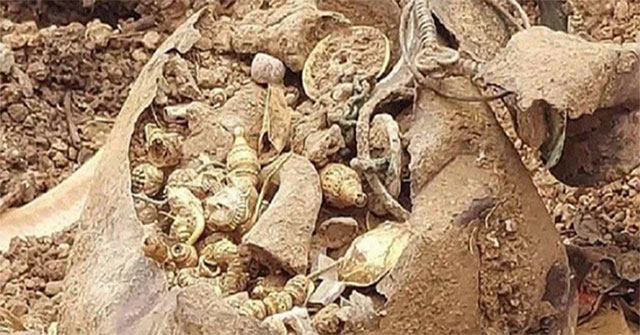
Archaeologists in Egypt have unearthed the 3,200-year-old remains of a military barracks containing a wealth of artifacts, including a hieroglyphic sword bearing the name of Ramesses II , the pharaoh of ancient Egypt.
The structure contained a series of chambers used for storing grain and ovens. The team also found remains of pottery containing animal bones, including fish. Several cow graves were also unearthed at the site, said Ahmed El Kharadly, an archaeologist at the Egyptian Ministry of Tourism and Antiquities who is leading the excavation at the site.
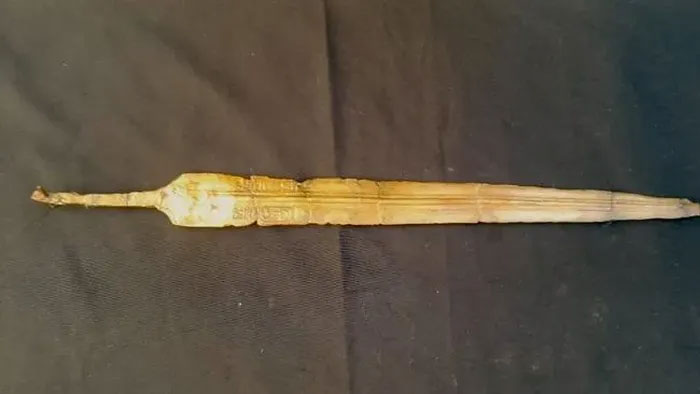
The long sword bears hieroglyphs referring to Ramesses II. It was likely given to a high-ranking officer. (Photo: Egyptian Ministry of Tourism and Antiquities).
The cow symbolizes strength, abundance and prosperity.
Cows in ancient Egypt symbolized 'strength, abundance and prosperity, as they were revered as heavenly deities,' the Egyptian Ministry of Tourism and Antiquities said. However, El Kharadly said that in this case, the cows would have been eaten. He noted that the cow bones were found in a silo area near an oven, 'which confirms that they could have been divided into several parts and then stored in the silo after drying,' El Kharadly said.
In addition, archaeologists discovered weapons, including a bronze sword inscribed with the name of King Ramesses II (reigned around 1279 to 1213 BC). The sword was found in a small room in the camp, near an area where enemies might have tried to enter, an indication that the sword was used for fighting and not just for display, El Kharadly said.
Bronze Sword, the King's Generous Grant
The ancient Egyptians placed the camp along a military road in the northwest of the Nile Delta. Its location would have allowed the army to confront groups entering the Nile Delta from the western desert or from the Mediterranean Sea, the statement said.
'This is an important discovery for understanding the strategy and especially the logistics of the Egyptian army under Ramesses II ,' said Peter Brand, a history professor and director of the Karnak Great Hypostyle Hall Project at the University of Memphis in Tennessee. Other military sites built by Ramesses II, such as fortresses, have been found in northwest Egypt, but they are not as well preserved as this one, said Brand, who was not involved in the excavation.
'The weapons demonstrate that the site was well equipped and that some weapons could even be produced on site,' Brand said. The bronze sword was likely given to a high-ranking officer as a royal reward. The king's name and title were engraved on it, increasing the owner's prestige and advertising the king's wealth, power, and generosity.