Throughout Earth's history, humans and their hominid relatives are believed to be the only animals known to create and use stone tools, according to archaeological records.
This is known as the Stone Age - a prehistoric period that lasted approximately 3.4 million years and ended around 8700 BC to 2000 BC, with the advent of metal tools. During this period, stone was widely used to create tools with sharp edges, pointed tips, or a face for striking. Stone tools were made from a variety of different types of stone. For example, flint and chert were sharpened (or chipped) to make cutting tools and weapons, while basalt and sandstone were used to make tools, such as grinding stones.
With the advantage of tools, along with superior intelligence and population, humans took the top position in the food chain. Animals that once considered humans as prey or large animals that could harm our ancestors were eventually subdued. It can be said that learning to use stone tools was the beginning of human intelligence.
However, the latest discoveries show that the number of animals that knew how to make stone tools and were in the Stone Age was greater than we thought.
Primates are in the Stone Age
Chimpanzees (Pan troglodytes) have been using tools such as hammers and anvils made of stone for millennia. According to research published in 2007 in the journal Proceedings of the National Academy of Sciences, chimpanzees in Ivory Coast were using these tools 4,300 years ago.
Thus, the Stone Age of Chimpanzees even predates the emergence of settled, agricultural human villages in areas of the African rainforest.
For more context, see East African chimpanzees have literally entered the Stone Age..

Capuchin monkeys are in their own 'Stone Age,' as they've been spotted using stones as tools. Here's a Capuchin monkey cracking open a coconut with a stone. Photo: Dorit Bar-Zakay / Getty Images
Capuchin monkeys (Sapajus libidinosus) in Brazil have also been using stone tools to grind nuts for 3,000 years. The style of their stone tools has changed over the millennia in response to different types of food, according to findings published in the journal Nature Ecology and Evolution.
Meanwhile, a team of researchers found stone tools used by Burmese long-tailed macaques (Macaca fascicularis aurea) to open seashells on a beach in Thailand, which may have been used between 1950 and 2004.
Overall, given its rather crude appearance, a stone hammer made by a chimpanzee would hardly compete with the sophistication of an ancient human hand axe. But that's not the point. These primates had developed a culture that regularly used stone tools. That means they were well into the Stone Age.
Why do primates know how to use stone tools?
At present, researchers are still unclear as to why these primates can learn to use stone tools . In each primate species, tool use is thought to be a social behavior learned from parents and other members of the group.
In the case of chimpanzees, the primitive stone tools suggest that their behavior was inherited from the common ancestor of humans and chimpanzees. However, it is also possible that humans and chimpanzees learned to use stone tools independently. The same is true of other animal species that use stone tools.
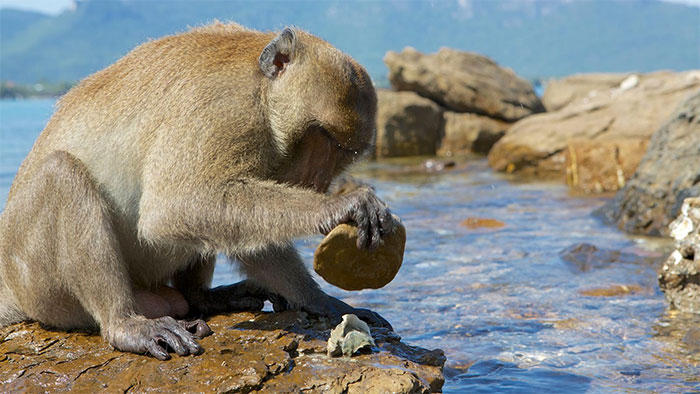
These primates developed a culture that regularly used stone tools, meaning they had entered the Stone Age.
Interestingly, different primate groups themselves use different types of stone tools. For example, some chimpanzee groups use a hammer made of stone to crush nuts, which is placed on an anvil also made of stone.
It must also be said that the fact that an animal species entered the "Stone Age" does not mean that it will soon follow the evolutionary and developmental trajectory of humans , as we enter the Bronze Age, the Iron Age and finally reach the information age that we live in today.
It also doesn't mean that animals that use stone tools are smarter than other animals. Instead, other animals can make similar tools from wood or leaves.
In the case of humans, although the term Stone Age is named after the surviving tools, in reality, we "did not use stones alone as tools".
Other animals are also 'Stone Age' animals. Chimpanzees, for example, use long strips of bark to catch termites. They also use medicinal plants to treat wounds. In many cases, the tools made from plants are actually more complex.
After primates, researchers hope to shed light on the history of another stone tool-using animal: the sea otter . Researchers have observed sea otters cracking mussel shells on rocks, which means the number of Stone Age animals will increase in the future.