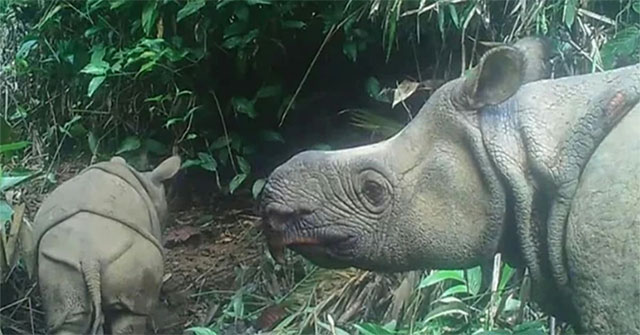
An expedition to Papua New Guinea has captured the first photos and videos of black-necked pigeons after 140 years of "disappearance" .
In a world where we constantly hear about extinction and endangered species, it's heartening to know that animals thought to have long since disappeared sometimes reappear.
Take the example of the black-necked pigeon , first described in the late 19th century and not seen for over 140 years. But now, a bird-finding team has filmed this species on Fergusson Island, a rugged island in the D'Entrecasteaux archipelago off the eastern coast of Papua New Guinea.
The photographs and videos taken by the researchers mark the first time this bird has been scientifically documented since 1882. Ornithologists know very little about the species, but they believe that the population on Fergusson Island is small and declining.
The research team captured images of this rare bird using remote-controlled camera traps at the end of a month-long search in Fergusson.
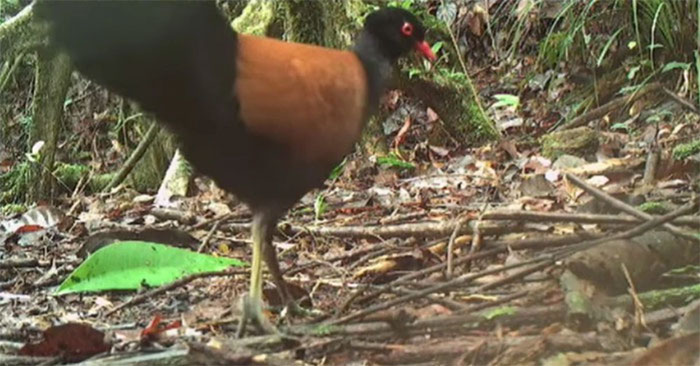
This is the first time this bird species has been scientifically documented since 1882.
The black-necked pheasant, also known as the black-necked pheasant (Otidiphaps nobilis) , is a large, terrestrial pigeon species. Pheasants are found in the primary rainforests of New Guinea and neighboring islands. They are primarily distributed in mountainous areas, but can also be found in lowlands.
"As we were collecting the camera traps, I noticed there was less than a one percent chance of getting a picture of a black-necked pigeon, " said Jordan Boersma, a postdoctoral researcher at Cornell University and co-leader of the expedition. " Then, as I was reviewing the photos, I was stunned by the picture of this bird walking right past our camera."
John C. Mittermeier, director of the Lost Birds program at ABC and co-leader of the expedition, added: "After a month of searching, seeing the first photos of the black dove is like a miracle. It's the moment you dream of your whole life as a conservationist and bird observer."
The expedition team arrived in Fergusson in early September 2022 and spent a month traveling around the island, interviewing local communities to identify potential camera trap locations in the hope of finding black-necked pigeons. The search proved extremely difficult due to the steep, mountainous terrain of Fergusson Island.
"It wasn't until we reached the villages on the western slopes of Mt. Kilkerran that we began to meet hunters who had seen and heard the calls of this bird," said Jason Gregg, a conservation biologist and co-leader of the expedition .
A local hunter provided a clue as to where to find this rare bird. He told the group that he had seen the black-necked pigeon several times in an area with steep mountain ridges and valleys. He also described hearing the bird's distinctive call.
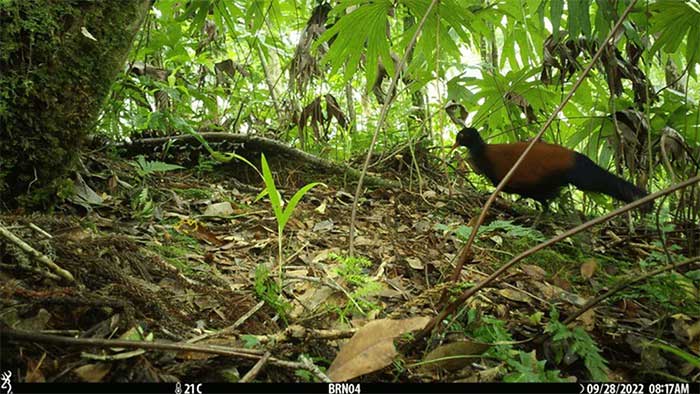
Images of black-necked pigeons have been captured.
Following the hunter's advice, the team set camera traps at the designated location where they found them in the dense forest. As part of the research, this was the first time camera traps had been set on Fergusson Island. A camera placed on a hillside at an altitude of 3,200 feet (1,000 meters) near the Kwama River eventually captured an image of a black-necked pigeon walking against the forest floor.
Doka Nason, a member of the team that set up the camera traps, said: "We found the black-necked pigeon in the final hours of the expedition. When I saw the photos, I was incredibly excited."
Researchers' findings suggest that the black-necked pigeon is potentially extremely rare . The rugged, inaccessible forest where they rediscovered the species may be its last home on the island as its habitat is declining.
According to Gregg, a researcher on the team, logging by foreign corporations poses a growing threat to the birds living in the forest. In addition, feral cats could kill pheasants and pigeons, just as they often do to other bird species on the island.
According to Australian scientists, small to medium-sized birds, ground-nesting and foraging birds, and birds living on remote islands or in arid regions are the top targets. Millions of birds in the country are killed by feral cats every day.
Preserving long-extinct bird species requires thorough understanding of their population activity and status, as well as the implementation of conservation projects to protect their habitats. Local people must be the main actors in conservation efforts.
"It's part of their history and culture. If we lose this bird, its cultural significance and its role in the ecosystem will also be lost. Not just in Fergusson, but in any part of the world, the conservation of rare species completely depends on the communities living there ," Boersma said.
The discovery of the black-necked pigeon has given researchers renewed hope of finding other bird species that have not been seen for decades and exist all over the world.
The black-necked pigeon resembles the pheasant in external morphology, particularly in its tail, which is flattened to the sides, and its rounded wings. They have a glossy black head, underside, back, and lower back; short, rounded brown wings; and a nape that is white, green, gray, or black depending on the subspecies.
No pheasants are found in New Guinea, and the pheasant pigeon has filled the ecological niche of these species. It is a very rare species, feeding on seeds and fallen fruit. This bird usually nests on the ground beneath trees and bushes. They typically lay only one egg and incubate it for about four weeks. Both the male and female birds incubate the egg and care for the chick.
It is believed that this species is declining due to deforestation shrinking its habitat. The black-necked pigeon was for a long time only known to science from a typical specimen collected in 1882, but was rediscovered on Fergusson Island in late 2022.