Just as the Earth's land surface has huge peaks and valleys, the ocean world has similarly varied terrain .
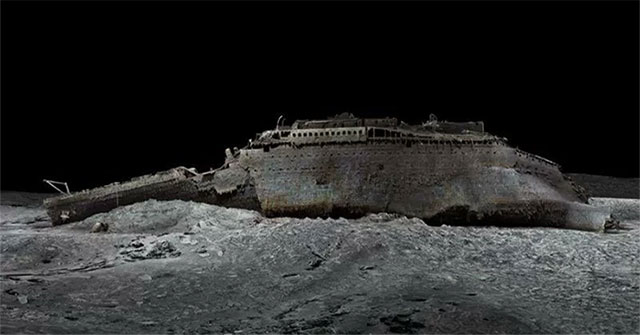
One of the most fascinating and fascinating places on the ocean floor is the Mariana Trench , a fissure in the western Pacific Ocean that stretches for more than 1,580 miles (2,540 km), and is home to the Challenger Deep , the deepest known point on Earth, at about 11,000 meters (36,000 feet) below sea level. For comparison, that's nearly three times deeper than the wreck of the RMS Titanic in the Atlantic Ocean and deeper than Mount Everest is tall. Here are some fascinating facts about the deep.
Related reading: What's in the deepest place on Earth?.
'Titanic' director is one of the few people to have explored the Challenger Deep
There have been very few human expeditions to the Challenger Deep. The first expedition in history to the deep took place in 1960, with the Trieste - a spherical submersible.
During their dives, explorers Jacques Piccard and Don Walsh said they were amazed to see living creatures in a place where scientists had thought nothing could exist.
Following Jacques Piccard and Don Walsh, James Cameron, director of the 1997 film "Titanic", was the next person to explore the Challenger Deep. In a submersible he helped design, James Cameron reached a depth of about 10,908 meters, setting a world record in 2012.
A plastic bag found in the Challenger Deep
Another explorer who has returned to the site is Victor Vescovo, who set a world record by diving to 10,927 metres in 2019. Vescovo has offered a harrowing insight into humanity's impact on these seemingly inaccessible places, noting that he found a plastic bag and a candy wrapper at the bottom of the Mariana Trench.

Plastic bags found in Mariana Trench.
After Victor Vescovo, a few more explorers have explored the Challenger Deep. However, very few expeditions to this location have been organized, due to its dangerous nature.
According to the National Oceanic and Atmospheric Administration (NOAA), for every 10 meters (33 feet) of depth a dive goes below the ocean's surface, the pressure on an object increases by 1 atmosphere. An atmosphere is a unit of pressure, equivalent to 6.4 kilograms per 6.5 square centimeters. A trip to the Challenger Deep could put a submersible under "the equivalent of 50 jumbo jets" of pressure.
Located in an area named after the god of the underworld
Like the Earth's atmosphere, the ocean can be described in layers. According to NOAA, the top layer is called the sunlit zone and extends just 200 meters below the surface.
The mesopelagic zone , or twilight zone, extends from the end of the sunlight zone to about 1,000 meters. This is followed by the bathypelagic zone , or midnight zone , and the abyssopelagic zone, or abyssal zone —which extends from 4,000 meters to 6,000 meters.

A hydrothermal vent on the sea floor.
In the abyss, very little life can survive. Sunlight cannot penetrate, and temperatures are near freezing. But the Challenger Deep goes even deeper – into the hadalpelagic zone, or hadal zone . It is named after Hades, the Greek god of the underworld.
Home to unique aquatic life and mud volcanoes
The hadal zone is one of the least explored habitats on Earth. At record depths devoid of sunlight, it was long thought that nothing could survive there. But that notion has been dispelled.
'Even at the bottom, life exists. In 2005, tiny single-celled organisms called foraminifera , a type of plankton, were discovered in the abyss,' according to NOAA. Discoveries at the Challenger Deep include colorful rock formations and bottom-dwelling sea cucumbers.

Drum eye fish.
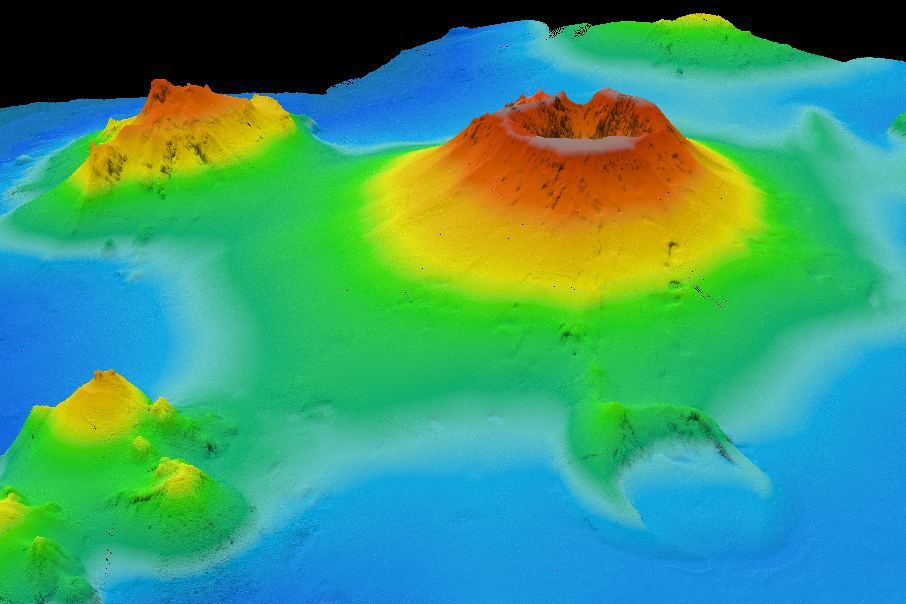
A series of undersea mud volcanoes and hydrothermal vents in the Mariana Trench also support unusual life forms, according to NOAA.
Although hydrothermal vents in volcanic ash spew out highly acidic hot water, strange species and microscopic organisms can still survive there. Despite the absence of sunlight, organisms still benefit from the nutrient-rich water that escapes from hydrothermal vents. The life-supporting environment is the result of chemical reactions between seawater and magma rising from beneath the ocean floor.
The exact depth of the Mariana Trench is still unknown.
The ocean floor remains one of the most mysterious places to humans. In fact, maps of the Moon and Mars are much more detailed than maps of Earth's seafloor.
Although humans have been exploring the ocean surface for tens of thousands of years, only about 20% of the seafloor has been mapped, according to NOAA data from 2022. However, with interest in the Mariana Trench high, researchers have made several efforts to develop increasingly detailed pictures of its features.
But it's not easy: Because of the vastness and depth of the ocean floor, scientists have to rely on sonar, or acoustic technology, to try to get a full picture of what's below. Thanks to constantly improving instrumentation and technology, the Challenger Deep's estimated depth was last updated in 2021 to be around 10,935 meters.