Appearing in many Hollywood horror movies, piranhas are portrayed as bloodthirsty, aggressive, and capable of terrifying destruction.
Piranha is a medium-sized freshwater fish that lives mainly in southwestern Brazil. Because of its sharp jaws that can tear apart its prey in an instant, piranha is also known as "blade-tooth fish".
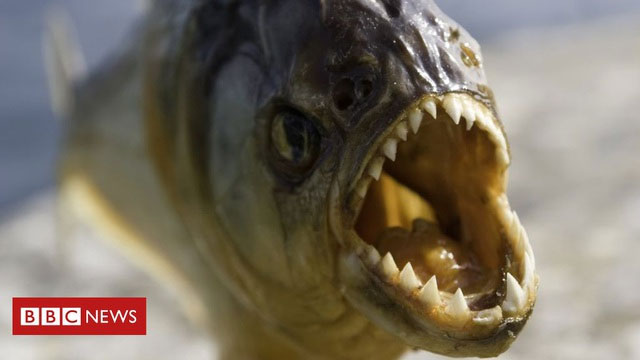
Close-up of the sharp jaws of a piranha.
This fish has existed on Earth for a very long time. Their fossils were found in South America, dating back about 25 million years. Meanwhile, the modern piranha we see today appeared about 1.8 million years ago.
Appearing in many Hollywood horror movies, piranha are portrayed as bloodthirsty, aggressive, and capable of destroying their prey at terrifying speeds. Therefore, when mentioning piranha, people often think of many scary things about this small creature. But how much of that is true?
There are more than 30 species of piranhas living in the Amazon River basin . Most piranhas are considered bloodthirsty "devils" of the water. Although only about 20cm long, they have sharp fangs like saw teeth, strong bite force and the characteristic of living in groups. These are the things that make them one of the top predators in the Amazon River basin.
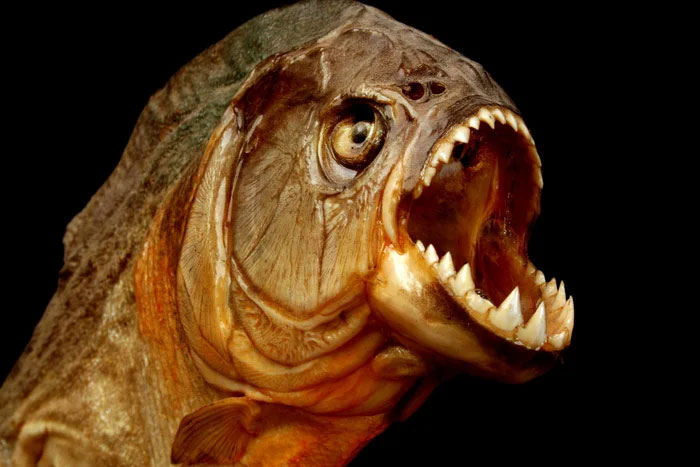
The piranha's lower jaw has sharp teeth protruding forward.
Piranhas can easily bite through 5-layer aluminum cans and can leave teeth marks on super hard beef bones, wherever there are schools of piranhas, there is a scary atmosphere.
In the vicinity of the Amazon River basin, there are many ferocious animals that make many people feel scared such as: electric eels, crocodiles, giant otters, anacondas, piranhas. and piranhas are the species that make many people feel the most scared.
The piranha's lower jaw has sharp, knife-like teeth that protrude forward, joining with the upper jaw to form a guillotine shape. When biting, these teeth can quickly cut through all the muscles of their prey.
Some species of piranha have two parallel rows of teeth in the upper jaw and only six large teeth protrude outward but have seven fangs hidden inside.
Like most fish, piranhas do not chew, and can tear off a three-centimeter square of flesh in one bite. With their ability to swallow quickly, piranhas can easily consume prey dozens or hundreds of times larger than themselves. In just over 10 minutes, a group of piranhas can turn their prey into a white skeleton.
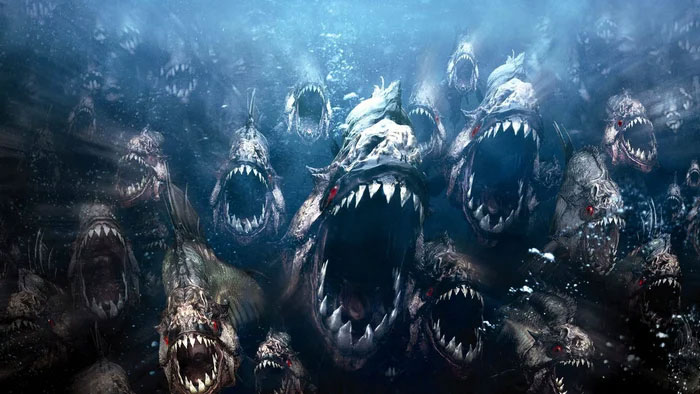
Like most fish, piranhas do not chew.
Piranhas have a thick back, looking from the side of their head like a steep mountain with super hard scales. These hard scales can play a very good role in protecting against friction and external impact, and these scales also have strong regenerative capabilities.
There are lateral lines on both sides of the piranha's body, which are important structures for them to sense water pressure and vibration frequency. One end of the lateral line is the external opening of the nervous system conductor in the fish's body, and the other end is sensitive sensory cells, so this is also one of the piranha's most important hunting weapons.
Piranhas are very sensitive to blood, fishy smells and rancid smells, because the nostrils above their mouths are made of mucous tissue. Therefore, when there is blood or rotting flesh in the water, piranhas will always be the first to notice.

Piranhas are very sensitive to blood.
During the breeding season, the body color of piranhas will change. Some species of piranhas that are originally red will turn their bodies into rainbow-like colors during the breeding season.
The female piranha will push the aquatic plants aside to clean the mud, then lay about 500 fish eggs in it, the male will swim up to the top of the fish eggs to fertilize, the fertilized eggs can hatch within two days. And a few days later, the baby fish can eat, the size of the baby piranha is only about 1cm and at this time they will eat insects, shellfish, small fish and shrimp.
Some species of piranhas are very cunning and do not care about their prey, when their prey is not alert, they will quickly attack. Sometimes piranhas also use aquatic plants to hide and attack their prey.
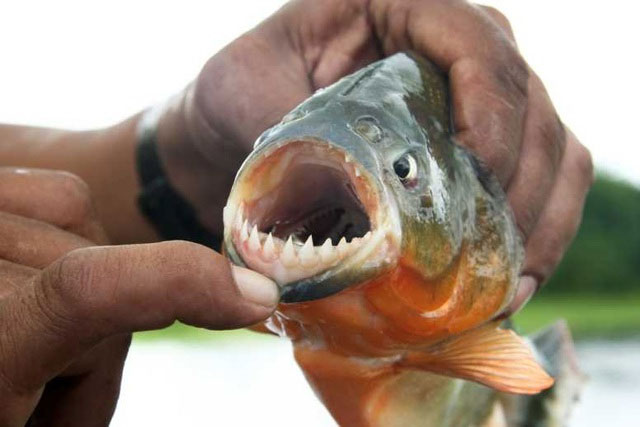
A piranha caught in the Amazon River.
In reality, piranhas do not like to eat people. They are not really dangerous to humans like in the movies, but are only "killers" with smaller prey.
In real life, piranhas are relatively calm. They are not particularly aggressive. Most of them eat insects, worms, small plants, or small fish in the rivers where they live. A few species of piranha are attracted by the scent of blood and will seek out prey of similar size.
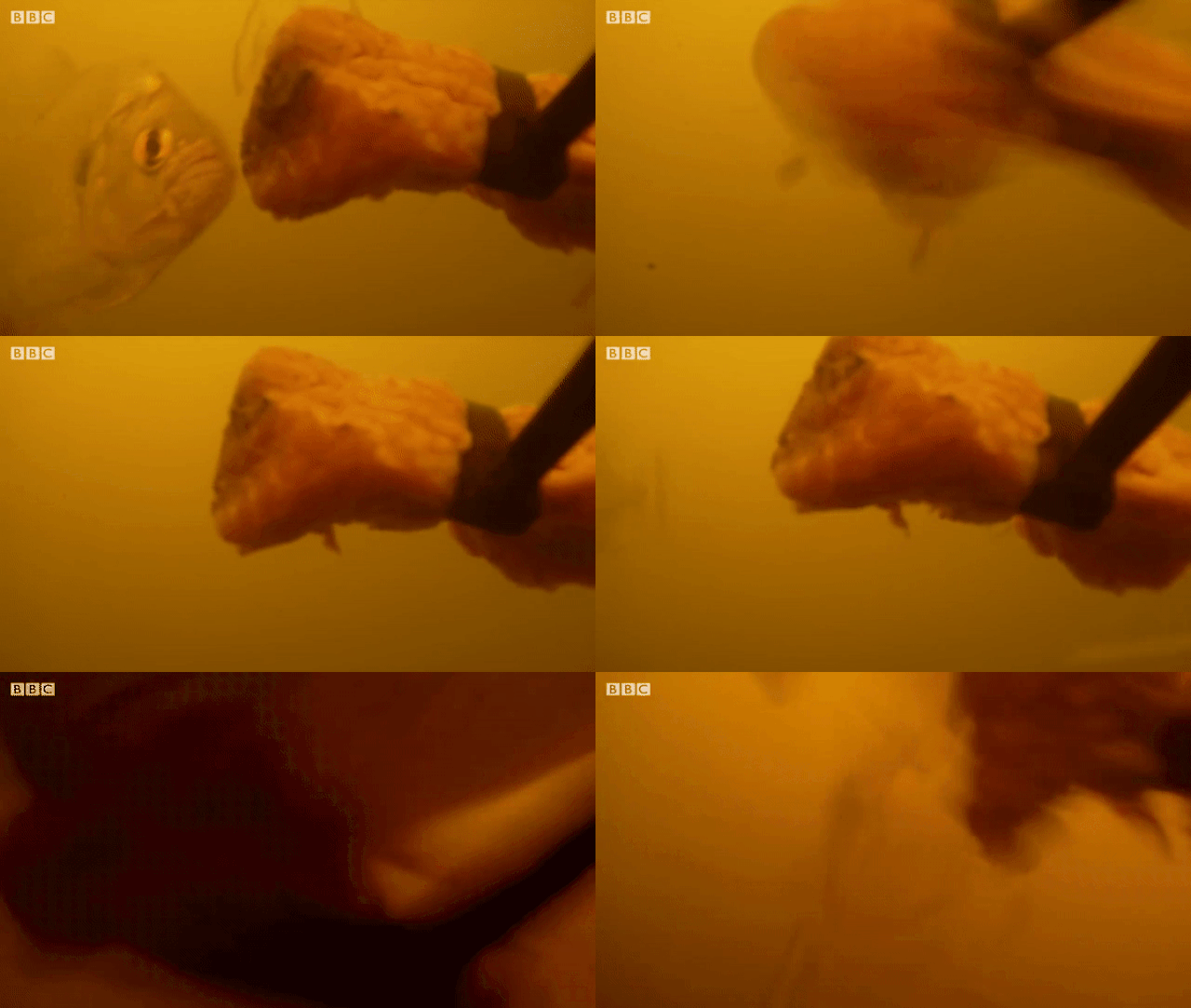
Watch a hungry piranha devour a piece of meat in seconds.
Previously, in a video recorded by BBC filmmakers, they tested the effect of dropping a piece of meat into a lake to see how the fish would react. The recorded images showed that, thanks to their especially sharp sense of smell, the piranha quickly discovered their "prey" and pecked at it at breakneck speed.
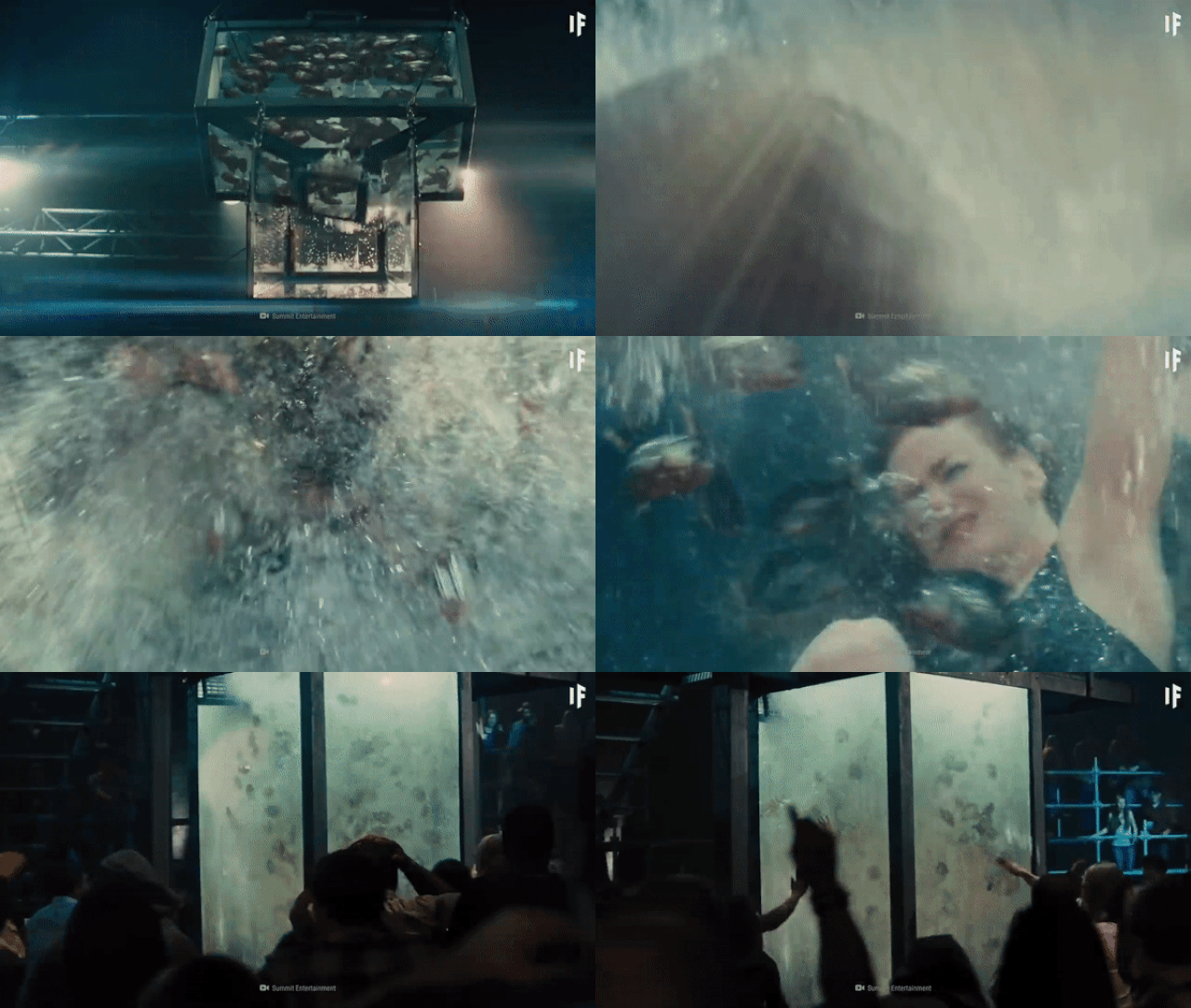
Hypothetical scene if you accidentally fall into a lake full of piranha.
Back to the original hypothetical question. What if you accidentally fell into a lake full of piranhas? In fact, you might even scare them away. Piranhas are not really interested in humans unless they are very hungry and the person is dead.
Today, many people still keep piranhas as ornamental fish, but for safety reasons, keeping piranhas in aquariums is still considered extremely dangerous, should not be attempted, and piranhas are an alien species, easily causing injury to humans and harming native ecosystems.
Piranhas, despite their gruesome name, have a positive side, they can help clean up dead animals in rivers and purify the water, some piranhas only eat fruit, can carry seeds to other areas, take root and germinate, and promote species diversity.
In addition, piranha meat is also very delicious, tastier than most fish, so local people like to catch them for dinner, the natives also use piranha teeth to make bows, knives, and even hair cutting tools.