The 2,000-year-old remains discovered at the Qin Shi Huang mausoleum complex belong to a strange chariot that appeared in Chinese legends and history.
According to the head of the archaeological team, Jiang Wenxiao, told China Daily, it was a chariot pulled by sheep. Archaeologists did not find the chariot, which was probably made of wood and had rotted after 2,000 years of being buried, but the skeletons of six sheep with the chariot's accessories were still intact.
Six sheep skeletons were found in the "western tomb" area of the Qin Shi Huang Mausoleum in China's Shaanxi Province, a few miles northeast of Xi'an City.
Related reading: China suspended excavation of the tomb of Qin Shi Huang.
The excavation site is also close to the site of the famous "terracotta army" .
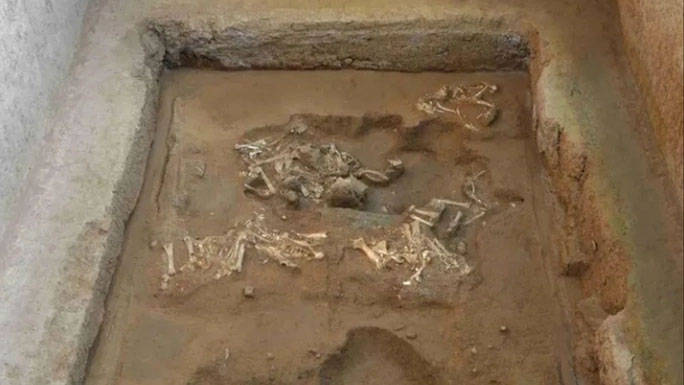
Remains of a sheep-drawn cart in the "western tomb" of the Qin Shi Huang mausoleum complex - (Photo: Dayoo News).
According to Mr. Wenxiao, horse-drawn carriages and ox-drawn carts were very common in ancient China, but sheep-drawn carts were extremely rare.
They appear only sparingly in Chinese history and legend, and are believed to have been a form of "love chariot" for the king.
Legend has it that the founder of the Western Jin Dynasty, Jin Wudi (Sima Yan), rode a sheep cart every night in the harem and would sleep wherever the sheep stopped.
According to Live Science , this story is the origin of the modern Chinese saying , "seeking fortune in a sheep cart." Because it is said that the Western Jin emperor had 10,000 wives, he had to use the method of randomly selecting them using a sheep cart.
Archaeologists who presented the unique discovery at the recent Chinese Archaeological Congress in Xi'an said they are still conducting laboratory analysis of some items taken from the western tomb and hope to identify the tomb's owner.
In addition to the six-sheep chariot, archaeologists also unearthed a four-wheeled wooden chariot believed to be a horse-drawn chariot , equipped with an ornate rectangular parasol.
Numerous bronze chariots and horse-related artifacts, iron tools and bronze weapons were also excavated in the same area, providing insight into the early Iron Age in ancient China.
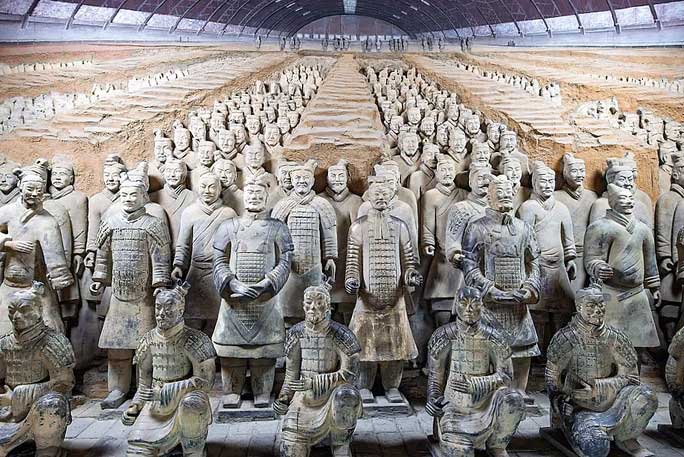
The Terracotta Army is the most notable relic in the Qin Shi Huang mausoleum complex - Photo: (Archaeology Wiki).
The entire mausoleum complex of Qin Shi Huang, the emperor who reigned from 221 to 210 BC, covers an area of 26 square kilometers and took 36 years to complete, according to ancient records.