Nearly 900,000 years after branching off from the common evolutionary tree of Homo sapiens - Neanderthals - Denisovans more than 1 million years ago, this "ghost human" quietly reunited and interbred with our ancestors.
A new study led by Dr. Sriram Sankararaman from the University of California, Los Angeles (UCLA) has found "ghost humans" mysteriously appearing in the DNA of four West African communities: the Yoruba and Esan people of Nigeria, the Gambians of West Gambia, and the Mende of Sierra Leone.
They share 2-19% of their DNA with a ghost lineage, but not the two closely related species known to have interbred with ancient Homo sapiens, Neanderthals and Denisovans.
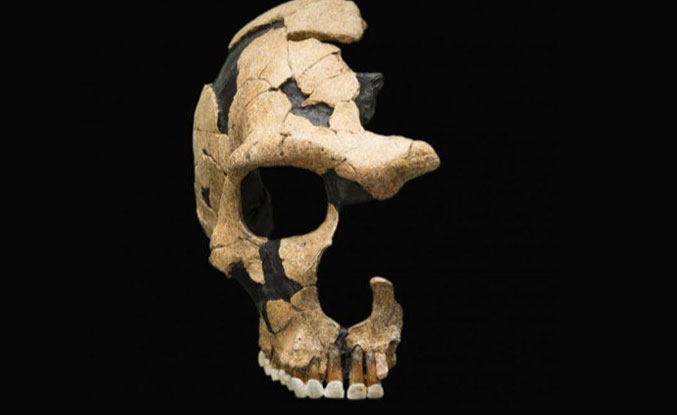
Reconstructed skull from a different species ancestor - (Photo: SMITHSONIAN INSTITUTE).
Previously, it was believed that our species Homo sapiens only mated with relatively close species, for example the two species mentioned above both belong to the genus Homo and have many similar characteristics to us, having separated from a not-so-distant common ancestor.
However, the ghost humans appearing in the DNA of these West Africans belong to a far different lineage, separated from the family tree of the three species Homo sapiens - Neanderthals - Denisovans at least 1.04 million years ago, according to research cited in Discovery Magazine.
Called "ghost humans" because apart from DNA traces in modern West Africans, there is no direct evidence such as remains, tools. of this mysterious species.
It can only be known that it is an extinct lineage, because now there is only one human species, Homo sapiens (Smart Man), we exist, dominating the entire human world.
It is estimated that this ghost species came across Homo sapiens around 124,000 years ago and interbred, leaving behind hybrid offspring whose descendants are the modern human groups mentioned above.
Previously, paleoanthropological studies showed that our Homo sapiens ancestors began to split from the ancestral line of Neanderthals and Denisovans about 700,000 years ago. Then, Neanderthals and Denisovans continued to split from each other about 400,000 years ago.
Neanderthals dominated Europe, while Denisovans were common in many parts of Asia.
About 194,000 years ago, our ancestors Homo sapiens from Africa began to migrate everywhere. It is estimated that about a few tens of thousands of years ago, our species encountered the two closely related species mentioned above and interspecies mating was quite common, causing the bloodline of most Homo sapiens outside of Africa today to no longer be "pure".
According to Dr Sankararaman, this rather distant interspecies marriage suggests that human history may be more complex than we know.