The find is a rare oddity, as the knife was found alone, without any accompanying objects, and was made of a stone not native to Norway.
An eight-year-old Norwegian girl named Elise picked up a strange grey-brown stone while playing at school in the western county of Vestland. The grey-brown find turned out to be a prehistoric dagger made by Stone Age people around 3,700 years ago.
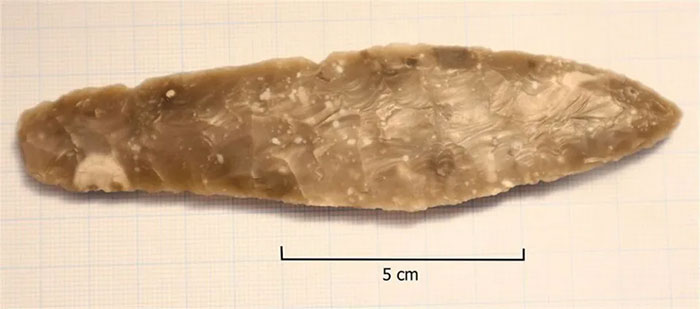
3700 year old stone knife.
Elise brought the discovery to her teacher, who noticed that the 12cm-long tool looked quite ancient and called in archaeologists from the Vestland County Council to examine the artifact.
Based on its style, the dagger may date from the Mesolithic or Neolithic period , when prehistoric humans began shaping stone tools and using domesticated plants and animals, building permanent villages, and developing crafts.
Because daggers of this type are rare, often found alongside sacrificial offerings, the Vestland County Council has teamed up with the Vestland County University Museum in Bergen, Norway's second-largest city, to conduct further research at the site. But no additional Stone Age evidence has been found so far.
Another question, however, has been raised about the type of stone the dagger was made from. Flint is a hard sedimentary rock that does not occur naturally in Norway, so the dagger likely came from neighboring Denmark across the North Sea, the researchers said. Previous finds of flint objects in Norway have been explained by the movement of rocks during the Ice Age or subsequent trade.
The Stone Age , which includes the Paleolithic, Mesolithic, and Neolithic periods, lasted from 10,000 BC to 1,800 BC in Norway. The first Stone Age people lived along the country's coast. They fished in the sea and hunted wild animals.
To do this, they needed tools, so they used stone and bone to make spears, axes, bows and arrows, harpoons and fish hooks. Some local hunter-gatherers settled permanently to cultivate crops around 2400 BC.