Gray whales learn to approach tourist boats to ask humans to remove itchy lice from their skin .
Gray whale swims near boat to ask for help picking lice. (Video: Guardian).
Footage of the gray whale 's behavior was filmed by tour boat captain Paco Jimenez Franco in the Ojo de Liebre lagoon off the coast of Baja California, Mexico. In the video, the whale can be seen swimming close to the boat and struggling to stay afloat while Franco repeatedly picks lice from its head.
Whale lice are pale, crab-like creatures that crawl on whales' heads and feed on algae that cling to their bodies or on dead skin and necrotic tissue around wounds. However, they also make whales itchy.
"I think gray whales have a love-hate relationship with lice," says British zoologist Mark Carwardine. "They have very sensitive skin. Thousands of tiny lice clinging to their skin or crawling around with their sharp claws must be very uncomfortable for them."
Franco first removed lice from the female whale's head when she got close enough. After he removed the first lice, she swam closer so he could do the same. The gray whale returned several times to have Franco remove the parasites.
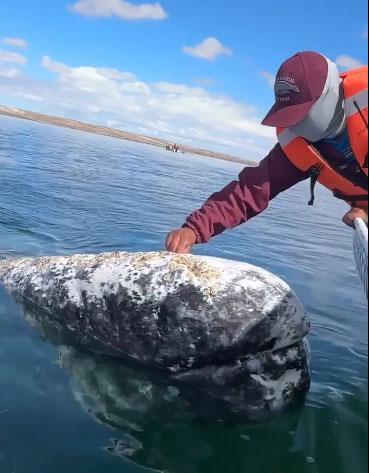
Paco Jimenez Franco picks lice off the female whale's head for the first time when she gets close enough.
Like many large, relatively slow-moving whales, including humpbacks and right whales, gray whales, which can grow up to 15 metres long, are particularly susceptible to parasites. They also pick up barnacles as they nibble on crustaceans on muddy seafloors.
Gray whales off Baja California are relatively tame with boats, despite being heavily hunted in the 20th century. Carwardine couldn't determine whether approaching humans for lice removal constituted a new behavior for the whales. " The whales don't seem to mind having people remove lice, although you'd have to remove hundreds of them to make a difference," the researcher said.
Because the lice feed on the dead skin and necrotic tissue of whales, Carwardine says they are not parasites but symbionts, meaning the two species benefit from each other. Since gray whales can live for at least 80 years, it's possible they've adapted to benefit from human interaction.