Humans face nearly 5 million deaths each year linked to bacterial resistance. A team led by US biotech researcher Cesar de la Fuente is using artificial intelligence-based computational methods to search for new antibiotics by mining the genetic information of extinct organisms.
American scientists have successfully revived something extremely important in fighting "killer" pathogens that humanity lost with the extinction of the two human species Neanderthals and Denisovans.
A team of scientists led by Dr. Cesar de la Fuente from the University of Pennsylvania (USA) studied the protein expressions of two extinct human species, Neanderthals and Denisovans, and found dozens of small protein chains with antibiotic properties.
Their lab then succeeded in bringing long-lost chemicals back to life, paving the way for the creation of new drugs to combat the increasingly dire "pandemic" of antibiotic resistance.
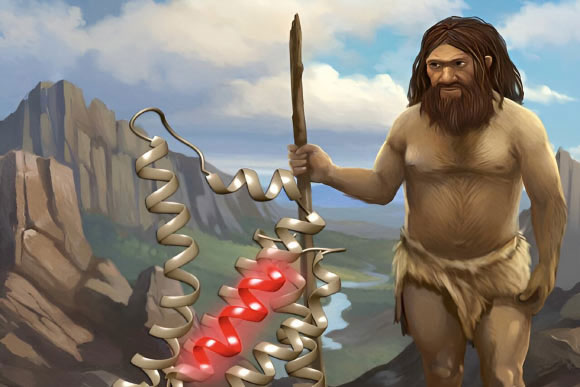
New molecule "resurrected" from ancient humans could make a huge contribution to the fight against antibiotic-resistant "killers" - (Graphic photo: Ella Marushchenko)
According to Sci-News, the genome of ancient humans once expressed proteins with natural antibacterial properties, but these molecules have long since become extinct.
Scientists have found that two ancient human species, Neanderthals and Denisovans, still had these elements before they disappeared about 30,000 years ago.
They are very close relatives of our Homo sapiens, who belong to the same genus Homo (Human genus).
In the groundbreaking experiment, scientists used computers to "redesign" the relevant amino acid sequences, based on data about these two human species that scientists around the world have collected over nearly two decades.
The amino acids are converted into an actual molecule, which is then rebuilt using real materials in the lab.
Not only did the molecules literally revive us, they also performed spectacularly against pathogens in lab dishes and in mice.
This success has just been published in the scientific journal Cell Host & Microbe. However, scientists are still continuing to maximize the effects of the molecule through fine-tuning with AI (artificial intelligence) tools; as well as discussing with lawyers and bioethicists to be able to apply the work safely and for the right purpose.
'There hasn't been a truly new antibiotic in decades, so we need to think about more than just new drugs. We need new frameworks,' Dr. Fuente said of the main goal of the work.
Latest estimates suggest that more than 1 million people worldwide die from drug-resistant infections each year.
The threat is growing exponentially. The World Health Organization (WHO) has chillingly predicted that by 2050, antibiotic resistance-related deaths will reach 10 million a year.