The voracious blue crabs are threatening Italy's fishing industry, forcing the government to allocate $3.2 million from emergency funds to find ways to deal with them and calling for them to be turned into food.
The Atlantic blue crab ( Callinectes sapidus ) has invaded much of the Mediterranean, from Spain and southern France to Tunisia and is beginning to appear in Italian waters, where it has earned the nickname 'sea killer.' Native to the gulfs and estuaries of the North Atlantic coast of the United States, blue crabs accidentally arrived in the Mediterranean via the ballast water of ships.
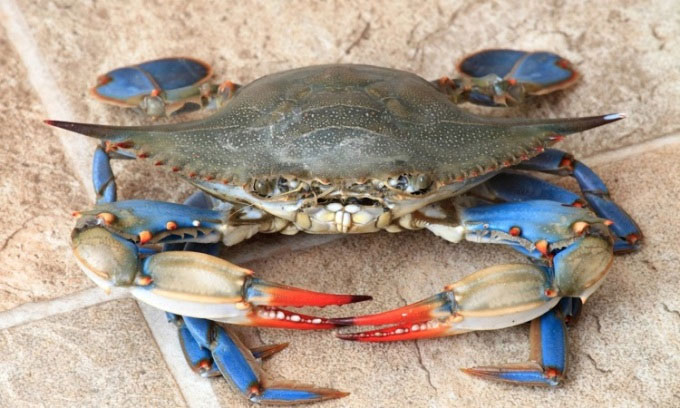
Atlantic blue crabs have invaded much of the Mediterranean. (Photo: Alamy).
The Italian government has announced that it is allocating $3.2 million from its emergency fund to find ways to deal with the rapid spread of blue crabs, the Telegraph reported on August 13. They specialize in eating mussels and clams, which are a popular dish for Italians in the summer. Blue crabs threaten the livelihoods of local fishermen. Coldiretti, the association of Italian agricultural producers, warned that 3,000 fishing businesses are threatened by the invasive species. Blue crabs also prey on young fish and eat fish eggs, according to Tonino Giardini, a representative of the Impresa Pesca fishermen's association.
The government funding will be used to help fishermen and encourage scientific research. Researchers still don't know much about green crabs, including how they live, reproduce and what factors influence their spread . "Increased knowledge could help us find effective solutions to deal with green crabs. In just a few months, they have become a problem in Italy. We need to know what is causing the recent explosion in their numbers ," Giardini said.
One theory is that heavy rains and floods in parts of northern Italy in the spring flow into the sea, mixing saltwater with freshwater, creating brackish conditions that allow blue crabs to thrive. Another theory is that their spread may be linked to climate change. There are so many blue crabs that fish populations could plummet, said Pier Luigi Piro, president of the fishermen's cooperative in the Tuscan coastal town of Orbetello.
Environmentalists say it is impossible to eradicate Atlantic blue crabs in Italian waters or elsewhere in the Mediterranean . Rather than viewing them as pests, they say they should be viewed as a valuable food source because their meat is delicious. Italian chefs are trying creative menus like spaghetti with blue crab meat and blue crab stew, hoping to convince customers to order them. In some parts of the country, blue crabs are selling for $11 a kilo.
Francesco Lollobrigida, Italy's minister of agriculture and fisheries, said the goal is to "turn the crisis into an opportunity ." " Blue crabs are a huge resource. Crab meat contains high levels of vitamin B12, which is very beneficial for humans, " said Lollobrigida.
Italy could follow the example of many other Mediterranean countries that have recognized the commercial value of blue crabs. In the Greek Cyclades, authorities erected signs in ports to inform fishermen that Atlantic blue crabs are edible , along with other invasive species such as red mullet, lionfish, blue-spotted pipefish, and cuttlefish. In Tunisia, blue crabs are now a major cash crop for fishermen.