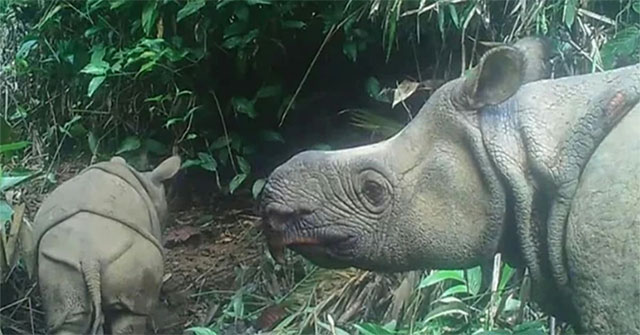
The ending of the seemingly unequal battle left many viewers surprised.
The king cobra has always been one of the most fearsome predators in nature. For a long time, people have considered the king of snakes to be the king cobra. They are venomous snakes of the Elapidae family (Tiger snake family), distributed mainly in dense forests stretching from India to Southeast Asia. The king cobra is considered a dangerous and fearsome species in its habitat.
Related reading: The most poisonous snake in Vietnam: Banded krait, king cobra or king cobra have no chance.
In fact, king cobras regularly eat all venomous snakes in their habitat and there has never been a recorded case of prey venom killing a king cobra. When prey is scarce, king cobras will eat some small vertebrates such as lizards, rodents, etc.
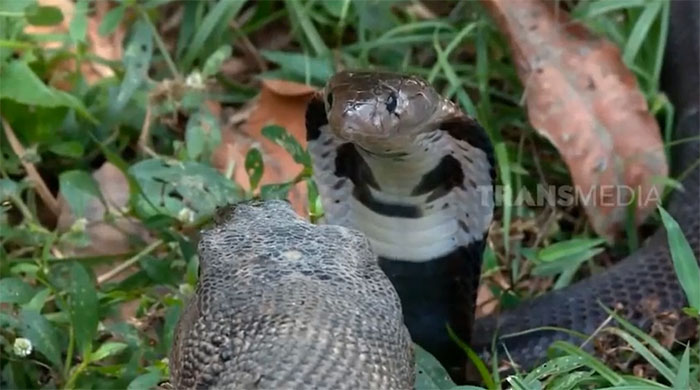
The cobra took the initiative to attack a monitor lizard.
Monitor lizards are quite large reptiles. Their entire body is covered with scales. Monitor lizards have long necks, strong tails and legs, and well-developed limbs. The external appearance of monitor lizards looks like geckos (lizards) but are larger and longer, can be up to 2.5 - 3 m long, weighing about 10 kg.
Monitor lizards usually live in forested areas near rivers, streams, creeks, swamps, islands, and humid tropical forests. Most of them nest in tree holes and crevices in rocks. Some also dig burrows or occupy burrows of other species to make nests.
Monitor lizards are carnivores. In the wild, they often catch mice, bugs, frogs, toads, snakes, eels, fish, lizards. to eat. However, they like to eat dead and smelly animals the most. They love to eat rotten eggs and rotten fish, and like cobras, they especially like to eat toads. Monitor lizards look quite heavy, but when chasing prey, they run very fast.
In the video below, a king cobra took the initiative to attack a monitor lizard. The seemingly effortless fight ended abruptly when the monitor lizard launched a dangerous attack on its opponent's head. It used its large, strong tail to hit the king cobra, stunning the snake.
A direct confrontation between a king cobra and a monitor lizard. (Source: Transmedia)
Although the king cobra tried to attack the monitor lizard's head, surprisingly this bite was completely useless to the monitor lizard. In the end, the direct confrontation ended with the monitor lizard winning. The king cobra became the monitor lizard's "meal".
Many people believe that monitor lizards are immune to snake venom. However, according to Daniel Bennett, a biologist, there is currently no evidence that monitor lizards can resist snake venom. According to him, the skin of monitor lizards is tough and thick, so the fangs of king cobras cannot inject venom through it.