A hundred-year dream of neuroscientists is to imagine a memory that has become a reality. Irvine researchers at the University of California have used microscopic techniques to capture the first image of the change of brain-cell connections that take place after a normal form of learning.
Detailed in the Journal of Neuroscience , the study shows that synaptic connections in an area of the rat brain are important for the perception of shape change when this rodent ' learn ' how to navigate a new and complex environment. In contrast, when drugs are proposed to prevent these changes, the mice are not aware, which confirms the important role of shape change in creating long-term memory.
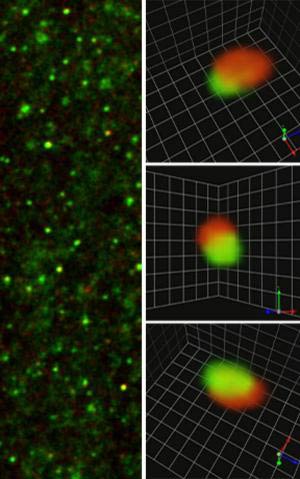
Image of brain cells.Synaptic connections (the connection between nerve cells) in an area of the rat brain are important for cognitive processes that change shape when this rodent is aware.(Responsible: Image of University of California - Irvine)
Gary Lynch, professor of psychiatry and human behavior at Irvine at the University of California and led one of the two research teams involved in these studies, said: 'This is the first time anyone can also see the natural background, or 'appearance' of a newly encoded memory. We have overcome obstacles that previously seemed impossible to overcome. '
New behavioral experiments take place after a series of recent findings made by Irvine's research team regarding changes in synapses that cause long-term potential (LTP for short). , a physiological influence closely associated with memory storage. This study used surviving rat brain cirrhosis in laboratories to identify chemical markers of synapses that were affected by LTP. This new study uses live animals.
Working with advanced microscopic techniques called microscopic microscopy to observe the spiral recovery process, the Irvine team discovered signs related to LTP appear. During cognitive processes and related synapses are extended in seahorses. Because the size of a neuron is related to its effectiveness in transmitting messages between neurons, the new study results show that cognition improves the communication process among brain cell groups. certain.
The results of the study open the way to one of the great goals of life science: Mapping for the distribution of memory between brain areas . Studying how to locate memory traces or they are often called ' traces ' has bothered 20th century researchers but failed because there was no way to 'label' the joints. Neurological changes due to new cognitive processes. These new results from Irvine's research help overcome this obstacle.
Irvine researchers will soon set up a cluster of laboratories to build the first maps of memory.
Vadim Fedulov, Christopher S. Rex, Danielle A. Simmons and Christine M. Gall of Irvine research group - University of California and Linda Palmer of Carnegie Mellon University also participated in this study.
Purl