The treasure that was just discovered at the Maritime Academy in Kent, England, has baffled scientists because the things inside seem to have been made to serve the lives of giants.
The excavation, led by Dr Letty Ingrey and colleagues from the Institute of Archaeology at University College London (UCL), the University of Wales and Wessex Archaeology, unearthed a collection of 800 stone tools that are at least 300,000 years old .
It is a huge archaeological treasure, crafted from the most precious materials of the Stone Age, such as flint; and shaped in a very strange way.
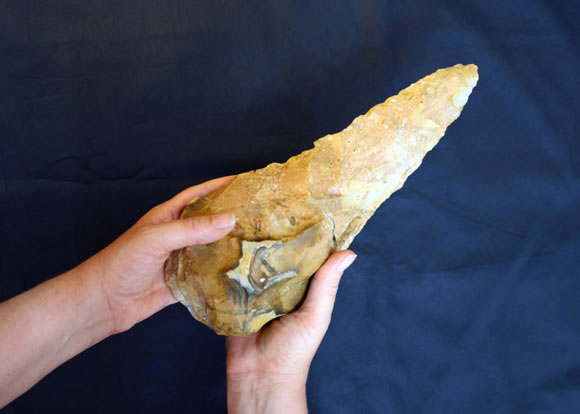
Giant flint axe, the most remarkable artifact in the treasure trove of 800 300,000-year-old artifacts - (Photo: ARCHAEOLOGY)
Most notable in the treasure were two enormous flint tools , described as giant hand axes , much larger than the hand axes commonly used by ancient people.
"They have long, finely crafted tips and much thicker bases than contemporary axes ," according to Sci-News.
The largest axe measures 29.5cm in length and is one of the longest hand axes ever excavated in Britain, adding to a collection of other giant axes unearthed in the Thames and Medway regions.
'These hand axes are so large that it is difficult to imagine how they could have been held and used with such ease,' said Dr Ingrey.
And that's the most interesting thing: They were most likely not used for work but rather symbolic, in the same way that modern people make exquisite swords and knives for decorative purposes, rather than for use. It is a testament to the power and skill of the makers and owners.
That's completely shocking considering the 300,000-year-old date of the items. 300,000 years ago is the date when modern humans, Homo sapiens, were just emerging.
The treasure is suspected to belong to our cousins of the same genus Homo, who emerged about half a million years earlier and lived alongside our ancestors for tens of thousands of years: Neanderthals.
Some evidence suggests that Neanderthal culture began in the region at this time, and possibly even other early human species. But whoever they were, this archaeological treasure trove is testament to how far other humans had come before we, Homo sapiens, came along.
The highly crafted tools also allowed them to survive the harsh ice age of that period, something scientists have always wondered about. The results have just been published in the scientific journal Archaeology.