Fossilized remains from two Homo sapiens individuals in Tam Pa Ling cave have challenged the long-standing theory of our species' first migration wave out of Africa 50,000-60,000 years ago.
According to an article published in Nature Communication , scientists previously discovered 70,000-year-old human bone fragments in Tam Pa Ling Cave, also known as Monkey Cave , at an altitude of 1,170 meters above sea level, in northern Laos.
This anomaly prompted them to dig deeper because according to theories proven by previous archaeological records, modern humans Homo sapines (Human Wisdom) only recently migrated out of Africa about 50,000 - 60,000 years ago.
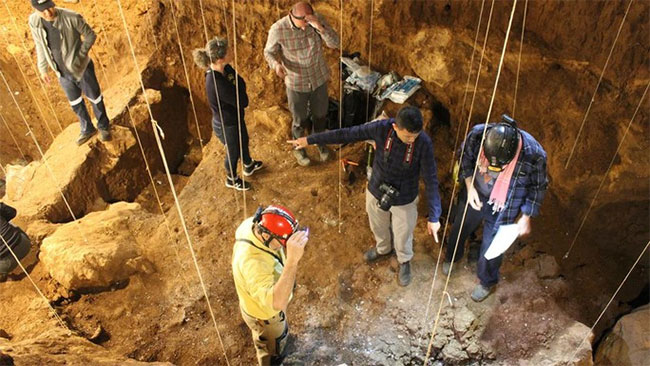
Researchers working at Tam Pa Ling cave (Laos) - (Photo: Kira Westaway)
The new excavation yielded fossilized skull and shin bones from two individuals, which were correctly identified as Homo sapiens and not some other native species, CNN reported .
According to Live Science, radiocarbon dating of the sediment in which the remains were encased revealed the most shocking thing: The skull must have been 73,000 years old, while the shin bone was 86,000 years old!
It is unclear how these ancient Homo sapiens came to be present in Laos tens of thousands of years before the great migrations documented by archaeological evidence in Europe, Asia and North Africa, but it is clear that historical records must be rewritten.
The study's lead author, a paleontologist from the University of Copenhagen (Denmark), said Tam Pa Ling is an ideal place to ask some questions about migration, because Southeast Asia is really at the "crossroads" of East Asia and island Southeast Asia-Australia.
This statement suggests a hypothesis that tens of thousands of years ago, there were "land bridges" connecting today's divided continents, creating many overland migration routes that gave Homo sapiens the opportunity to travel around the world along routes that have completely disappeared in modern times.
And either way, these fossils confirm that there were other migrations before the great migration 50,000 - 60,000 years ago . Although they may have been dead ends, they were the first Homo sapiens to leave their "homeland" of Africa.
There has been very little paleoanthropological research in Laos so far, so scientists believe there are many interesting things that have been left out, which can help them complete the fascinating history of Homo sapiens' exploration of the world: leaving Africa, spreading to other continents, competing or intermarrying with ancient human species and becoming the last survivor.