Tools made with advanced technology dating back 3 million years have been found on the shores of Lake Victoria, Africa. What has baffled scientists is that they were not made by Homo sapiens or any other species once called humans.
According to Science Alert, the discovery comes from a site that began excavating in 2016 on the shores of Lake Victoria in Nyayanga, Kenya, and has a design similar to Oldowan tools - the earliest stone tools created by human hands.
"Human" here does not mean us Homo sapiens, but other species of the same genus Homo (Human) , species that are believed to have completely separated from the hominid world to become more advanced creatures.
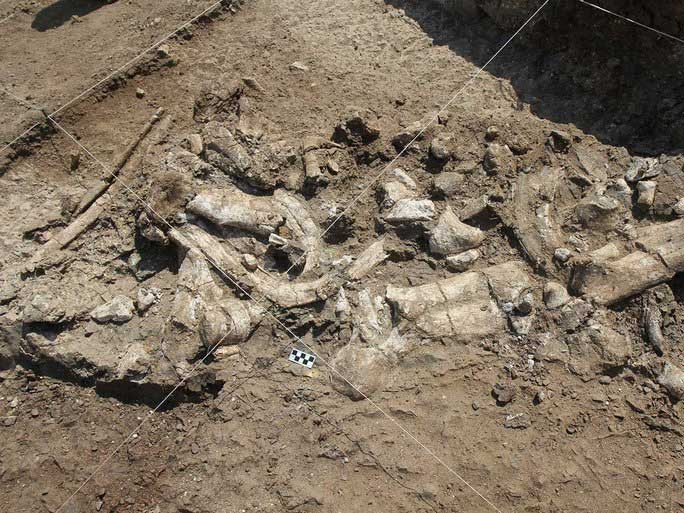
The area where the shocking stone tools were found - (Photo: SMITHSONIAN MAGAZINE)
Analysis showed the tools were made between 2.6 and 3 million years ago , and included 330 items in all, found among 1,776 fossilized animal bones that showed signs of butchery.
This date is older than the date of the oldest Oldowan tools previously excavated, which were about 2.6 million years old.
But according to a research team led by paleontologist Rick Potts from the Smithsonian Institution's National Museum of Natural History (USA), these tools show that Oldowan technology may not have been human.
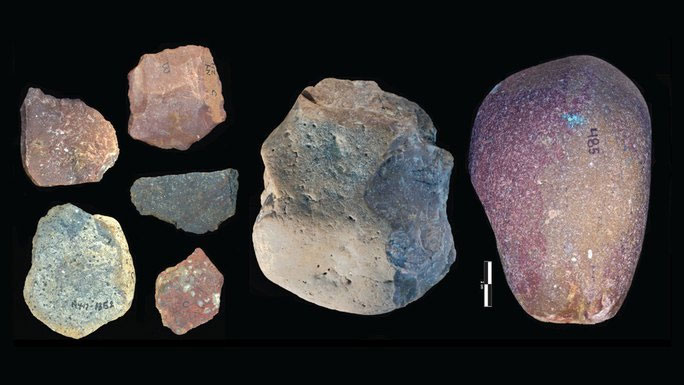
The tools after being dug up and restored - (Photo: SMITHSONIAN MAGAZINE).
These included tools capable of crushing elephant jaws and lions with ease. Other tools were effective for stripping meat from bones, extracting bone marrow, and for grinding plant material.
The technology spread across Africa by 2 million years ago. By 2 million years ago, the discovery of the Nyayanga site extends the technology's geographic range 1,300km to the southwest after years of being found only in Ethiopia's Afar Triangle .
The most shocking thing from Nyayanga was that for the first time, they found something that could have belonged to the owner of the toolkit - two molars, one intact, one broken in half.
An analysis to determine which species of hominin it belonged to yielded an unexpected result: It was a Paranthropus hominid , a distant cousin of humans, not a Homo. Radiocarbon dating of the tooth enamel showed that the 'human' most likely ate food prepared with that arsenal of stone tools.
The genus Paranthropus also belongs to the Homo tribe but is not considered "human", but a form of ape, and is completely extinct ; while the genus Homo has one surviving species, our Homo sapiens.
The Oldowan tools are often attributed to the genus Homo, but the overlapping existence of other hominins such as Paranthropus and now the two teeth as evidence suggests that humans were not the only ones proficient at making stone tools, which helped them eat a wider variety of foods, the researchers concluded.
Scientists are still analyzing more specimens and other things at this particular site to make more specific assertions. "Finding Paranthropus and these stone tools will open up a fascinating mystery," Dr. Potts said.
Preliminary research has just been published in the scientific journal Science.