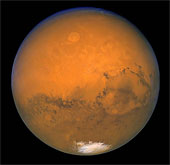
Space science
India 'uplifted' for the mission to explore Mars
The head of the Indian space agency on October 31 issued a warning about a high degree of complexity in the mission of exploring Mars.
Browse ScienceInfo articles and explainers related to Planet.
2,878 published items.
The head of the Indian space agency on October 31 issued a warning about a high degree of complexity in the mission of exploring Mars.
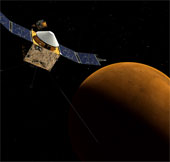
The US Aeronautics and Space Administration (NASA) has said it is working on a plan to launch the Maven probe to Mars in the middle of this month.

The US Space and Aeronautics Agency (NASA) has published a photo taken by the Hubble Space Telescope, which captures Near-Body, the star closest to the solar system, whi…
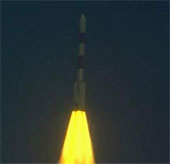
According to Indian national television, boosters carrying unmanned probes were launched at 9h08 GMT (16h00 Vietnamese time) from launchers in Sriharikota, Andhra Prades…

NASA scientists estimate that among planetary systems orbiting stars similar to the Sun, about 22% contain a life-sustaining planet.
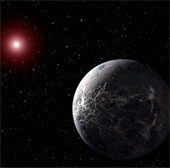
The appearance of the seventh planet around a distant star has turned it into one of the most planetary systems ever observed.
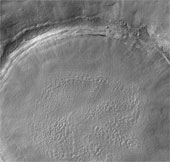
Russian scientists say there has been a huge ocean on Mars three billion years ago and can still observe its ruins.
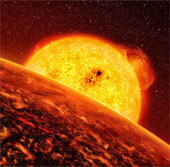
Scientists have discovered 6 planetary candidates with orbiting speed, only 4 hours to complete the rotation around their star.
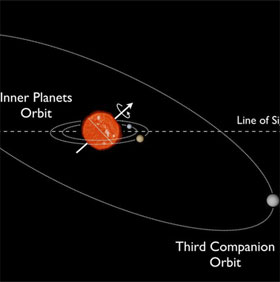
The Kepler telescope of the US Space and Aeronautics Agency (NASA) has transmitted an unusual planetary system, with
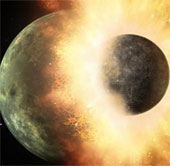
Mercury can unravel the long-standing mysteries of the moon's formation, after scientists found unexpected similarities between these two bodies.
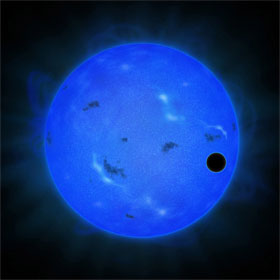
Scientists have discovered an extrasolar planet, not far from us, covered by a water-filled atmosphere.
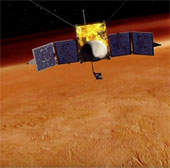
According to NASA, the Maven probe, the last mission mission on Mars, will be launched on November 18 this year.
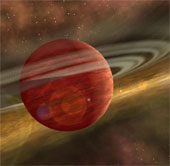
A giant planet recently discovered 25,000 light-years from Earth, can provide clues about the formation of planets.
Called PSO J318.5-22, the sun-free planet is 80 light-years from Earth and has 6 times the mass of Jupiter.
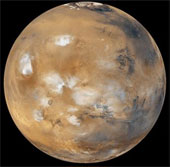
Scientists recently said it is possible to recreate the atmosphere of Mars in a giant cloud chamber at the decommissioned nuclear reactor in Karlsruhe, Germany.