Archaeologists have deciphered part of an "unknown" writing system from the Kushan Empire using the same technique that helped decipher the Rosetta Stone.
The Kushan Empire was an ancient state that stretched from present-day Uzbekistan to what is now northern India, and helped spread Buddhism to East Asia between the first and third centuries.
Starting in the 1950s, archaeologists began identifying and studying artifacts bearing the 'unknown Kushan script ,' but they were unable to understand what the mysterious characters meant. But researchers in Germany and Tajikistan announced in July 2023 that they had finally deciphered part of this ancient writing system.
The researchers accomplished this by comparing a bilingual text found by French archaeologists in Afghanistan in the 1960s with a bilingual text identified by Tajik archaeologists in Tajikistan in 2022.
So-called bilingual or trilingual texts are parallel examples of texts that present virtually the same meaning, but in two or three different languages. Like the Rosetta Stone, these multi-script texts allow researchers to identify characters and phrases in the ancient Kushan writing system.
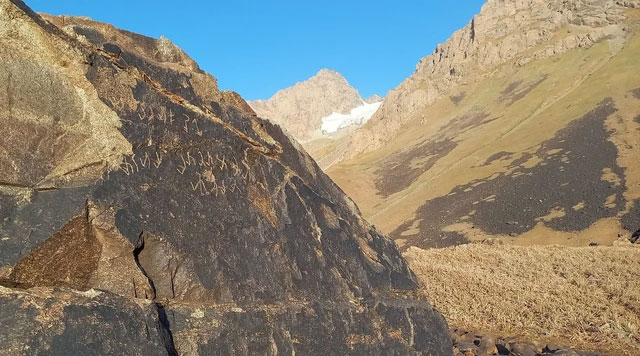
Kushan inscriptions discovered on a rock surface in Tajikistan. (Photo: History).
Archaeologists first identified the Kushan script in the 1950s, when they found ink characters on a staircase in Surkh Kotal, Afghanistan. In the 1960s, French archaeologists found the script on a rock at Dašt-i Nāwur, also in Afghanistan. The inscription on the rock contained Kushan script along with two other scripts representing the Bactrian language and the Gandhārī language .
The trilingual text, however, did not immediately lead to a breakthrough in understanding the Kushan script. This was partly because the French archaeologists took poor-quality photographs of the bilingual text and used an inaccurate drawing of it to discuss the discovery, said Svenja Bonmann, a linguist at the University of Cologne in Germany and lead author of the recent study. The paper on the unidentified Kushan script was published in the journal Transactions of the Philological Society in July 2023.
Without clear, accurate images of the bilingual text, researchers were unable to translate the unknown Kushan script. Over the next few decades, archaeologists found several more examples of the script, including an inscribed silver bowl in Kazakhstan, but its meaning remained elusive. Then, in 2022, Tajik archaeologists identified a bilingual text in Tajikistan's Almosi Gorge that contained the previously unknown Kushan script along with the Bactrian language.
'The archaeologists were following up on information provided by a local man, ' said Jakob Halfmann, a linguistics researcher at the University of Cologne and co-author of the recent paper. 'He saw inscriptions on the mountainside near where he lives, and he tried to tell the archaeologists about this for a while, but they only believed him and listened to him last year. And then they started an expedition and actually discovered that there were indeed inscriptions there.'

Archaeologists first identified the Kushan script in the 1950s. (Photo: History).
After locating the bilingual script, Tajik archaeologist Bobomullo Bobomulloev worked with Bonmann, Halfmann, and Natalie Korobzow, another linguistics researcher at the University of Cologne, to decipher the text (Bobomulloev and Korobzow also co-authored the recent paper).
One of their important findings was that the name of the ruler, king Vema Takhtu, appears in the Bactrian sections of both the bilingual and trilingual texts, allowing them to identify his name in both sections of the Kushan script.
This method is similar to the process that French philologist Jean-François Champollion used when translating the Rosetta Stone, which famously contains a passage written in Egyptian hieroglyphs, Egyptian Demotic script, and Greek script. Champollion began by identifying royal names like Cleopatra in Greek script and then found them in sections of ancient Egyptian stone.

The Kushan Empire was an ancient power in Central Asia. At its height (105-250), the empire stretched from Tajikistan to the Caspian Sea and from Afghanistan down to the Ganges River basin. Because it was located at the heart of Central Asia's transportation network, it had diplomatic relations with the Roman Empire, Sassanid Persia, and Han China, and for several centuries was a center of exchange between East and West. (Photo: History).
Most known archaeological examples of Kushan writing date from the 2nd century BC to the 3rd century AD, and are found in the present-day countries of Kazakhstan, Uzbekistan, Tajikistan, and Afghanistan. The writing corresponds to an unidentified Iranian language that was likely one of the official languages of the Kushan Empire, along with languages such as Bactrian, Gandhārī, and Sanskrit.
One reason Bonmann and her colleagues' research is significant is that it provides further evidence for the existence of Vema Takhtu, who ruled the Kushan Empire in the first century and expanded its reach into northwest India. Previously, some scholars had debated whether this king actually existed. Identifying his name in two different examples of Kushan script adds to the historical evidence that he was an important ruler of the Kushan Empire.
In addition to identifying Vema Takhtu's name, the authors of the recent paper also identified the phrases 'king of kings' and 'great savior' – both of which describe Vema Takhtu. The authors estimate that they have deciphered about half of the Kushan characters and hope to decipher more in the future. Further research may provide more information about the empire and the people who lived there some two millennia ago.