According to a recent study, scientists have discovered the origin of Citrinus lanatus vulgaris, or familiar to us as "watermelon".
Watermelons originated in Africa, but exactly when, where, and how they bred and became the fruit we know today remains a mystery to botanists.
After many years of research on the biological origin of the genus Citrillus, the results of the report were published in the Proceedings of the National Academy of Sciences of the United States.
As the study's lead author, Susanne Renner, once said: "Everyone thought there were only four wild melon species in the world, the sweet watermelon we commonly eat today comes from South Africa."

Watermelon originated in Africa.
But in 2015, one of Susanne's then-students, Guillaume Chomicki, found something unusual after sequencing the genes of various melons across Africa. It was likely that the supposed southern ancestor of the watermelon was just a distant relative.
'This opens up a lot of other research opportunities,' Renner says. For now, the researchers argue that the Kordofan watermelon , a wild fruit native to Sudan, South Africa, is the most likely species to be the genetic origin of the modern watermelon.
Chomicki, a botanist at the University of Sheffield in the United Kingdom, says the conclusion that the watermelon originated in South Africa is likely flawed. About 150 years after taxonomist Carl Linneaus's descendant discovered and named a new watermelon near Cape Town as Citrullus lanatus, an American botanist merged the fruit with a watermelon of the same name. Chomicki says the South African theory has since taken hold.
Watermelons and ancient species tend not to fossilize, further obscuring the true origins of the juicy tropical fruit. In fact, some fossilized seeds exist around the world, making ancient DNA research easier.
However, the oldest genetic samples mentioned in the report were watermelon leaves dating back 270 years. The team has now taken seeds and grown all the ancient melons in greenhouses in Munich, Germany and New York, USA.
They then sequenced the melon samples and compared them with DNA extracted from Kordofan melons. The results revealed about 16,000 genetic variations between the two plants, mapping those differences to specific traits of each fruit.
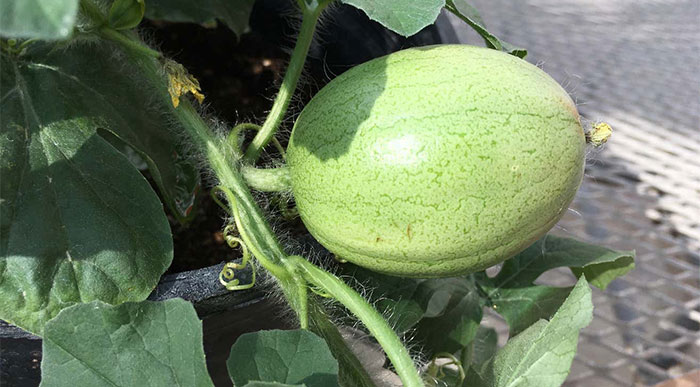
Kordofan melon variety.
On the other hand, the team also discovered that watermelons can become sweeter after domestication. Meanwhile, the original bitter taste of this fruit has long been lost, because the existing Kordofan variety is not bitter at all.
Additionally, some Cold War plant breeders have noted the possibility that the Kordofan plant is the ancestor of the watermelon . In fact, the Kordofan melon is smaller than the traditional watermelon and lacks the striped pattern on its rind.
Given the range of Kordofan in northeastern Africa, it is reasonable to assume that the domestication of watermelon occurred in the same region. However, the team does not rule out the possibility that watermelon originated in West Africa and was then brought east.
"Through ancient Egyptian art symbols, we can know that long and large watermelons appeared 4,360 years ago. However, because it is only a drawing, it cannot be confirmed that the original watermelon's flesh structure was red like the modern melon variety," said Chomicki.
In the absence of concrete physical evidence, scientists have had to rely on a combination of genetic research and historical context. The melon samples the team used came from ancient Nubia, the precursor to Darfur in western Sudan. Renner argues that it is likely that the plant was domesticated in Nubia and then moved across the Nile through trade.
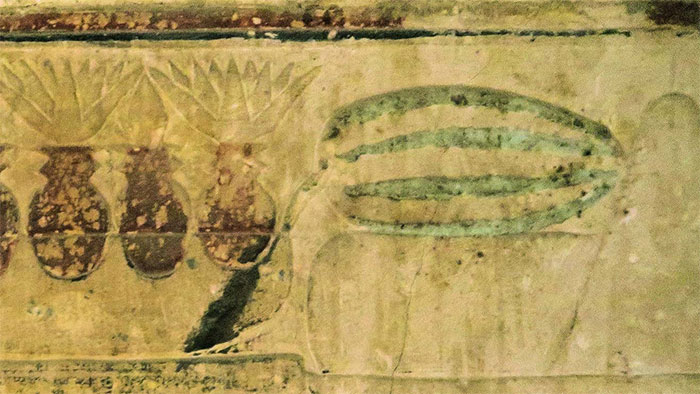
Ancient Egyptian watermelon pattern.
On the other hand, the differences between Kordofan melons and modern watermelons are not that great. Renner explains that it is likely that watermelons changed independently of human agricultural developments, through many changes at the genetic level between 4,000 and 6,000 years ago.
Even today, there is evidence of some connection between Kordofan and watermelon. 'In the 1800s, white-fleshed melons were common in the United States, but with the development of commercial agriculture and human demand, white-fleshed melons have largely disappeared,' Renner says. There are still some wild melons, of course, but they're not likely to be found in your average grocery store.
Once the team can examine DNA from seeds of ancient cultivated melons, they can hone in on the domestication process of watermelons. It's also worth noting that modern watermelons may have lost some of the immunity-related genes that Kordofan melons have.
Introduced into Eastern countries via the Silk Road
With the opening of the Silk Road, watermelons were gradually introduced to China and other Eastern countries.
In China, watermelon has become an indispensable cooling fruit in summer. People have also invented a special tool for eating watermelon - watermelon bowl, as well as the art of watermelon carving, which vividly expresses their love and unique feelings for watermelon.

The first people to bring watermelons to America were African slaves.
Propagation in the United States
In the United States, the popularity of watermelons is closely tied to the slave system. The first people to bring watermelons to America were African slaves.
Later, to control slaves, Southern plantation owners began using watermelon seeds to limit their freedom, making watermelons one of the symbols of slavery and racism.
Cultural significance of watermelon
Watermelon, with its refreshing red color and sweet taste, is not only a refreshing fruit but also has many different profound cultural meanings in countries around the world. In China, watermelon symbolizes luck, prosperity and love. It is often used in important festivals and events, such as the Lunar New Year. The image of watermelon carved on the rind is considered a work of art and has a blessing meaning.
In ancient Egypt, watermelons were considered a gift from the gods and were used in religious ceremonies. Images of watermelons appear on many ancient wall paintings, showing their importance in the lives of the Egyptians. In Vietnam, the fairy tale of Mai An Tiem and the watermelon has become an indispensable part of Vietnamese folklore. Watermelon symbolizes wealth, luck and filial piety.
In Western countries , this fruit is often associated with summer, beaches and holidays. It is also a symbol of youth and vitality.

Watermelon carries many different cultural meanings in countries around the world.
The relationship between cuisine and culture
The spread and development of watermelon actually reflects the social development and cultural changes in different regions. Whether in Eastern or Western countries, people's knowledge and understanding of watermelon are influenced by the historical and social context at that time, forming completely different cultural connotations.
As a cultural carrier, food can often deeply reflect social structure, religious beliefs, living customs and other aspects of the times. The way people use and interpret food will also influence and shape the inheritance and development of culture, forming a rich and colorful culinary culture as well as different historical memories and emotional experiences.