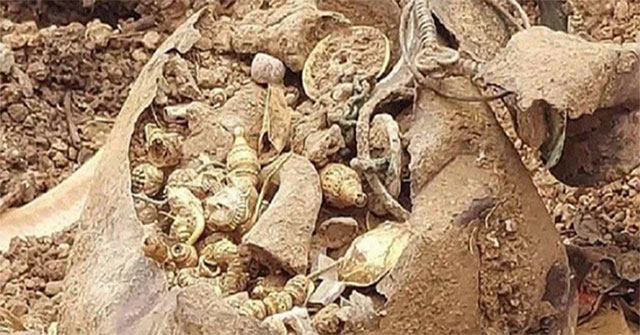
Why are these supposed 'Egyptian' traces in Australia? Did the ancient Egyptians travel to this remote location and leave signs of their presence there?
Everything mankind knows about recent history has been proven to be incomplete. What we are taught in history books is by no means all that exists in the past.
Egyptian hieroglyphs in Australia
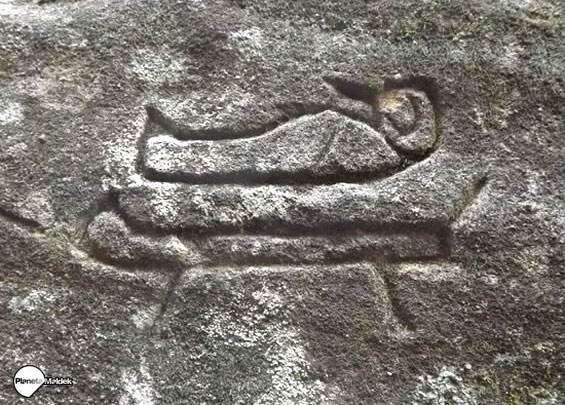
The Gosford Glyphs , also known as the Kariong Hieroglyphs , are a group of about 300 Egyptian-style hieroglyphs located at Kariong, Australia. They were found in an area known for its Aboriginal petroglyphs, just between Gosford and Woy Woy, New South Wales, in the Brisbane Water National Park. (Photo: Planetamaldek)
For decades, locals on the New South Wales central coast have debated the authenticity of a series of hieroglyphs carved into a hidden rock face in Brisbane Water National Park . Many believe the distinctive symbols are of ancient Egyptian origin.
The brave explorers climbed the narrow space between the two sandstone faces and entered a narrow passage to examine the hieroglyphs. The symbols, which would look familiar to anyone with any knowledge of ancient Egypt, included images of Anubis, the name of King Khufu, customarily enclosed in a cartouche, and many others.
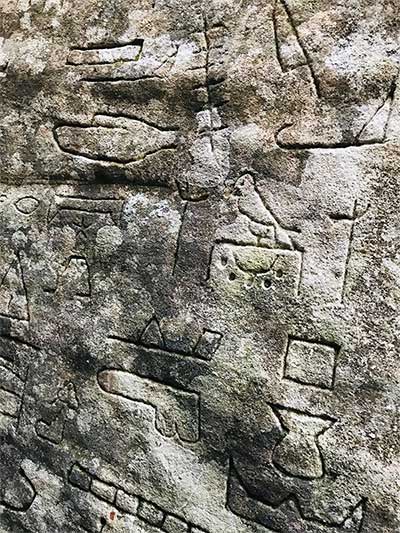
They depict boats, chickens, dogs, owls, people, as well as what appear to be the names of kings, one of whom is Khufu (second king of the Fourth Dynasty, 2637-2614 BC). (Photo: Atlasobscura).
In an area known for its abundance of Aboriginal petroglyphs, this rather unusual set of rock carvings was first documented in the 1970s and has been the subject of debate ever since.
Since then, questions have been raised as to whether they were the work of two Egyptian princes shipwrecked on the Australian mainland? Or were they simply a decades-old hoax?
Others have suggested they may be the work of a local resident living in the area or reflect the Egyptology craze that spread around the world after the discovery of Tutankhamun's tomb.
Regardless of who created them, these interesting carvings in Australia are certainly a sight to behold.
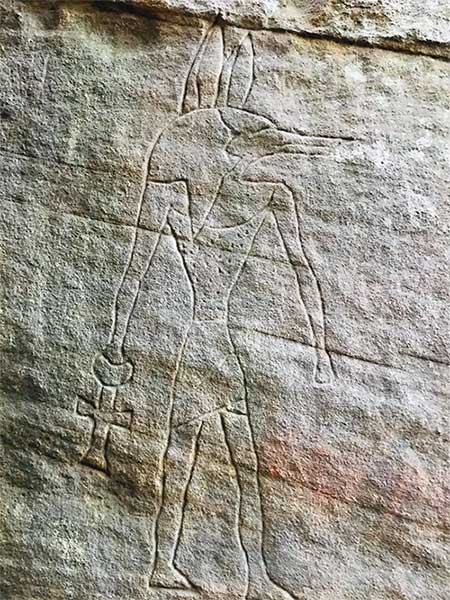
The carvings were first officially reported in 1975 by Alan Dash, a local surveyor working for Gosford Council. (Photo: Atlasobscura).
The Truth About Egyptian Hieroglyphs in Australia
To answer the question of whether the ancient Egyptians ever set foot in Australia, Egyptologists visited and studied the glyphs and concluded that they were a hoax and that there were many inconsistencies and errors in the characters. However, that did not stop many locals from maintaining their belief in their authenticity.
As quoted in an Australian Geographic article from March 2021, a spokesperson for the New South Wales National Parks and Wildlife Service said that there was 'no evidence' to support the theory that the hieroglyphs were actually carved by ancient Egyptians.
Additionally, Egyptologist Boyo Ocinga of Macquarie University has also dismissed claims that the inscriptions could have been made by shipwrecked Egyptians millennia ago.
In an Australian Broadcasting Corporation (ABC) report , he said there were both chronological and structural errors in the way the "hieroglyphs" were carved.
'First of all, the way they are cut is not the way ancient Egyptian stone carvings were made, they are very disorganized,' he said .
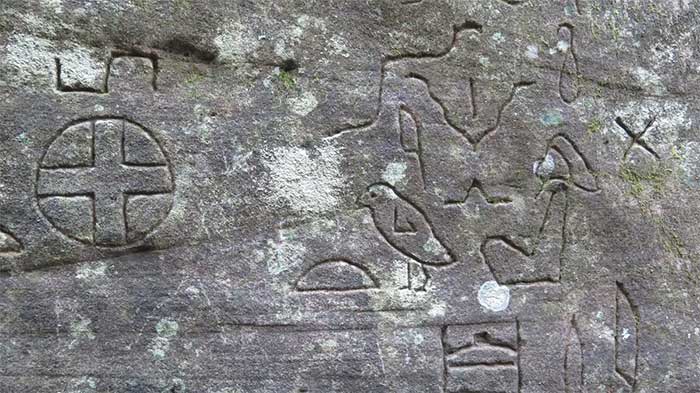
Photo: Atlasobscura
Essentially, this means that the hieroglyphs used here come from different periods in Egyptian history – periods thousands of years apart – and have been grouped together and made to appear as if they were done by one group of people.
So who made them? As quoted in the ABC article , Dr. Ocinga suggests that it is likely that the characters come from a more recent period in Australian history.
He believes that these carvings were most likely made in the 1920s, as there was a surge of interest in ancient Egypt following the discovery of Tutankhamun's Tomb at that time.
Throughout human history, many civilizations used glyphs, but only the Egyptian writings are truly considered hieroglyphs.
We don't know exactly when hieroglyphs were developed, but we do know that they are very ancient. It is possible that the idea of a hieroglyphic writing system was "imported" to Egypt from Sumerian cuneiform, but this theory is highly debated.
Our earliest evidence of primitive hieroglyphs dates from around 3500 BC, and the first full sentence in hieroglyphs actually dates from around 2800-2700 BC. Both of these examples are found in tombs, with paintings on vases buried during the Naqada II period and reliefs from tombs from the First Dynasty.
The hieroglyphs themselves were never lost - they were displayed in Egypt from ancient times and were known throughout the Roman Empire, as well as the Middle East and Africa from the Dark Ages to the modern era.