Scientists are waiting for new achievements in 2014, with breakthroughs in the fields of physics, medicine, robotics and archeology.
2014 is expected to continue to be a glorious year in the field of science, thanks to the pace of technology development.
New era of neutrinos
If 2013 is the year of the Higgs, then 2014 will be the time when the neutrino will be crowned. This nearly massless molecule contains no charge, but can be detected everywhere, every second passing through our bodies and each planet. Because neutrinos are invisible and interact weakly with other particles, they are difficult to detect. However, these lurking molecules are the silent messengers of the radiation process, which can help experts hunt down cosmic rays or even monitor future nuclear weapons. It is known that scientists at the Iceberg Neutrino Observatory, which is the telescope under the Antarctic, have for the first time discovered high-energy neutrino waves coming from outside the solar system, achievements was evaluated to have opened a new era in the field of cosmic neutrinos.
Genetic treatment
In 2014, more researchers and doctors will use genetic engineering to treat cancer patients, critically ill babies and even take care of health for healthy people. strong. The rapid pace of development in this area will help people better understand their own bodies, prescribed genes and affect every cell in the body. When analyzing a person's genome, the information collected can allow doctors to treat it more easily and offer special procedures that suit each person's condition.
In addition, experts predict that this year will witness outstanding developments in the field of diagnosis of Alzheimer's by CT and MRI scans. Stem cell therapy is also very promising, expected to have a breakthrough in the treatment of conditions such as spinal injury.
Terminate research on chimpanzees
2013 is the year of chimpanzee liberation. In June, the US government announced the release of all chimpanzees, keeping only 50 to continue research. At the same time, the US Fisheries and Wildlife Service proposed to put this animal on the list of endangered species, pushing laboratories into a difficult situation to use chimpanzees for experiments. drug. In the near future, the habit of conducting experiments on chimpanzees will soon end.
New step of paleontology
As predicted, the application of technology in the field of excavation and fossil analysis will become more and more popular. For example, CT scans and computer modeling can accelerate fossil assessment without having to interfere with the specimen, avoiding the risk of damage. Researchers can also use 3D printing techniques to scan and create perfect versions for experiments and displays.
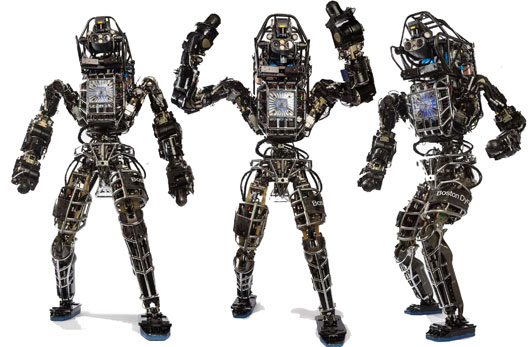
Experts are putting a lot of effort into robot projects - (Photo: Boston Dynamics)
Robots move like people
The challenge in 2014 is to create robots that can step on bumpy surfaces and consume less energy like humans. So far, robot Atlas of Boston Dynamics has the ability to move on hard terrain, but uses too much energy. Experts also hope to build moving robots like in the animal world, and the military will also start using armor on the battlefield to enhance muscle strength for soldiers.
New discoveries about the universe
The Planck Telescope of the European Space Agency is pursuing the goal of exploring the origin of the universe and collecting data to draw a more detailed map of our universe. Earlier, European experts announced the image of the universe at the beginning, when it was about 380,000 years old.