Archaeologists in Germany have discovered the 1,700-year-old grave of a Barbarian, or "barbarian," who lived on the fringes of the Roman Empire and was given valuable burial objects, including glassware, pottery and a fine-toothed comb.
The tomb, believed to date back to the first half of the 4th century, holds the remains of a man who died at around the age of 60. The tomb was found in May during excavations ahead of the construction of new homes in the center of the village of Gerstetten , about 40 miles (64 kilometers) east of Stuttgart in southwestern Germany, according to a statement from the Stuttgart Regional Council. The elaborate tomb, surrounded by a wooden chamber, is located in an isolated but prominent location.
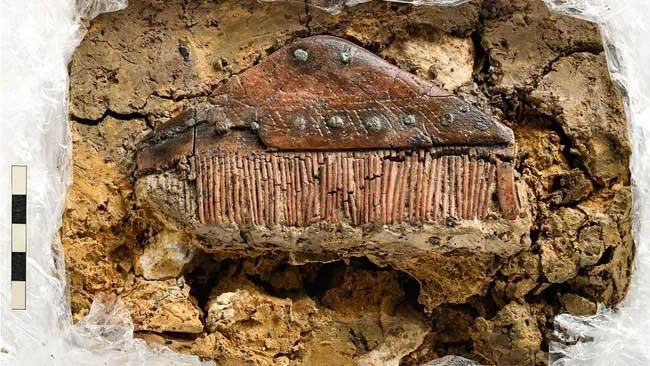
The 'barbarian' burial objects, including the intricate comb, were sent to a nearby laboratory for cleaning and restoration. (Photo: Yvonne Mühleis/State Office for Monuments Conservation, Stuttgart Regional Council)
Among the grave goods, a glass cup was of exceptionally high quality and may have come from the nearby Roman fort at Guntia, now Günzburg, while the distinctive features of other burial objects suggest they came from further north, in the Elbe-Saale region, now in central Germany.
barbarian
The northern limit of the Roman Empire in this area was known as the "Upper Germanic Lands" running north of Gerstetten; beyond that was the land known as "Magna Germania" or Greater Germania , where Germanic tribes lived.
The Roman Limes were heavily defended by legions stationed at forts along the frontier, such as the one at Guntia, but Germanic lifestyles and burial rituals were carried out outside the forts.
The Romans called the Germans "barbarians", meaning "different speakers", which they used to refer to non-Romans outside their territory.
After the fifth century, barbarian Germans led by the Visigoths and Vandals invaded Roman lands to the south and hastened the empire's collapse.
The man buried at Gerstetten was likely an Alemanni , a confederation of Germanic tribes whose people lived near the Upper Rhine Valley. Alemanni graves from that period are rare in the area, the statement said. Investigations have shown that the man was buried between 263 and 342 AD.
They are usually found in groups of five to 12 individuals, and archaeologists believe that two more graves may still be found in the vicinity.