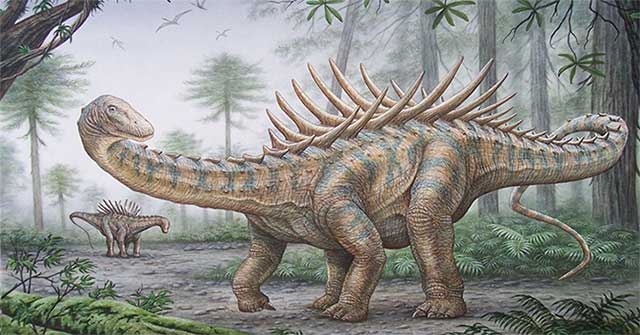
Many people must have known about the dinosaur era 65 million years ago, that was the period when dinosaurs dominated the Earth. If there was no event of an asteroid hitting the Earth causing the extinction of dinosaurs, it is difficult to say what the current biological world of Earth would be like.
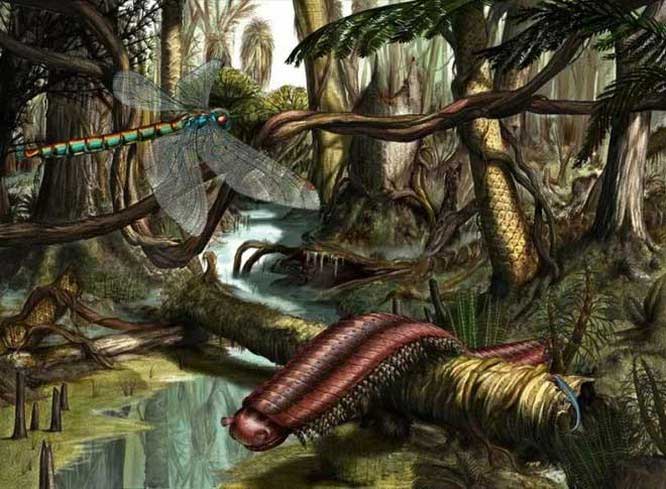
Giant prehistoric creatures.
The rise of any biological overlord is no accident. The rise of the dinosaurs came after the third mass extinction, also known as the Permian extinction . This was the most devastating extinction event in history, wiping out most of the life on Earth, resetting virtually the entire ecosystem. Paleontologists say that as much as 90% of marine life and 70% of terrestrial life were wiped out.
However, this mass extinction created the conditions for the emergence of dinosaurs. Why did dinosaurs rise after the third mass extinction? What drastic changes occurred in the Earth's ecosystem during that period?
According to scientists, an unprecedented event occurred on Earth 234 million years ago, which not only sparked the third mass extinction but also led to the rise of the dinosaurs.
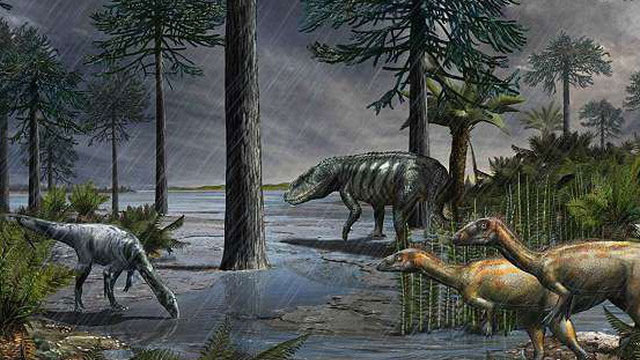
This rain brought with it the rise of the dinosaurs.
This event is called the "Carnian fertility event" by scientists . More specifically, this is a continuous rain that lasted for 2 million years. Everyone is familiar with rainfall, every year when the rainy season comes, there will be different levels of rainfall, especially the rainy season in the Central region often causes a series of floods. If the rain lasts for many days, it will greatly affect people's lives, if it lasts for a whole month, it will be a major disaster.
But 234 million years ago, nature created a continuous rainfall that lasted for 2 million years. You can imagine what a terrible disaster that was. At that time, floods were everywhere on Earth, and creatures that could not adapt to survive in water were basically extinct, and dinosaurs originated from aquatic creatures, so after the mass extinction, they were able to increase rapidly.
Some people ask: How could such a long period of rain happen? With the natural ecological cycle of the Earth, continuous rain for a month is very rare, let alone rain lasting for 2 million years. What happened to the Earth at that time?
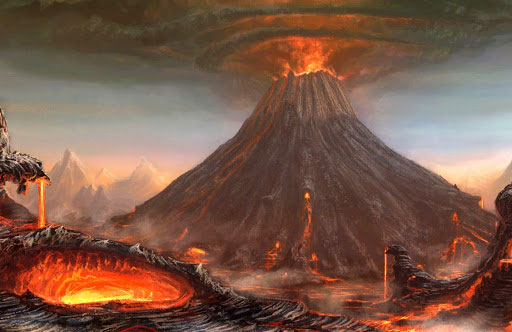
The cause of this rain may be a volcanic eruption in Alaska, North America.
Scientists also have different opinions about this long-term rainfall. After in-depth research, scientists believe that the cause of this rain may be due to the eruption of a volcano in Alaska, North America. The lava layer stretches for hundreds of miles, and the volcano continuously erupts, pushing dust and gases into the atmosphere, increasing carbon dioxide, decreasing oxygen, and many creatures become extinct.
Some people believe that while the magma from a supervolcano can cause some degree of climate change, have you ever heard of a volcanic eruption that can also bring long-term, continuous rainfall? If it were just a volcanic eruption, it really couldn't cause long-term global rainfall. The lava would create a huge plume of smoke, covering the sky and causing the Earth to enter a mini ice age.
If that were the case, volcanic eruptions would not cause continuous rainfall, so why did a supervolcanic eruption 234 million years ago bring rain that lasted for about 2 million years? The basic reason is that the underground coal layer was destroyed by lava, burning a large amount of coal, causing a series of chain reactions. As evidence, scientists have discovered that there was very little coal left during the Triassic extinction.

Scientists believe that the average temperature of Earth 234 million years ago was at least 6 degrees Celsius higher than it is now.
Once the coal layer is burned in large quantities, the global impact will be completely different, the most obvious impact is the continuous increase in temperature, according to estimates, the sea water temperature at that time was at least about 40 degrees. Such high temperatures cause a large amount of sea water to evaporate, the water vapor floating in the atmosphere. Scientists believe that the average temperature of the Earth 234 million years ago was at least 6 degrees Celsius higher than it is now. Such high temperatures lasted for about 10 million years.
The prolonged high temperature weather has turned a lot of sea water into steam, volcanoes will not last forever, over time, the heat of the Earth will slowly cool down. At this time, the water vapor in the atmosphere begins to fall and cause widespread rain, the water vapor accumulated for tens of millions of years cannot escape in a short time, so the rain lasts for 2 million years. The rain contains a lot of acid, promoting the appearance of large-scale tropical forests on land, similar to the Amazon rainforest today, the area of tropical forests can almost spread to the north and south poles.
When the rainy season ends, the increase in rain forests will bring more oxygen, the oxygen content on Earth will increase again, which is also an important condition for the birth of dinosaurs. The increase in oxygen content tends to give birth to some large creatures, such as insects that dominate in the "age of giant insects".
During this period, there were mosquitoes as long and thick as an index finger, arthropods that could grow up to 1.55 meters long, and giant tadpoles that were 2.6 meters long. Because the oxygen content on Earth was very high at that time, the small insects that initially evolved into giant insects and dominated the Earth.
The giant rainforest created a perfect ecological environment for the survival of dinosaurs, allowing dinosaurs to spread across the world and dominate the Earth.
Today, although there are no supervolcanoes erupting on Earth, the increase in global temperature due to industrialization is becoming more and more serious. Once the global temperature rises to the temperature of 234 million years ago, a large amount of sea water will evaporate, at that time there will also be a large amount of water vapor in the Earth's atmosphere.
If this happens, the prolonged rainfall that occurred 234 million years ago could also happen in the future, which would be another mass extinction event. It can be seen that the increase in global temperature due to the greenhouse effect has an impact far beyond human imagination. The reason we still do not feel the impact too much but only feel the weather is unusually hot, mainly because the temperature increase has not exceeded a certain limit point.